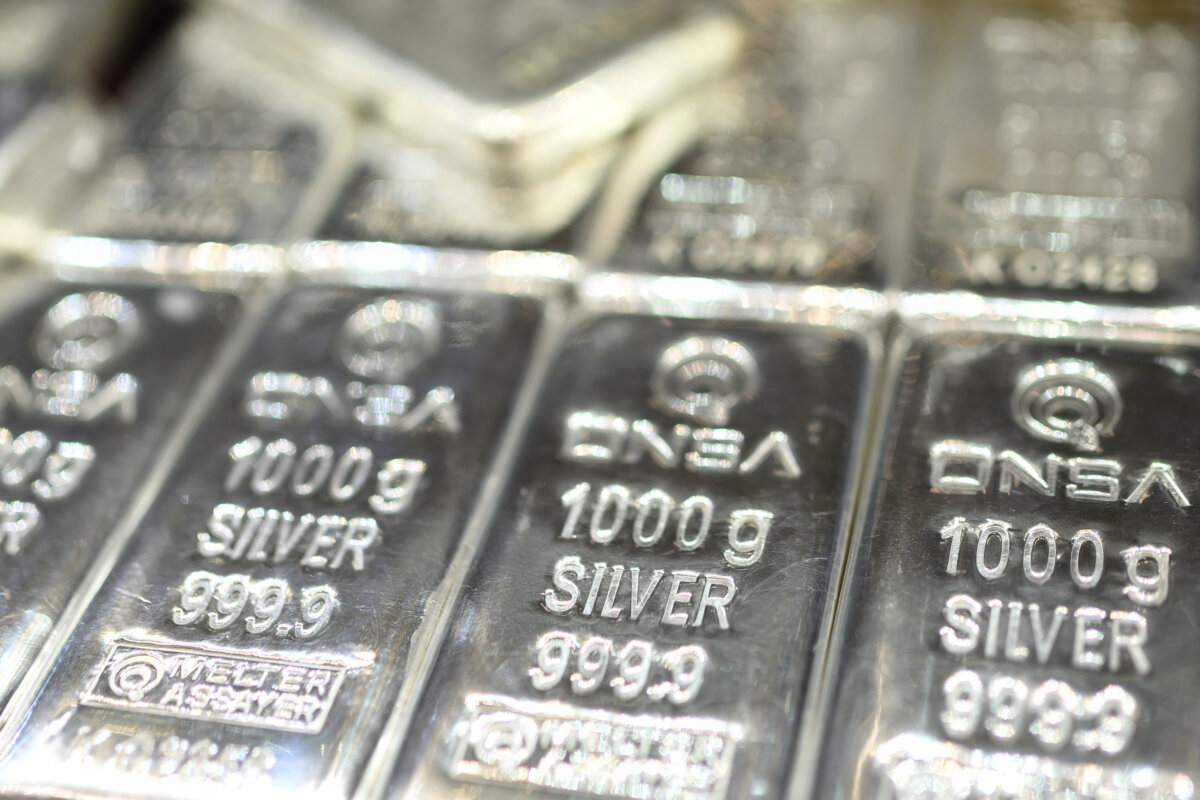

Silver prices fell 6 percent to start the holiday‑shortened trading week, days after industrialist Elon Musk weighed in on China’s planned export restrictions for 2026.
On Dec. 29, silver plummeted more than $5, or about 6.7 percent, to around $72 per ounce on the COMEX division of the New York Mercantile Exchange.
The white metal had reached $84 an ounce for the first time in overnight trading before staging a massive reversal.
Over the past year, silver has been one of the top-performing assets in global financial markets, rising 145 percent.
Last week’s breakout performance was supported by posts circulating on social media indicating that China would impose export restrictions on silver, effective Jan. 1, 2026.
This caught the attention of SpaceX and Tesla Motors CEO Elon Musk.
“This is not good. Silver is needed in many industrial processes,” Musk said in a Dec. 26 X post.
In October, the Chinese Ministry of Commerce published new rules on the export of silver, antimony, and tungsten for 2026 and 2027, “to protect resources and the environment and strengthen the management of rare metal” shipments.
Earlier this month, officials said they received and approved applications for some Chinese exporters for general export licenses.
Silver—both an investment and an industrial metal—has rocketed on a flurry of other tailwinds, including tightening global supply concerns, strengthening demand, and a weakening U.S. dollar.
“Dovish Fed policy bets paired with a lingering sense of macroeconomic uncertainty provided fundamental support and match the decisively bullish technical set up that emerged last week,” Tom Essaye, president and co-founder of The Sevens Research Report, said in a note emailed to The Epoch Times.
Following a better-than-expected November inflation report and solid third-quarter growth, the Federal Reserve is widely expected to keep cutting interest rates next year.
There has been a divergence in expectations between policymakers and investors.
Based on the Summary of Economic Projections, the Fed has signaled a quarter-point rate cut in 2026. The futures market is betting on two or three actions in the year ahead, according to the CME FedWatch Tool.
Anticipation of a more dovish central bank has weighed on the greenback.
The U.S. dollar index, a measure of the greenback against a weighted basket of currencies, has declined nearly 10 percent this year.
A weaker buck is good for dollar-denominated commodities because it makes it cheaper for foreign investors to purchase.
Fabien Yip, market analyst at IG, thinks intensifying industrial demand and a persistent structural supply deficit could keep silver prices “beyond $65” in the year ahead.
The metal has shifted from “‘the forgotten asset’ to one of the most powerful stories in commodities,” Yip said in a Dec. 22 note. “Silver hasn’t just outperformed gold—it has rewritten the narrative after almost a decade of lagging.”
JPMorgan Chase estimates silver will average $56 an ounce for the whole year.
Seeing Red in Gold Markets
Sister metals, meanwhile, fell in the home stretch of 2025.
Gold prices declined by more than $100, or nearly 3 percent, to around $4,420 an ounce. The yellow metal has risen 68 percent this year.
Despite the sharp turnaround in gold prices, market watchers are still optimistic for the year ahead.
“Once primarily driven by real yields and the dollar, gold has evolved into a strategic asset supported by structural demand from central banks, geopolitical fragmentation, and rising fiscal risks,” Ole Hansen, head of commodity strategy at Saxo Bank, said in a Dec. 17 note.
“As we head into 2026, gold is no longer just a hedge against inflation or falling rates—it is increasingly a cornerstone asset in a world defined by fragmentation, fiscal strain, and geopolitical uncertainty.”
Strategists at JPMorgan Chase forecast gold prices pushing toward $5,000 per ounce by the fourth quarter of 2026. In their base case, Goldman Sachs experts project gold climbing to $4,900 an ounce by December 2026.
Copper fell by 4 percent, to $5.60 per pound. The red metal has surged 39 percent year to date.
Platinum and palladium have had tremendous years, rallying 140 percent and 91 percent, respectively. However, they also fell by double-digit percentages to start the final trading week of 2025.
 Friends Read Free
Copy
Facebook
Tweet
Friends Read Free
Copy
Facebook
Tweet