

U.S. stocks slipped at the start of the holiday-shortened trading week as investors worried about tariff uncertainty and rising bond yields.
The blue-chip Dow Jones Industrial Average declined almost 500 points, or about 1 percent, during the Sept. 2 trading session. The index of 30 stocks is up about 6 percent this year.
The tech-heavy Nasdaq Composite Index dropped more than 300 points, or 1.6 percent. The broader S&P 500 Index erased about 1.3 percent. Both indexes have risen 10 percent and 9 percent, respectively, year to date.
The U.S. stock market experienced a strong August, with the S&P 500 recording its fourth consecutive month of gains.
Meanwhile, heading into the Labor Day long weekend, a federal appeals court determined that most of President Donald Trump’s global tariffs are illegal. The U.S. Court of Appeals for the Federal Circuit ruled 7–4 that only Congress can authorize levies.
“The core congressional power to impose taxes such as tariffs is vested exclusively in the legislative branch by the Constitution,” the court said. “Tariffs are a core congressional power.”
Trump responded to the decision in a Truth Social post, stating that “all tariffs are still in effect.”
“If these tariffs ever went away, it would be a total disaster for the country,” Trump stated on his social media platform. “If allowed to stand, this decision would literally destroy the United States of America.”
Wall Street also combed through the latest manufacturing data from S&P Global and the Institute for Supply Management (ISM).
The August ISM Manufacturing Purchasing Managers’ Index (PMI)—a monthly survey highlighting the sector’s prevailing economic direction—was stuck in contraction territory for the sixth consecutive month. The latest results indicated a sharp decline in production, which was partially offset by a rebound in new orders. Employment, order backlogs, and customers’ inventories fell.
Conversely, the S&P Global U.S. Manufacturing PMI rebounded in August, fueled by strong production, new orders, employment, and inventories of finished goods.
“Purchasing managers reported that the U.S. manufacturing was running hot over the summer,” Chris Williamson, chief business economist at S&P Global Market Intelligence, said in a note.
However, cost pressures increased and were “passed on to customers via widespread hikes to factory gate prices,” he added.
“The big question is the degree to which these price rises will then feed through to higher consumer price inflation in the coming months,” Williamson said.
Higher US Yields
Investors are also keeping an eye on the U.S. bond market as long-term yields ventured higher to kick off September.
The benchmark 10-year yield topped 4.26 percent. Yields on the 20- and 30-year Treasury securities rose more than 4 basis points, to above 4.91 percent and 4.96 percent, respectively.
Wall Street fears that if the court’s decision is upheld, then Washington might be forced to return tariff income, potentially worsening the federal government’s fiscal outlook.
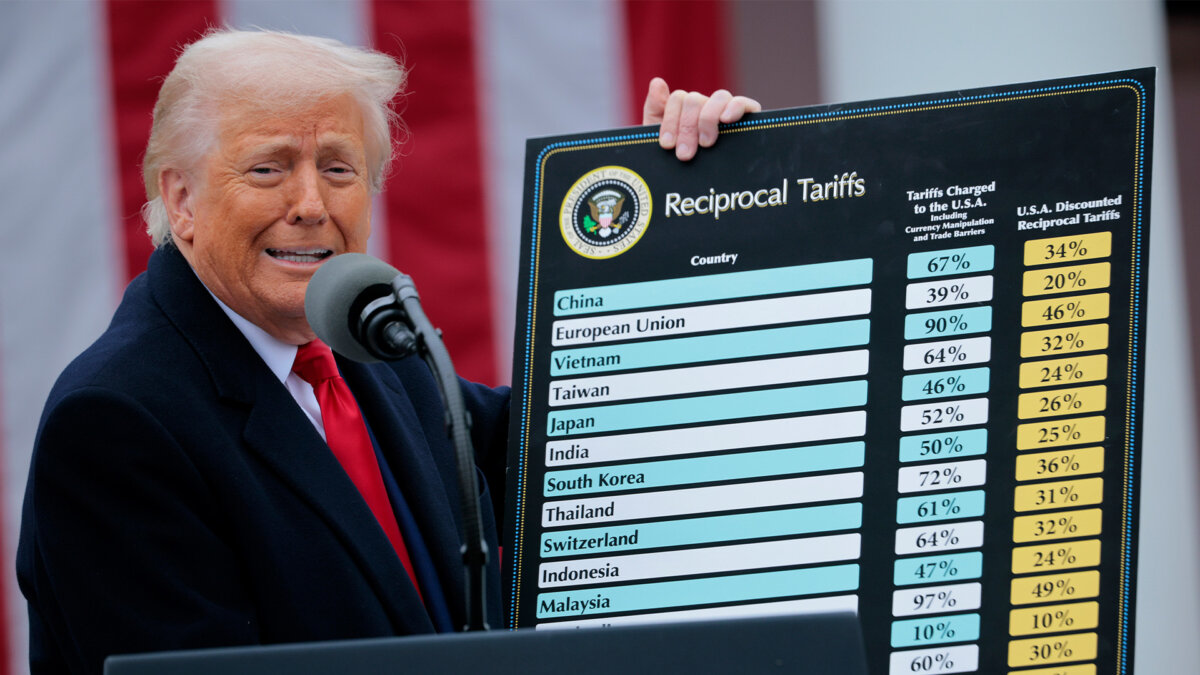
“There’s an Oct. 24 deadline to rule on that; if the tariffs are struck down, the trillions in new revenues that Trump promised may disappear,” Greg Valliere, chief U.S. policy strategist at AGF Investments, said in a note.
According to the Aug. 28 Daily Treasury Statement, the U.S. government collected approximately $31 billion in “customs and certain excise taxes” last month. Fiscal year to date, Washington has garnered $183.1 billion in tariff revenue.
The Congressional Budget Office, a nonpartisan budget watchdog, recently projected that the president’s increased tariffs could lower the budget deficit by about $4 trillion over a decade—$3.3 trillion in lower primary shortfalls and $700 billion in reduced interest costs. This is up from the previous estimate of $2.5 trillion.
U.S. Treasury yields, meanwhile, are following the upward trajectory overseas.
In the United Kingdom, the 30-year gilt yield surged 4.6 basis points, to 5.687 percent. The French 30-year government bond swelled 5 basis points, to 4.5 percent. The 30-year German bond climbed 4.5 basis points, to 3.406 percent.
European bond yields have risen for different reasons, says Ed Yardeni, president and chief investment strategist at Yardeni Research.
“A new wave of sovereign risk is washing over European economies, with the UK and France most vulnerable as they navigate fiscal fragility, political instability, and cratering bond market confidence,” Yarden said in a note.
Monetary policy could also play a pivotal role in the U.S. and European bond markets in the coming weeks.
Later this month, the Federal Reserve and the European Central Bank (ECB) are expected to lower interest rates by a quarter point. While the ECB has been on a rate-cutting crusade for more than a year, the Fed’s highly anticipated 25 basis-point reduction to its benchmark federal funds rate would be the first since December.
Investors are betting on a 92 percent chance of a rate cut, according to the CME FedWatch Tool. However, the odds could change over the next week as policymakers digest the August employment and inflation reports.
The consensus estimate suggests that the U.S. economy added 75,000 new jobs last month, and the unemployment rate rose to 4.3 percent.
According to the Federal Reserve Bank of Cleveland’s Inflation Nowcasting, the headline annual inflation rate in the August Consumer Price Index (CPI) is expected to rise to 2.8 percent from 2.7 percent.
 Friends Read Free
Copy
Facebook
Tweet
Friends Read Free
Copy
Facebook
Tweet