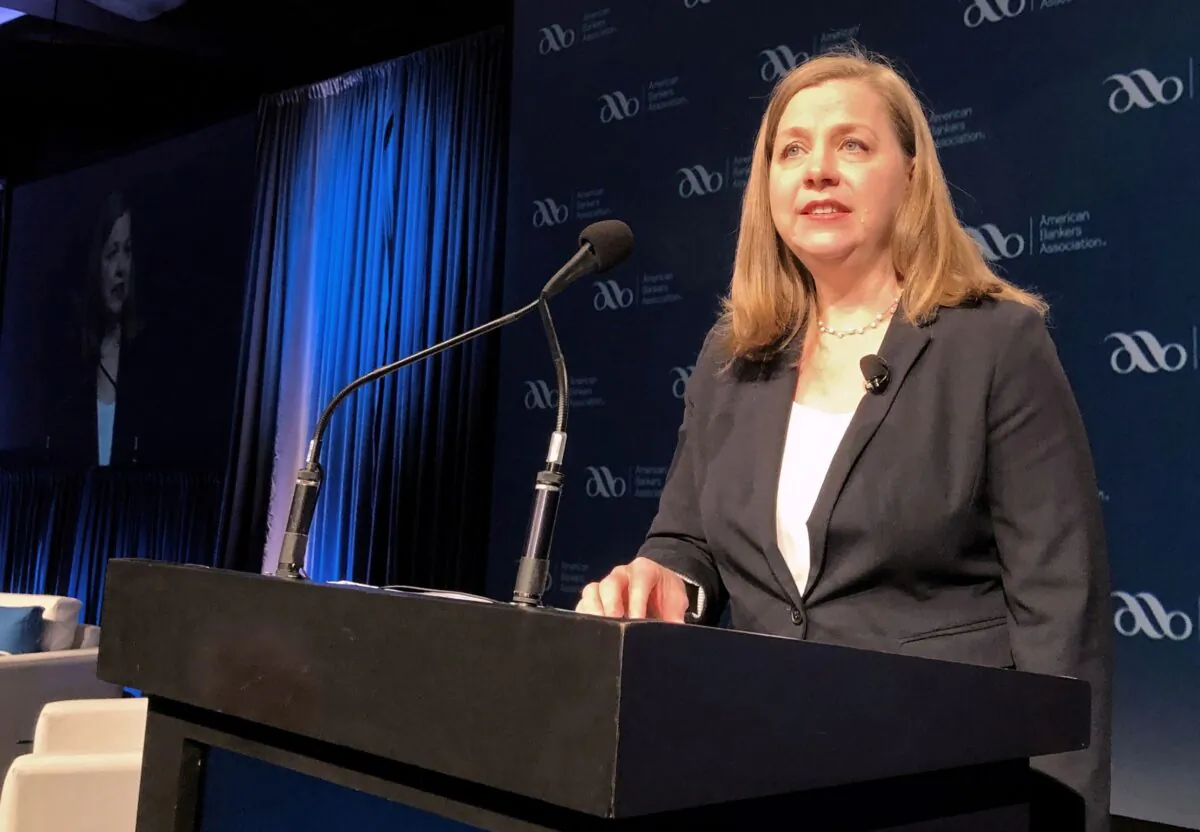

Federal Reserve Governor Michelle W. Bowman said on Monday that the U.S. central bank should consider bringing down interest rates if inflation remains contained or if data shows a weakening in labor market conditions.
The Federal Reserve kept interest rates unchanged at a range of 4.25 percent to 4.5 percent at the fourth Federal Open Market Committee (FOMC) meeting on June 18
“As we think about the path forward, it is time to consider adjusting the policy rate,” Bowman said during a June 23 speech in Prague, Czech Republic.
“As inflation has declined or come in below expectations over the past few months, we should recognize that inflation appears to be on a sustained path toward 2 percent and that there will likely be only minimal impacts on overall core PCE inflation from changes to trade policy.”
The Personal Consumption Expenditures (PCE) price index is the Fed’s preferred gauge of inflation. After PCE inflation hit 2.6 percent in February, PCE inflation consistently declined over the next two months to hit 2.1 percent in April.
Bowman warned that the downside risks to employment could soon become noticeable due to softness in consumer spending and fragility in the labor market.
“Before our next meeting in July, we will have received one additional month of employment and inflation data,” Bowman said.
If the data show inflation continuing to “evolve favorably” or if there are signs of softening spending negatively affecting the labor market, these developments must be addressed, she added.
“Should inflation pressures remain contained, I would support lowering the policy rate as soon as our next meeting in order to bring it closer to its neutral setting and to sustain a healthy labor market,” she said.
The next FOMC meeting is scheduled for July 29–30.
Bowman’s statements came a day before Fed Chair Jerome Powell is scheduled to present the agency’s semi-annual monetary policy report before the House Committee on Financial Services.
President Donald Trump has been calling for interest rates to be lowered and referenced the hearing in a June 24 Truth Social post.
“Jerome Powell, of the Fed, will be in Congress today in order to explain, among other things, why he is refusing to lower the Rate. Europe has had 10 cuts, we have had ZERO,” he wrote.
“No inflation, great economy – We should be at least two to three points lower. Would save the USA 800 Billion Dollars Per Year, plus. What a difference this would make. If things later change to the negative, increase the Rate.”
Fed Governor Christopher Waller has also suggested implementing rate cuts soon. Waller said it can be done as early as July.
‘Wait to Learn More’
In its June meeting, the Fed signaled that two rate cuts may be on schedule in 2025, with interest rates expected to finish the year at 3.9 percent.
The Federal Reserve is looking at bringing down inflation to the 2 percent level and is waiting to see the impacts of the Trump administration’s tariff policies before considering lowering interest rates. Tariff negotiations with several major partners are ongoing.
After the June meeting, Powell told reporters that while inflation has eased significantly from its 2022 highs, it still “remains somewhat elevated relative to our 2 percent longer-run goal.” He added that “near-term measures of inflation expectations have moved up over recent months.”
As for changes in trade, immigration, regulatory, and fiscal policies, their effects on the American economy remain uncertain, Powell said.
“Increases in tariffs this year are likely to push up prices and weigh on economic activity,” he said. “The effects on inflation could be short-lived—reflecting a one-time shift in the price level. It is also possible that the inflationary effects could instead be more persistent. Avoiding that outcome will depend on the size of the tariff effects, on how long it takes for them to pass through fully into prices.”
Since the high inflation readings of January and February, there have been three months of “favorable inflation readings,” which Powell said was “highly welcome news.”
He said that the impact of tariffs on inflation may take some time to be visible as it makes its way through the distribution chain to the final consumer retail price.
“A good example of that would be goods being sold at retailers today may have been imported several months ago, before tariffs were imposed. So, we’re beginning to see some effects, and we do expect to see more of them over coming months,” the Fed chair said.
“For the time being, we are well positioned to wait to learn more about the likely course of the economy before considering any adjustments to our policy stance.”
U.S. Secretary of Commerce Howard Lutnick criticized the Federal Reserve for not bringing down interest rates.
“The United States of America is the greatest country in the world yet it has to suffer with the highest interest rates of any first class country,” Lutnick said in a June 21 post on social media platform X.
“These high Interest Rates make no sense. Enough is enough!!!”
 Friends Read Free
Copy
Facebook
Tweet
Friends Read Free
Copy
Facebook
Tweet