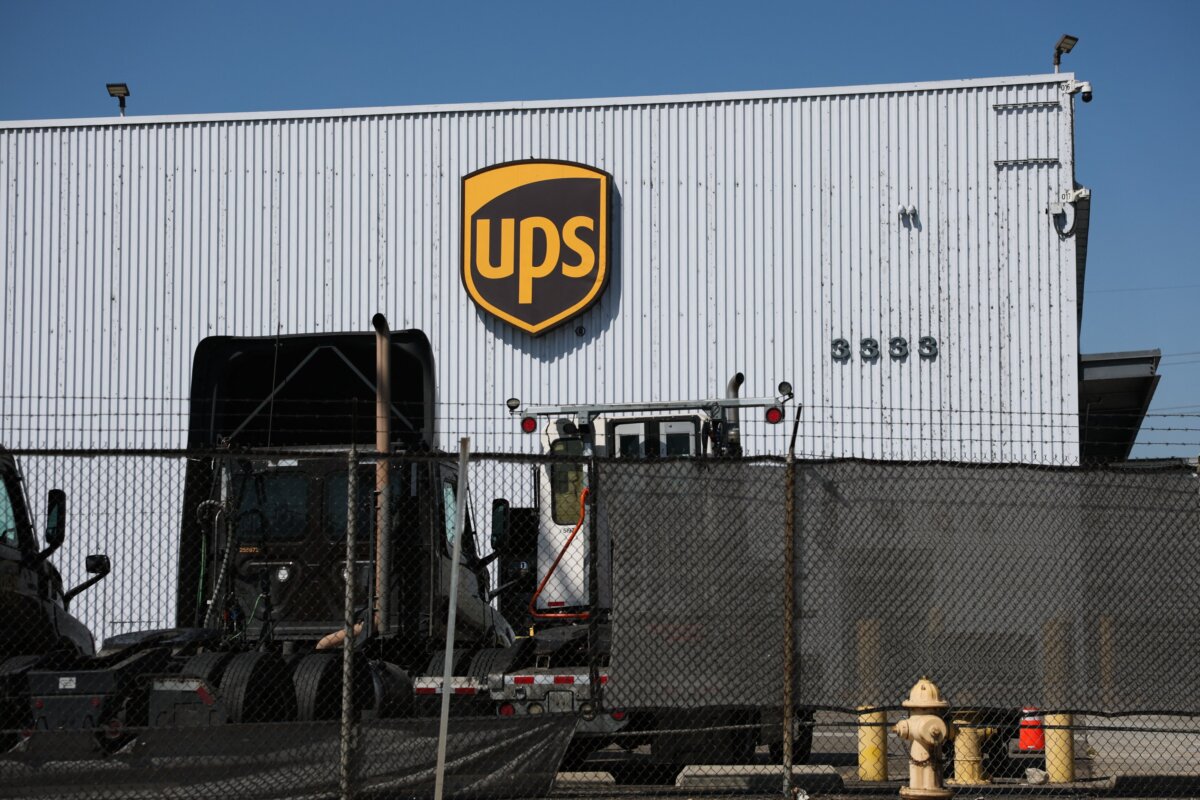

UPS plans to hire 100,000 seasonal workers across the United States for the 2026 holiday shipping rush, 9 percent fewer than last year, as the delivery giant increasingly relies on automation and a leaner distribution network.
The seasonal employees will help sort, transport, and deliver packages at hundreds of locations nationwide, UPS stated on Oct. 7.
This marks the second straight year that the delivery giant has reduced its temporary hiring target.
UPS sought roughly 110,000 seasonal workers last year, and this year’s target is down by 20 percent from the 125,000 workers the company hired for the 2024 holiday season.
The company is also adding more technology to its peak-season operations.
UPS stated that it expects new or upgraded automated facilities in Denver; St. Paul, Minnesota; Syracuse, New York; and Portland, Oregon, to improve efficiency and service performance.
The company is also expanding the use of passive radio-frequency identification (RFID) chips embedded in shipping labels. The chips can be detected by readers installed in sorting facilities and delivery vehicles, helping UPS track packages as they move through its network.
UPS expects to handle more than 4 billion RFID-enabled packages by the end of 2026.
The smaller seasonal workforce comes as UPS undergoes a broader transformation of its U.S. delivery network aimed at lowering costs and reducing package volumes from Amazon, its largest customer. Dealing with Amazon brings UPS high volume but at low margins.
In January, UPS announced a plan to cut 30,000 operational positions as part of winding down its partnership with Amazon. The company also stated that it planned to reduce total operational hours by about 25 million.
In July, UPS stated that it had successfully completed an “Amazon glide down” as planned, reporting $22.8 billion in consolidated second-quarter revenue and $2.1 billion in adjusted operating profit.
The company then raised its full-year revenue forecast to approximately $91.2 billion and increased its adjusted operating profit target to about $8.65 billion.
Those figures accounted for the cost of UPS’s restructuring. The company recorded $891 million in after-tax transformation charges, largely tied to employee separation costs.
The overhaul has also generated savings. UPS stated that shrinking Amazon delivery deals and other restructuring measures had produced about $1.2 billion in benefits through the first half of 2026, toward a roughly $3 billion full-year target.
Holiday Demand Remains High
Holiday spending is nevertheless expected to remain strong this year.
The Mastercard Economics Institute expects U.S. retail sales, excluding automobiles and gasoline, to increase by 5.5 percent from a year earlier between Nov. 1 and Dec. 24.
The forecast is based on Mastercard SpendingPulse, which measures in-store and online retail spending across all forms of payment.
If materialized, it would mark the strongest holiday sales growth since 2022.
Like last year, Thanksgiving falls relatively late again. This shortens the traditional shopping period between Thanksgiving and Christmas and potentially encourages retailers to launch holiday promotions earlier, Mastercard stated.
One notable difference from last year is the timing of Cyber Monday, which falls in November in 2026.
Black Friday and Cyber Monday being in the same calendar month could concentrate a significant share of online holiday shopping into one extended weekend, Mastercard stated. It could make November particularly important for retailers and delivery companies.
 Friends Read Free
Copy
Facebook
Tweet
Friends Read Free
Copy
Facebook
Tweet