

The war in Iran dragged consumer confidence to a historical low this month amid increasing concerns about inflationary pressures.
The University of Michigan’s preliminary April Consumer Sentiment Index, released on April 10, declined 11 percent to an all-time low of 47.6.
This is down from the previous month’s final reading of 53.5 and below the market estimate of 52.
April’s downturn reflected a sharp 20 percent plunge in expected business conditions, alongside an 11 percent deterioration in respondents’ views of their personal finances.
Consumers cited concerns surrounding high prices and weaker asset values.
Open-ended comments blamed current conditions on the six-week-old Iranian conflict. Nearly all the surveys of respondents were conducted before the two-week ceasefire agreed to by the United States and Iran on April 7.
“Economic expectations will likely improve after consumers gain confidence that the supply disruptions stemming from the Iran conflict have ended and gas prices have moderated,” Joanne Hsu, director of consumer surveys, said in a news release.
Still, consumers anticipate higher prices in the year ahead.
The one-year inflation outlook surged to 4.8 percent from 3.8 percent in March—the largest monthly increase since April 2025 when President Donald Trump unveiled his sweeping global tariff plans.
“The current reading exceeds those seen in 2024 and remains well above the 2.3–3.0 percent range seen in the two years pre-pandemic,” Hsu noted.
Long-run inflation expectations edged up to 3.4 percent—the highest reading since November 2025—from 3.2 percent.
This comes as the Bureau of Labor Statistics reported that March’s annual inflation rate surged to a two-year high of 3.3 percent. Despite the spike in headline numbers, underlying inflation came in below expectations, ticking up to a 12-month rate of 2.6 percent.
Depending on how the two-week ceasefire holds up, consumers could contend with another couple of hot inflation reports, says Jeffrey Roach, chief economist for LPL Financial.
“Since the Hormuz chokepoint was closed for an extended period, we should expect another one or two hot inflation prints, driven by transportation services and some durable goods categories,” Roach said to The Epoch Times in an emailed note.
“The second-order effects will likely add another 0.2 over the next few months.”
The April Consumer Price Index (CPI) report is expected to show the annual inflation rate rising to 3.6 percent, according to the Cleveland Federal Reserve’s Nowcasting model. But core inflation could be unchanged at 2.6 percent.
Appetite for Spending
As consumers contend with higher gasoline prices, market watchers are waiting to see if the data will show shoppers reluctant to open their wallets.
For now, households appear to still have an appetite for consumption, according to new data from the Bank of America Institute.
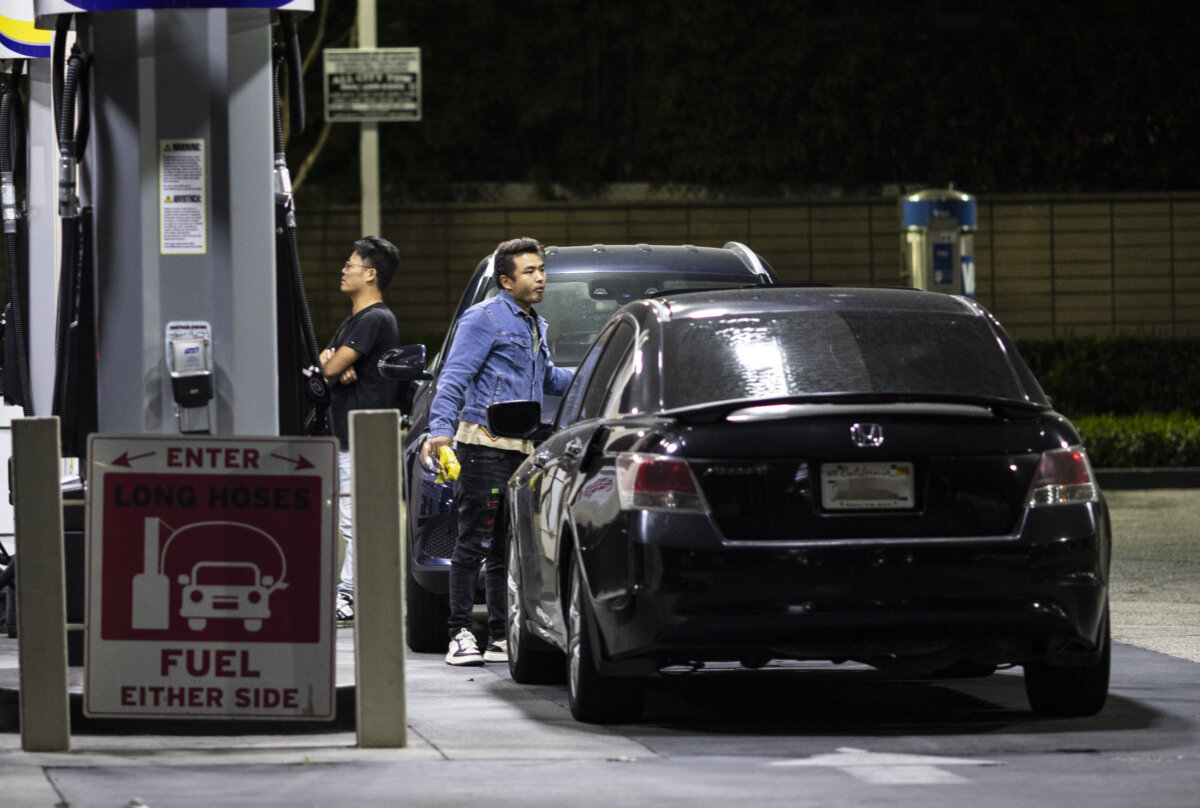
Total credit and debit card spending per household increased 4.3 percent year over year, the strongest growth since 2023.
Pump prices contributed to the significant increase. However, total card spending excluding gasoline still rose 3.6 percent year over year.
“While the duration of the conflict is highly uncertain—as is the impact on oil prices—if higher gas prices are sustained for a prolonged period all households will be impacted, but lower-income families are most exposed,” Bank of America economists said in the April 10 report.
Should consumers adapt to elevated gas prices, they could begin trimming their spending on durable goods, groceries, and food services, the bank noted.
Retail sales rebounded in February, advancing 0.6 percent from the 0.1 percent dip in January.
Similar to a year ago, when there was uncertainty from the president’s tariffs, there is now uncertainty from Middle East tensions, clouding the economic outlook.
“This year, we’re layering on additional uncertainty around energy prices and how that flows through to both the industrial and consumer economies globally,” Josh Rubin, client portfolio manager at Thornburg Investment Management, said in a note emailed to The Epoch Times.
The U.S.–Iran truce has calmed global energy markets, with oil prices sliding below $100 per barrel.
The recent drop in crude oil, which accounts for half the cost of gasoline, has helped mitigate some of the pain at the pump.
As of April 10, the national average price of a gallon of gasoline dipped by $0.01, to $4.15, according to the American Automobile Association.
 Friends Read Free
Copy
Facebook
Tweet
Friends Read Free
Copy
Facebook
Tweet