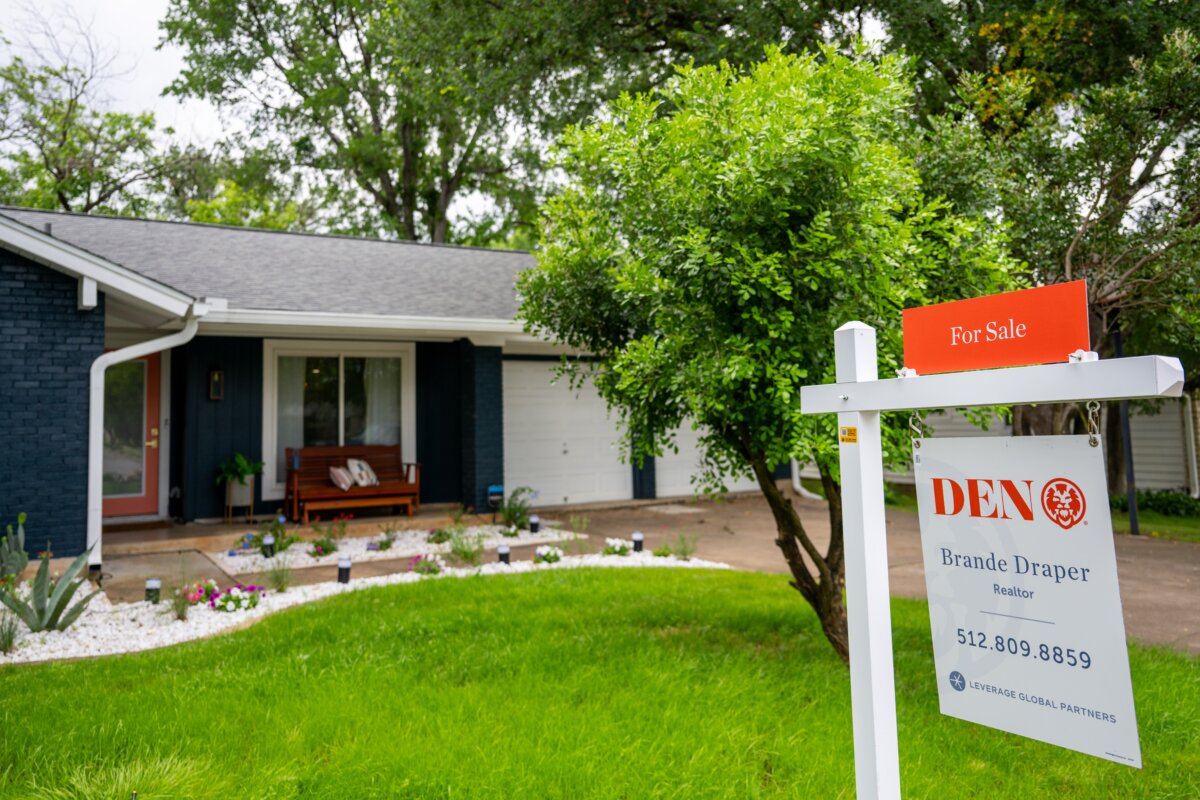

U.S. existing-home sales fell 8.4 percent in January to a seasonally adjusted annual rate of 3.91 million, according to a Feb. 12 report from the National Association of Realtors (NAR). It marked the largest monthly decline since February 2022 and the lowest level since December 2023.
The report shows the median sales price for all housing types at $396,800, a slight uptick of 0.9 percent from January 2025. However, the sales continued a declining trend with a 4.4 percent year-over-year decrease in existing-home sales.
“The decrease in sales is disappointing,” NAR Chief Economist Lawrence Yun said in the report.
“The below-normal temperatures and above-normal precipitation this January make it harder than usual to assess the underlying driver of the decrease and determine if this month’s numbers are an aberration.”
Yun noted that because of January’s lower supply of inventory, the median home price reached a new high for January. The nation’s total inventory decreased by 0.8 percent from December 2025, but was 3.4 percent higher than in January 2025. The January 2026 housing supply stood at 3.7 months, up from 3.5 months in December 2025.
While January’s single-family market sales declined by 9 percent month over month, condominium and co-op sales saw only a 2.6 percent decrease in month-over-month sales. The NAR reported the January median sales price for single-family homes at $400,300, up 0.6 percent from last year, and condos and co-ops at $364,600, for a 3.8 percent increase from January 2025.
Regionally, the West experienced the sharpest sales decrease at 10.3 percent, followed by the South at 9 percent and Midwest at 7.1 percent. Only the Northeast showed an increase in sales, at 5.9 percent. The West held the country’s highest median prices at $600,400, and the Midwest held the lowest medians, at $294,400.
Affordability Improving
According to the report, affordability improved for the seventh consecutive month.
“Affordability conditions are improving, with NAR’s Housing Affordability Index showing that housing is the most affordable it’s been since March 2022,” Yun said.
“This is due to wage gains outpacing home price growth and mortgage rates being lower than a year ago. However, supply has not kept pace and remains quite low.”
A similar report this week from Redfin also notes that home affordability is getting better, but American households need to earn at least $111,252 a year to afford the average home on the market. While that amount is down 4 percent from one year ago, the report estimates the typical household nationwide earns just over $86,000 annually.
Redfin considers a home affordable if a buyer with a mortgage spends no more than 30 percent of their income on their monthly housing payment.
The report concludes that affordability is improving in 37 of the 50 most populous U.S. metropolitan areas, with the most improved affordability in Dallas, Texas; Sacramento, California; and Jacksonville, Florida.
“While housing remains historically expensive, the trajectory is finally starting to reverse, with the door to buying a home opening a bit wider rather than closing tighter,” Redfin’s head of economics research, Chen Zhao, said in the report. “But while affordability is improving, Americans are contending with other obstacles on the road to buying a home, like nerves about layoffs and economic uncertainty.”
When it comes to buying versus renting, Redfin reported that homebuyers typically need to earn $35,000 a year more than renters to afford monthly payments. In this case, renters would require an annual salary of at least $76,000 to afford a typical apartment. The report indicates median rents nationwide are about $1,900.
“Many Americans have been hesitant to jump from renting to buying due to high homeownership costs, but the recent drop in mortgage rates and rise in homebuyer negotiating power may help some take the leap,” Redfin economist Grishma Bhattarai said in the report. “We expect home-buying affordability to gradually improve in the coming year as mortgage rates stay closer to 6 percent than 7 percent, home-price growth loses steam and wages rise faster than housing costs.”
Redfin named Austin and San Antonio, Texas; Denver, Colorado; Tampa, Florida; and Phoenix, Arizona as the top five metros where the level of income needed to afford rent has decreased.
 Friends Read Free
Copy
Facebook
Tweet
Friends Read Free
Copy
Facebook
Tweet