

U.S. job openings were little changed in October, reaffirming elevated uncertainty over the U.S. economy, according to delayed data from the Bureau of Labor Statistics released on Dec. 9.
Following a solid 431,000 gain in September, vacancies rose more modestly in October, up 12,000 to 7.67 million.
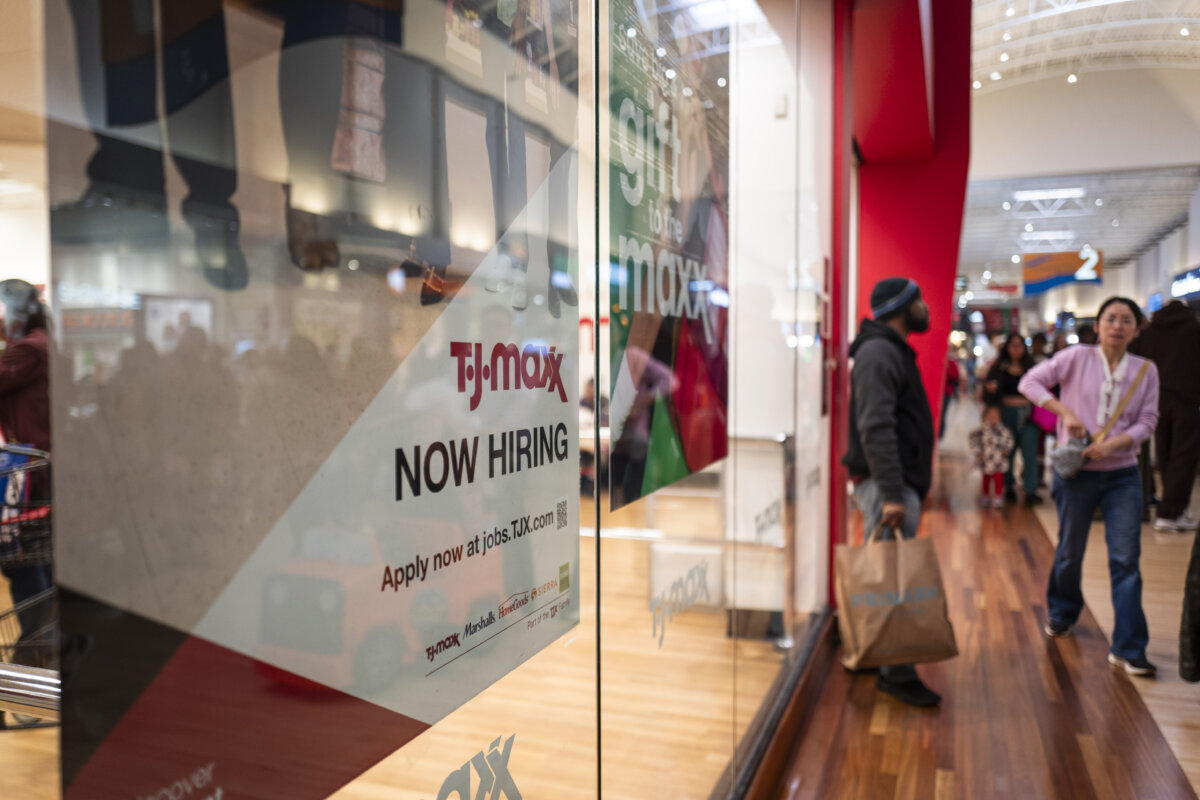
The Job Openings and Labor Turnover Survey (JOLTS)—postponed due to the government shutdown—found that openings were led by the retail trade, with 142,000.
Declines were centered mainly in professional and business services (down 114,000), the federal government (negative 25,000), and leisure and hospitality (down 22,000).
The number of job quits—a signal of worker confidence in the labor market—declined by 187,000 to 2.94 million, the lowest since August 2020.
This was firmly below the 3.21 million job quits from a year ago.
The decline was concentrated in accommodation and food services (down 136,000), health care and social assistance (minus 114,000), and the federal government (negative 25,000).
A measurement of voluntary job leavers as a proportion of total employment—the quits rate—dipped to 1.8 percent from 2 percent in September.
New hires were little changed at 5.1 million, while layoffs were also flat at 1.9 million.
These numbers further support the months-long trend of a “low fire, low hire” environment.
“The job market has cooled but hasn’t cracked. October job openings rose to nearly 7.7 million, higher than expected, but well below the post-pandemic peak. Hiring remains subdued, and quits are falling,” Mark Hamrick, senior economist at Bankrate, said in a statement to The Epoch Times.
“That mix suggests employers are cautious and workers are even more so.”
JOLTS figures helped fill the government data vacuum, but the main event will be next week, when the bureau releases the November jobs report.
Michael Brown, senior research strategist at Pepperstone, forecasts that the U.S. economy added 40,000 new jobs last month.
“The final ‘proper’ trading week of the year will see the release of not only the full November labour market report, but also partial data for October, helping both market participants and policymakers to build a picture of how the employment backdrop has evolved during the bulk of the fourth quarter,” Brown said in a Dec. 8 note.
If accurate, the November reading would be slightly above the short-run breakeven rate—the pace of monthly job growth needed to keep the unemployment rate stable—which the Dallas Fed estimates is 30,000.
It would also be sharply down from September’s 119,000 new jobs.
At the same time, recent data indicate employment conditions could be bouncing back in the home stretch of 2025.
U.S. private business employment increased an average of 4,750 jobs per week in the four weeks ending Nov. 22, according to payroll processor ADP data released on Dec. 9.
This reading could show that private-sector job losses slowed in mid-November, says Nela Richardson, ADP’s chief economist.
“This week’s positive number hints at an upswing in the labor market after four straight weeks of negative pulse estimates,” Richardson said in a release.
Additionally, in the final week of November, the number of Americans filing for unemployment benefits plummeted to 191,000—the lowest level in more than three years.
Recurring claims—a gauge of the number of jobless individuals currently receiving unemployment benefits—slowed for the second straight week.
This measure is vital for economists because it can reveal the challenges that out-of-work people face in locating employment.
Supply-Demand Dynamics
The bureau’s JOLTS figures provide a comprehensive assessment of labor demand.
However, because the report is published with a lag of about one to two months, economic observers will search elsewhere for more up-to-date snapshots of supply-demand dynamics in the U.S. labor market.
Data from Indeed Hiring Labor show that job postings have risen since early November, climbing to an almost three-month high.
The month-long rebound is likely driven by seasonal hiring that is currently outpacing last year’s anemic levels.
The share of driving jobs tagged as seasonal has more than doubled, climbing from about 1 percent a year ago to 2.6 percent now.
“But the surge in demand may ring a bit hollow—last year was the weakest seasonal hiring year in recent Indeed data, and this year’s demand still pales in comparison to stronger years recorded in 2020, 2021, and 2022,” Cory Stahle, an economist at Indeed Hiring Lab, said in a report.
Despite growing worries that the U.S. labor market could be spiraling downward, some economists and policymakers say conditions are merely cooling and entrenched in a “low fire, low hire” climate.
“We see a labor market that’s kind of—I don’t want to say ‘stable,’ but it’s not clearly in motion, it’s not clearly declining quickly in any case,” Federal Reserve Chair Jerome Powell told reporters at the post-meeting press conference in October.
“It may be just continuing to gradually cool.”
The unemployment rate, slightly above 4 percent, remains near historically low levels. The labor force participation rate ticked up for the second straight month in September to 62.4 percent.
Real (inflation-adjusted) average hourly earnings rose 0.8 percent year-over-year in September but were flat on a month-over-month basis. Real average weekly earnings also climbed 0.7 percent from a year ago.
However, others fear that the unemployment rate will continue to edge up heading into 2026, and weakness should give the Fed ammunition to ease monetary policy restrictions.
“Since earlier this year, when we started to see a material weakening in the jobs market, I have believed labor demand is weak enough for the Fed to cut, including this month,” Jeffrey Roach, LPL Financial’s chief economist, said in a note emailed to The Epoch Times.
Roach anticipates the jobless rate will rise to 4.6 percent by year-end and remain elevated into the new year.
The commonly cited job openings-to-unemployment ratio—a gauge of how many jobs are available relative to how many people are looking for work—stands at 1.0. Anything above 1.0 points to slack building in the labor market.
Conversely, anything below this threshold suggests employment conditions are loose.
Policymakers are widely expected to lower interest rates at the final meeting of the year, following through on the third straight quarter-point reduction to the benchmark federal funds rate.
 Friends Read Free
Copy
Facebook
Tweet
Friends Read Free
Copy
Facebook
Tweet