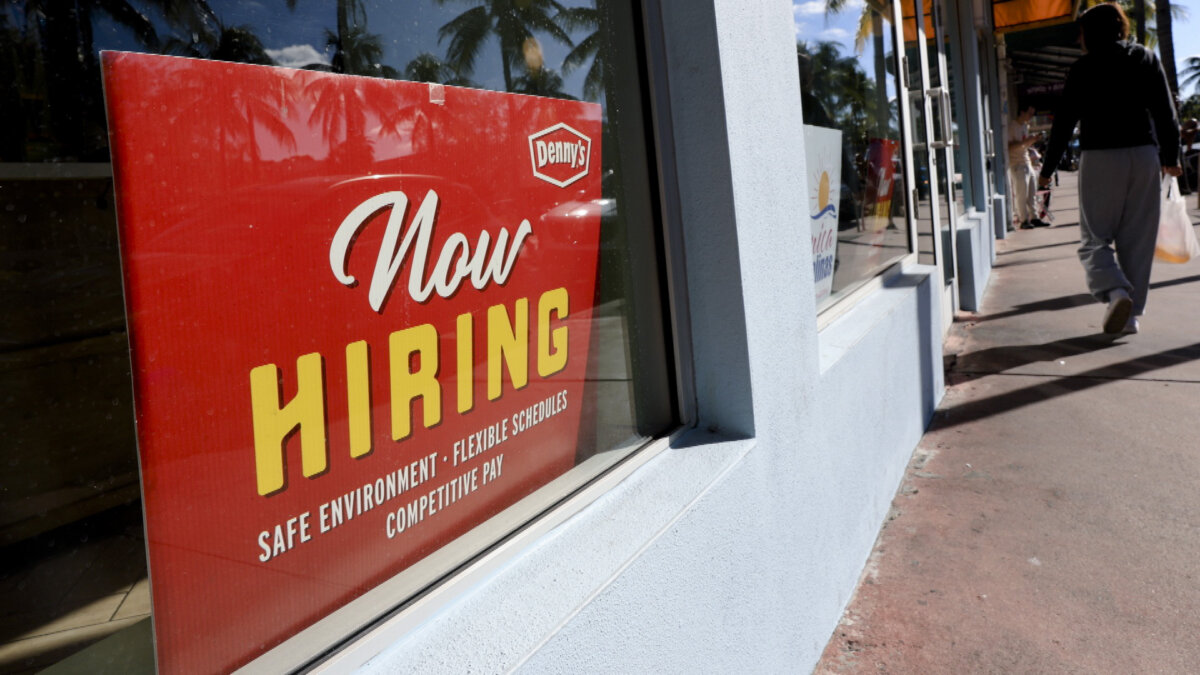

The number of Americans filing for unemployment benefits sank to its lowest level in almost six decades.
Initial jobless claims declined by 26,000 to 189,000 for the week ending April 25, according to Department of Labor data published on April 30. The previous week’s reading was revised up slightly to 215,000.
Economists had forecast a consensus estimate of 215,000.
This represents the lowest level since September 1969, reflecting the persistent low-fire makeup of current employment conditions that have been prevalent for the past year.
The four-week average, which strips out week-to-week volatility, edged lower to 207,500.
Fifty-seven years ago, the United States enjoyed a low unemployment rate of 3.5 percent, before spiraling into a climate often referred to as stagflation—an environment of anemic growth, high unemployment, and rising inflation.
Fast forward to the present day, and like the broader economic landscape at that time, the U.S. labor market remains resilient amid a plethora of headwinds, from higher gasoline prices to President Donald Trump’s sweeping global tariffs.
Federal Reserve Chair Jerome Powell described the labor market last summer as being in a “curious kind of balance.” This resulted from a slowing in the supply of and demand for workers, according to his remarks.
Today, however, it is an “unusual and uncomfortable kind of a balance,” he said.
“There’s effectively no new net job creation,” Powell said in his post-meeting press conference on April 29. “In a sense, the labor market is in balance, but it’s an unusual and uncomfortable kind of a balance where people who don’t have jobs will have a hard time breaking in unless somebody quits their job.”
Still, fewer people are currently receiving unemployment benefits.
Continuing jobless claims fell to 1.78 million—the lowest level since April 2024—from 1.81 million in the previous week.
Economists use recurring claims as a proxy to gauge the challenges workers may be facing in finding employment. It could also signal that the unemployed are exhausting their benefits, as many states cap eligibility.
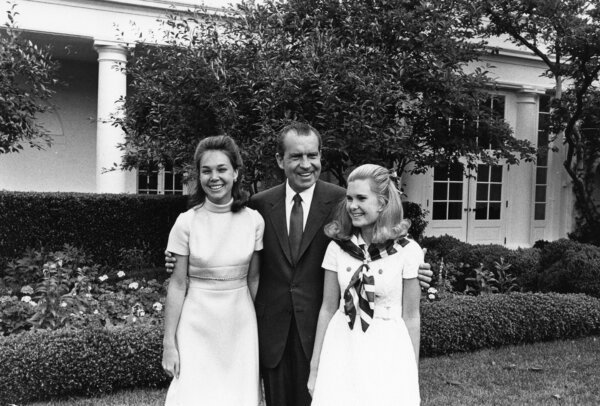 Richard Nixon and his daughters (L) Julie Nixon Eisenhower and Tricia Nixon on Father’s Day, June 15, 1969. (Nixon White House Photographs/Public Domain)
Labor Market Dynamics, the Fed
Hiring momentum has ebbed and flowed this year, suggesting that while companies are not eager to terminate staff, they may also be refraining from expanding their workforce.
U.S. private employers added an average of 39,250 jobs per week in the four weeks ending April 11, according to payroll processor ADP. The figures indicate stabilization in the labor market after a spike in employment gains in the second half of last month.
A fresh snapshot of the job market will be released next week as the Bureau of Labor Statistics publishes the April nonfarm payrolls report.
In March, the country added a larger-than-expected 178,000 new jobs. This month, economists are penciling in a gain of 73,000 and an unemployment rate holding steady at 4.3 percent.

The unemployment rate could continue to be low moving forward as the break-even level stays low.
Research by the Dallas Federal Reserve suggests that the break-even rate—the monthly pace of job growth necessary to keep the unemployment rate low—is almost zero. Its report listed decreasing immigration and a drop in the labor force participation rate.
“Real-time data point to an important change in the U.S. labor market: The benchmark for evaluating payroll growth has moved significantly,” Dallas Fed economists wrote in a March 31 paper.
“As net outflows of unauthorized immigrants reduced employment growth in late 2025, payroll gains that might historically have signaled economic slack are now consistent with a balanced labor market.”
Despite employment holding up, “cracks are still showing,” say economists at Indeed Hiring Lab.
“Long-term unemployment has steadily grown since the pandemic, and the strong March reading could not fully offset weaker reports from earlier in the year,” they wrote in an April 30 note.
Although unlikely, a stagflation scenario remains possible, which could force the Federal Reserve to tighten monetary policy, the economists added.
The Fed kept interest rates on hold this month for the third consecutive meeting, and traders expect monetary policymakers to keep the benchmark federal funds rate higher for longer.
With downside risks to employment diminished and the upside threats to inflation elevated, it would be difficult to advocate for rate cuts, particularly at a time of solid growth and a strong labor backdrop, Christian Hoffmann, head of fixed income at Thornburg Investment Management said in a note emailed to The Epoch Times.
“At the same time, we view monetary policy as unlikely to resolve current pressure points for inflation,” Hoffmann added, pointing to higher oil prices and the closure of the Strait of Hormuz.
 Friends Read Free
Copy
Facebook
Tweet
Friends Read Free
Copy
Facebook
Tweet