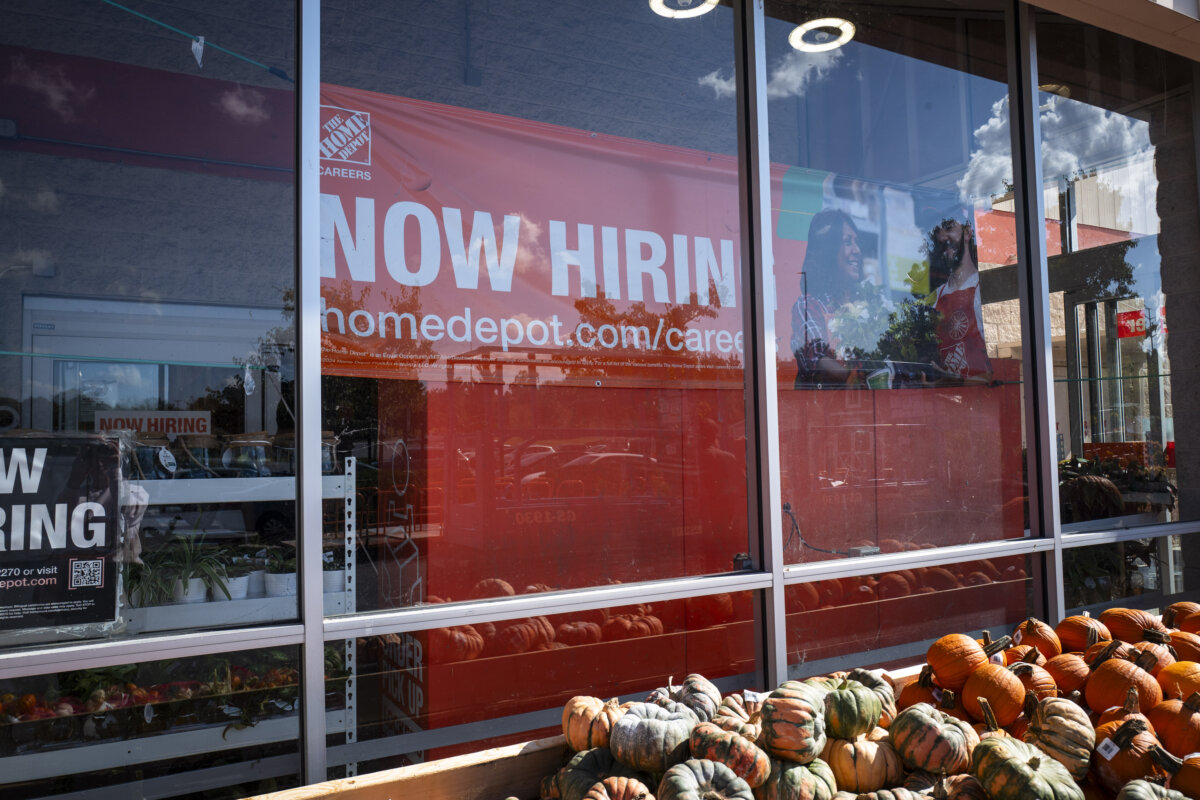

The private sector rebound may have been temporary as companies shed thousands of jobs per week last month, new data released on Nov. 11 show.
Businesses eliminated 11,250 jobs per week on average in the four weeks ending Oct. 25, according to the research arm of private payroll processor ADP.
Although the figures are preliminary, ADP chief economist Nela Richardson said the new data suggest the labor market faltered in generating consistent job growth during late October.
This comes a week after ADP’s National Employment Report showed payroll growth totaling 42,000 last month, following the loss of 29,000 private-sector jobs in September.
“Not only is the pace of employment growth shifting lower, it’s doing so in a jagged path across occupations, industries, and geographies. Going forward, instead of being a stable constant, the break-even rate more likely will be constantly moving,” Richardson said.
The break-even rate represents the minimum number of jobs the economy needs to add each month to maintain a steady unemployment rate. If job growth falls below this threshold, the jobless rate may rise.
Anton Cheremukhin, principal research economist at the Dallas Federal Reserve, estimates the current break-even rate is approximately 30,000, down from about 250,000 two years ago.
However, while the current narrative suggests that employment conditions are deteriorating, the data indicate a more balanced labor market, Cheremukhin said in a paper on Oct. 9.
“A break-even rate of around 30,000 appears to be the new reality for the U.S. labor market. This means modest payroll gains, which might have seemed alarming in 2023, are now indicative of a stable and balanced market,” he said.
Stabilization or Weakness
At the same time, various alternative metrics suggest the U.S. economy is shedding jobs.
Revelio Labs, using individual-level data from online professional profiles, reported on Nov. 6 that the labor market lost more than 9,000 public and private sector jobs.
This is down from the group’s forecast of 33,000 new jobs added in September.
In addition, global outplacement firm Challenger, Gray, and Christmas found that U.S.-based employers announced more than 153,000 planned layoffs last month.
Due to the six-week government shutdown, alternative economic measurements have been thrust into the spotlight to determine the broader economy’s health.

The Fed, which relies on vital data to craft monetary policy, has been scanning surveys and other information sources to examine the trends forming in the United States.
“We are interpreting data that we never pay attention to and extrapolating what the Fed may do based on it,” Jay Woods, chief market strategist at Freedom Capital Markets, said in a note emailed to The Epoch Times.
“While the Challenger report showed labor weakness and created more talk of a December cut, it’s not reliable like the data the Fed expects to get this week.”
Fed Chair Jerome Powell and his colleagues say they are not exactly flying blind, but the longer the crucial data points are unavailable, the more challenging it will be for them to cut interest rates.
Powell spooked financial markets last month when he stated that a December rate cut was not guaranteed, noting that the central bank might take a break during the current cycle.
Despite the Fed head stating that an interest rate cut next month is “not a foregone conclusion,” investors say there is a 70 percent chance of a quarter-point reduction to the benchmark federal funds rate—a key rate that influences borrowing costs for businesses and consumers.
The government shutdown, now in its 42nd day, is expected to conclude this week. It remains uncertain as to when the federal government will release the crucial reports on inflation, employment, and gross domestic product.
The October Consumer Price Index and Producer Price Index reports were scheduled for release later this week.
In the meantime, prices for big-ticket items and personal-care products rose 0.22 percent in October, down from 0.48 percent in the previous month, according to data intelligence firm OpenBrand.
Truflation, a real-time inflation tracker, suggests the annual inflation rate is 2.54 percent, far below the government’s headline rate of 3 percent.
The rate-setting Federal Open Market Committee will hold its next two-day policy meeting on Dec. 9 and 10.
 Friends Read Free
Copy
Facebook
Tweet
Friends Read Free
Copy
Facebook
Tweet