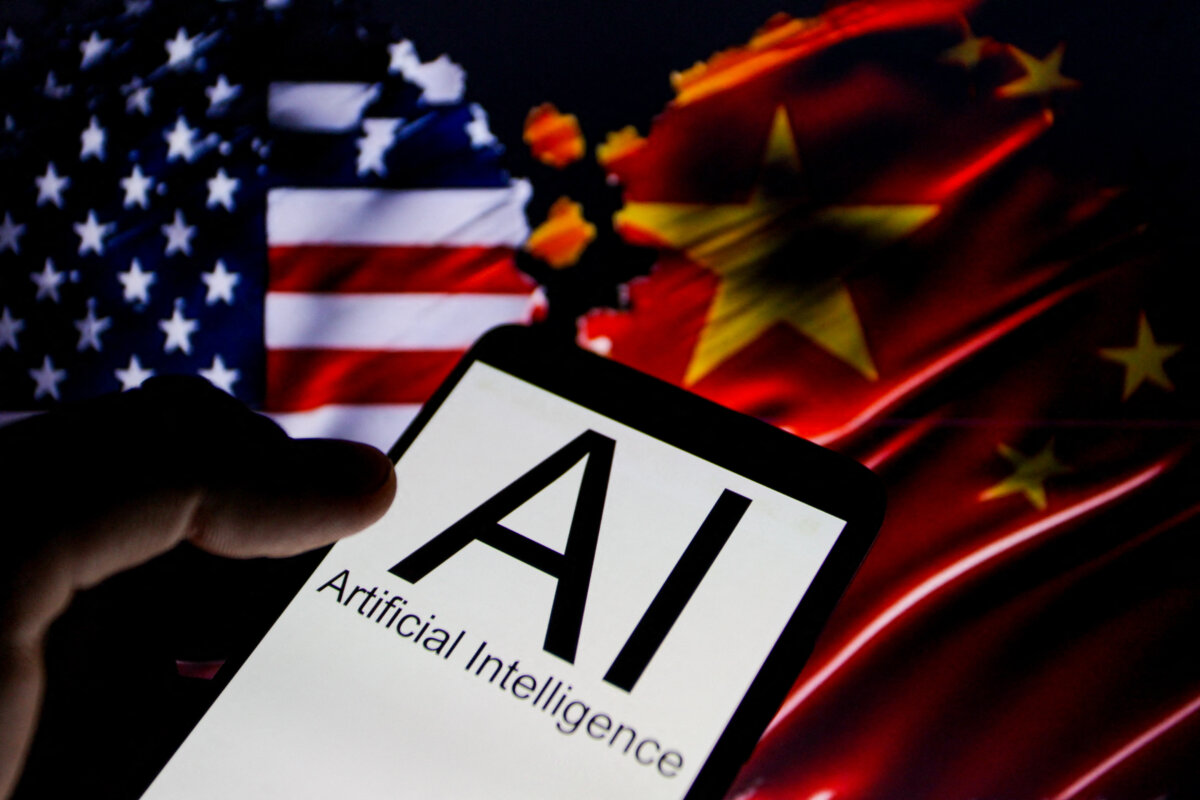

Artificial intelligence will be at the forefront of the upcoming meeting between President Donald Trump and Chinese leader Xi Jinping, according to several sources familiar with the matter.
Beijing will be willing to discuss some risks arising from the rapidly developing technology but won’t share information that could give the United States an edge, as the regime views AI as a strategic asset and an area where it may be able to surpass the United States, some sources said.
The Chinese Communist Party (CCP) leadership has put the full weight of the regime behind AI development in recent years, making it a pillar of China’s increasingly state-run economy. Beijing is particularly worried that the United States may impose additional restrictions on Chinese AI platforms, a source close to the Chinese establishment told The Epoch Times.
Xi is scheduled to arrive in the United States on Sept. 23 for a three-day visit. AI has been placed on the agenda as a “core topic” at Washington’s request, the source said.
Earlier this year, the United States proposed setting up a communication channel to coordinate efforts to bar terrorists and criminal groups from exploiting frontier AI models. China may agree to set up such a channel, but it will not disclose the number of attacks it has faced, nor will it reveal details regarding system vulnerabilities, defense mechanisms, or the extent of losses, the source said.
“If China were to disclose the number of attacks, it would effectively expose its defensive capabilities and allow the other side to adjust its attack strategies,” the source said.
Another Chinese insider source agreed that Beijing will refuse technical cooperation.
“China attaches great importance to AI because the leadership senses that, in certain respects, the technology can rival that of the U.S.,” the source told The Epoch Times.
“If the U.S. proposes cooperation to jointly combat cyberattacks, China would likely politely decline; they have no desire to hand over algorithms or training data to the Americans.”
Xi’s regime is currently analyzing Washington’s motives for accusing Chinese tech companies of distilling American AI models just before Xi’s visit, a third source, close to the Chinese Ministry of Commerce, said.
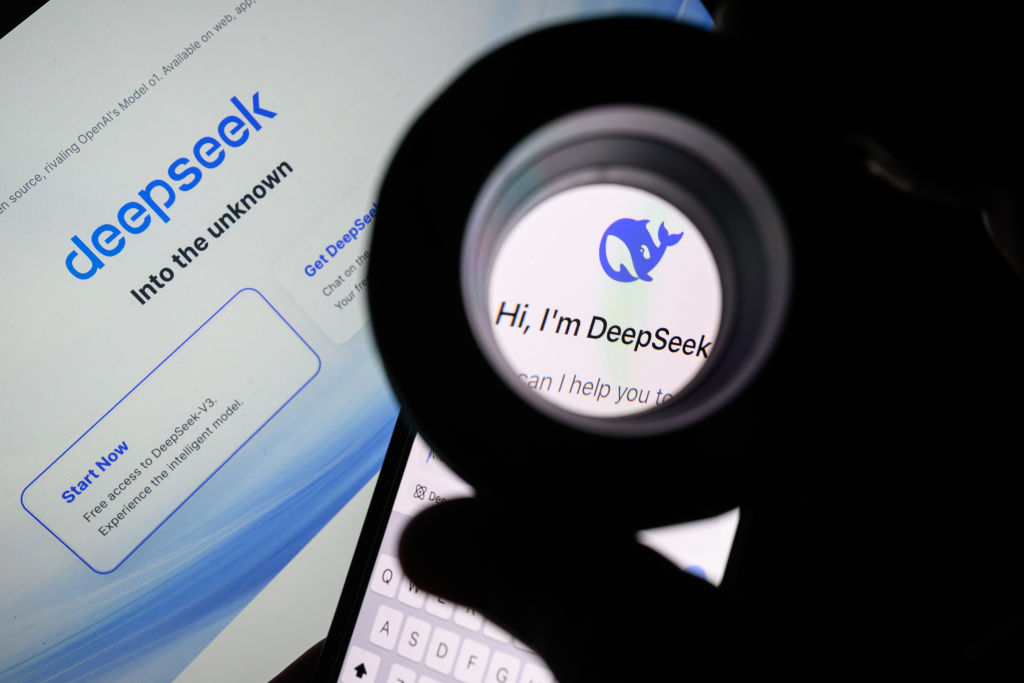 The Deepseek logo is seen through a magnifying loupe while displayed on a mobile phone screen in London on Jan. 29, 2025. (Leon Neal/Getty Images)
Distillation is a method that subjects an AI model to a large number of queries and uses the output as a shortcut to boost another AI model’s capabilities.
On Sept. 8, the FBI, the NSA, and the Cybersecurity and Infrastructure Security Agency (CISA) issued a joint advisory alleging that six Chinese AI companies had been conducting “aggressive, malicious, and targeted distillation activities at an industrial scale” against frontier U.S. models since at least late 2024.
U.S. officials said the Chinese companies used methods such as proxy accounts and shared subscriptions to circumvent restrictions and access outputs from systems developed by OpenAI, Anthropic, Google, and xAI. China’s Ministry of Commerce denied the allegations, stating that distillation is a standard industry technique.
In June, just weeks after Trump returned from a trip to China, the U.S. Department of Defense expanded a list of companies the U.S. government considers tied to China’s military, including some tech companies such as Alibaba, Baidu, and WuXi AppTec. The move indicated that officials increasingly view commercial innovations in artificial intelligence as dual-use technologies aiding the Chinese military, several experts previously told The Epoch Times.
Despite extensive dealings with Trump, Beijing remains in reactive mode, the Chinese Commerce Ministry source said.
“The biggest problem is that no one knows what he is thinking or what his next move will be. China can only react step-by-step to the U.S.’s moves.”
U.S. Commerce Secretary Scott Bessent recently identified America’s AI supremacy as a dire matter of national security.
“There is no day after tomorrow if China wins at this,” he said at a recent Breitbart event.
He noted that China is, for now, limited by its reliance on distilling American AI models.
“If you are looking over the shoulder of the United States of America, you can’t pass us for right now,” he said.
 Friends Read Free
Copy
Facebook
Tweet
Friends Read Free
Copy
Facebook
Tweet