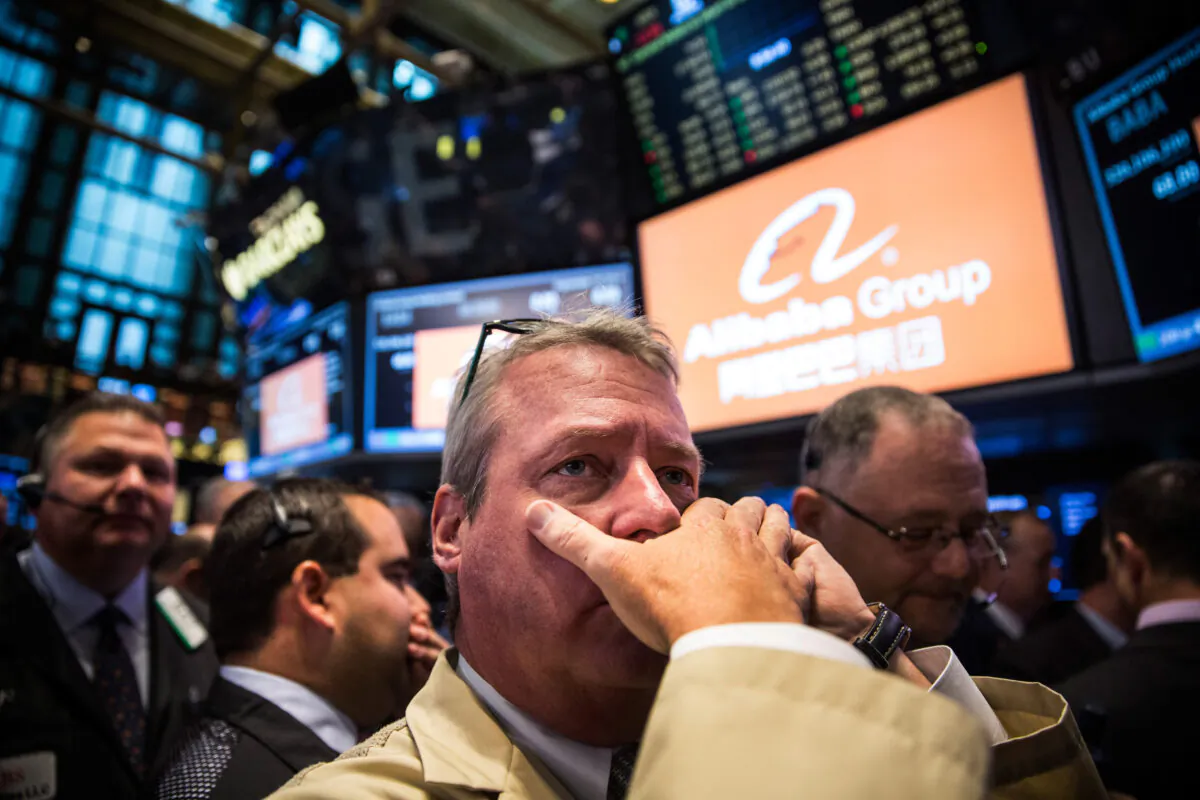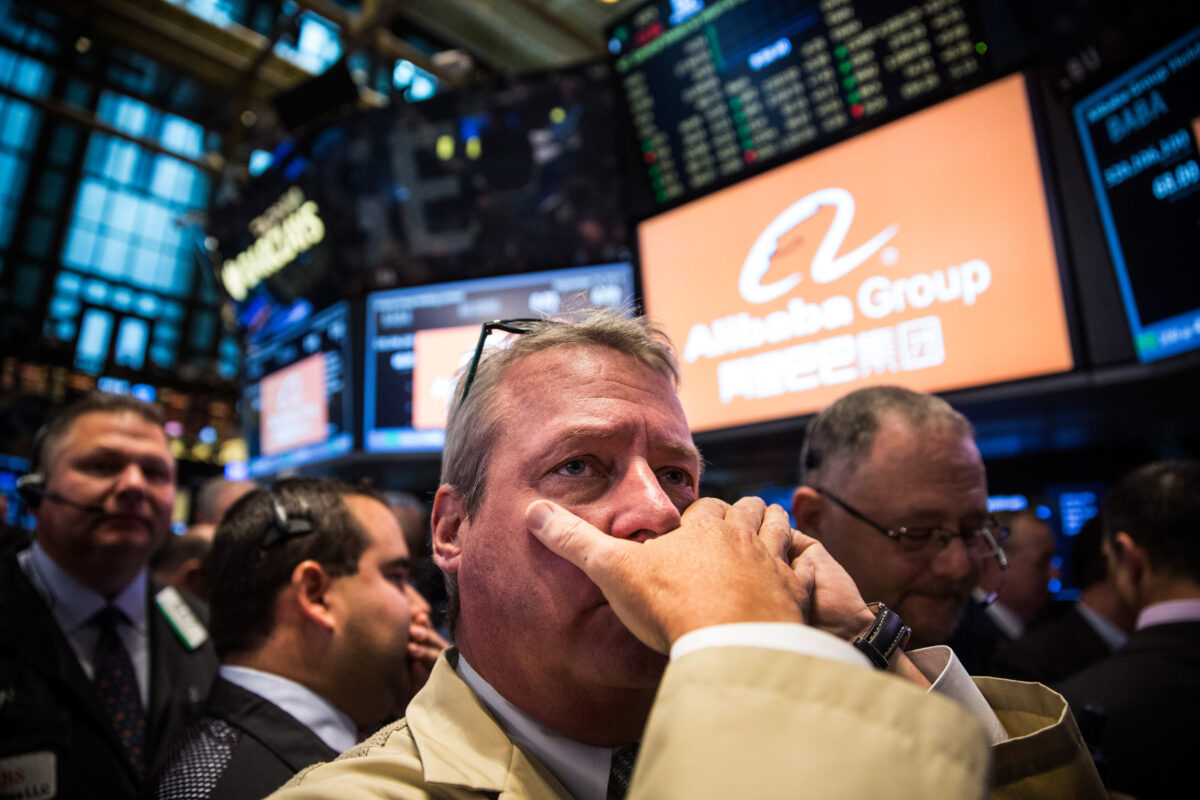

Alibaba Group’s net income plunged 75 percent in the June quarter, while operating income—profit from its core business operations—fell 57 percent as the Chinese technology giant continued heavy spending on artificial intelligence and computing infrastructure.
Net income fell to 10.4 billion yuan ($1.54 billion) for the three months ended June 30, from 42.4 billion yuan ($6.25 billion) a year earlier, according to Alibaba’s quarterly results.
Operating income dropped to 15.2 billion yuan ($2.24 billion), from about 35 billion yuan ($5.16 billion) a year earlier.
Alibaba’s adjusted operating profit, a company-defined measure known as adjusted EBITA, fell 30 percent to 27.3 billion yuan ($4.02 billion). Non-GAAP net income, which excludes certain costs and gains under Alibaba’s accounting definition, fell 38 percent to 20.7 billion yuan ($3.05 billion).
Adjusted earnings were 8.52 yuan ($1.26) per American depositary share, below the 10.53 yuan ($1.55) expected by analysts surveyed by financial-data provider LSEG.
Alibaba attributed the net-income decline to lower operating income, smaller gains from the sale of investments, and smaller gains from changes in the market value of its equity investments. Those market value changes can create accounting gains or losses even when the investments have not been sold.
The company said the sharper drop in operating income was driven by lower adjusted operating profit, a goodwill write-down, and a provision tied to a European Union fine.
Alibaba reported the results before the U.S. market opened. Its U.S.-listed shares opened at $122.29 on Aug. 20, about 5 percent below the previous session’s close of roughly $128.84, according to Nasdaq market data.
The June results followed another steep deterioration in profitability three months earlier. For the quarter ended March 31, Alibaba swung to an operating loss of 848 million yuan ($125 million), from an operating profit of 28.5 billion yuan ($4.20 billion) a year earlier—its first quarterly operating loss since 2021.
The pressure has coincided with Alibaba’s increased spending on AI. On the May earnings call, Chief Financial Officer Toby Xu said negative free cash flow was “primarily driven by our AI investments over the past year.” Chief Executive Eddie Wu said Alibaba Cloud was prioritizing user growth, AI use, and market share, adding that “margin is still secondary.”
AI Costs Weigh on Cash Flow
That spending increased sharply in the June quarter.
Alibaba spent 67.7 billion yuan ($9.98 billion) on long-term assets such as computing equipment and infrastructure, up 75 percent from a year earlier, according to its quarterly results.
Free cash flow—the cash generated after operating expenses and spending on long-term assets—deteriorated to an outflow of 44.7 billion yuan ($6.59 billion), more than twice the 18.8 billion yuan ($2.77 billion) outflow a year earlier. Alibaba attributed the deterioration mainly to increased spending on cloud infrastructure.
Wu on the Aug. 20 earnings call described Alibaba’s AI operations as an “asset-heavy business model,” saying computing capacity has to be built before the company can generate revenue from it. He said Alibaba entered a “heavy investment cycle in hardware” beginning in 2025.
Management also cited higher semiconductor component prices, increased purchases of processors, and fluctuations in hardware-delivery schedules as reasons for the quarter’s elevated spending.
Alibaba announced in February 2025 that it planned to invest at least 380 billion yuan—about $53 billion at the time—in AI and cloud infrastructure over three years. Wu said about 190 billion yuan ($28 billion) had been invested under the plan through June.
Alibaba’s AI Labs and Applications unit also posted an adjusted operating loss of 13.9 billion yuan ($2.05 billion), more than four times the 3.2 billion yuan ($472 million) loss a year earlier. The unit includes Alibaba’s AI model development and Qwen, its consumer AI chatbot and app.
Alibaba attributed the larger loss mainly to increased AI investment and higher costs of running Qwen.
China Consumer Weakness Adds Pressure
Revenue from Alibaba’s established China online shopping business fell 8 percent to 110.9 billion yuan ($16.3 billion).
By contrast, revenue from its faster delivery retail business—including Taobao Instant Commerce and grocery chain Freshippo—rose 45 percent to 53.3 billion yuan ($7.85 billion).
Alibaba also acknowledged pressure from China’s broader economy. On the Aug. 20 earnings call, management said the domestic e-commerce market was facing “short-term macroeconomic challenges.”
Weak household confidence has persisted as China’s property downturn and uncertainty over incomes weigh on spending. The World Bank said cautious consumers, falling property values, and weak domestic demand were restraining the economy, with households saving more amid uncertainty over future earnings, according to a recent Epoch Times report.
The weakness also has a longer-running structural dimension. Derek Scissors, an economist at the American Enterprise Institute, told The Epoch Times that Beijing has favored production over household consumption for more than two decades.
Fine and Other Costs
Alibaba said the June-quarter operating income decline was also affected by a goodwill impairment of about 4.5 billion yuan ($660 million) and a provision tied to a 550-million-euro ($640 million) fine imposed on AliExpress by the European Commission.
A goodwill impairment is an accounting write-down made when a company determines that an acquired business is worth less than the value recorded on its books.
The European Commission said AliExpress violated the European Union’s Digital Services Act by failing to adequately assess and reduce risks involving illegal, unsafe, or counterfeit products sold through the platform.
Alibaba’s product development expenses also rose to 22.5 billion yuan ($3.32 billion), from about 15 billion yuan ($2.21 billion) a year earlier.
The company has faced separate legal pressure in the United States.
In July, Alibaba and AUS Merchant Services, a U.S.-based subsidiary of Ant Group, agreed to pay a combined $600 million under non-prosecution agreements with the U.S. Justice Department.
Alibaba admitted that it failed to prevent merchants on its platforms from carrying out about 80,000 sales involving illegal imports into the United States between 2016 and 2024.
Alibaba agreed to pay a $125 million criminal monetary penalty and forfeit $200 million. AUS agreed to pay an $85 million penalty and forfeit $190 million.
 Friends Read Free
Copy
Facebook
Tweet
Friends Read Free
Copy
Facebook
Tweet