
Beijing is escalating its coercion to isolate Manila within Southeast Asia and assert dominance over the South China Sea, experts warn.
China’s Maritime Safety Administration said on Sept. 24 that live-fire drills would be held in parts of the South China Sea from 8 a.m. to 5 p.m. on Sept. 28 and Sept. 30, during which ships would be barred from entering the area.
Coordinates listed in the notice show the no-sail zone lies in waters south of the Wanshan Islands, which sit off the mouth of the Pearl River near Hong Kong and Macau.
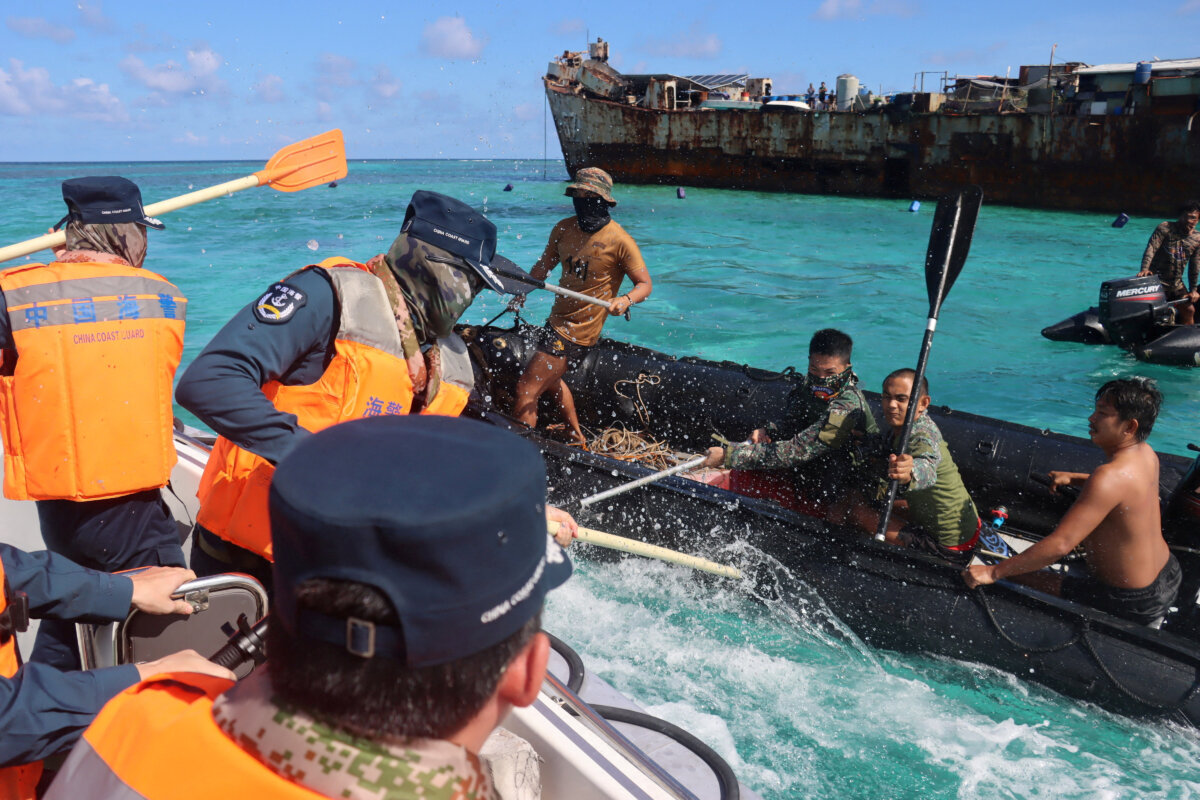
The warning was posted the same day the China Coast Guard (CCG) and the People’s Liberation Army (PLA) Navy hindered a resupply mission to Second Thomas Shoal, a Manila-held reef within its exclusive economic zone, according to a Sept. 25 press release by the Philippine National Task Force for the West Philippine Sea.
Three Chinese navy warships and five coast guard vessels closed in on the convoy as it sailed toward the shoal, the Philippine military said.
“The actions of the CCG and PLA Navy violate the International Regulations for Preventing Collisions at Sea (COLREGs) … They also run contrary to the 2016 Arbitral Award,” the press release reads.
The ruling by the Permanent Court of Arbitration in The Hague voided the Chinese regime’s broad territorial claims in the South China Sea.
Carl Thayer, emeritus professor of politics at the University of New South Wales, Canberra, said the Second Thomas Shoal incident and the announced live-fire drills are separate operations but part of the regime’s overall strategy to “assert its dominance over the South China Sea.”
“China’s employment of three PLA Navy ships marks an escalation in its past responses of relying on CCG vessels,” Thayer told The Epoch Times.
“China’s deliberate obstruction of a normal Philippine resupply mission signals that their 2024 mutual agreement has broken down.”
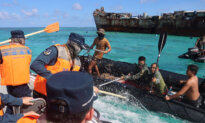
The encounter follows months of heightened tensions between Beijing and Manila in the South China Sea, including a July 20 clash near the shoal in which the Philippine military said Chinese coast guard personnel struck a sailor with a wooden baton.
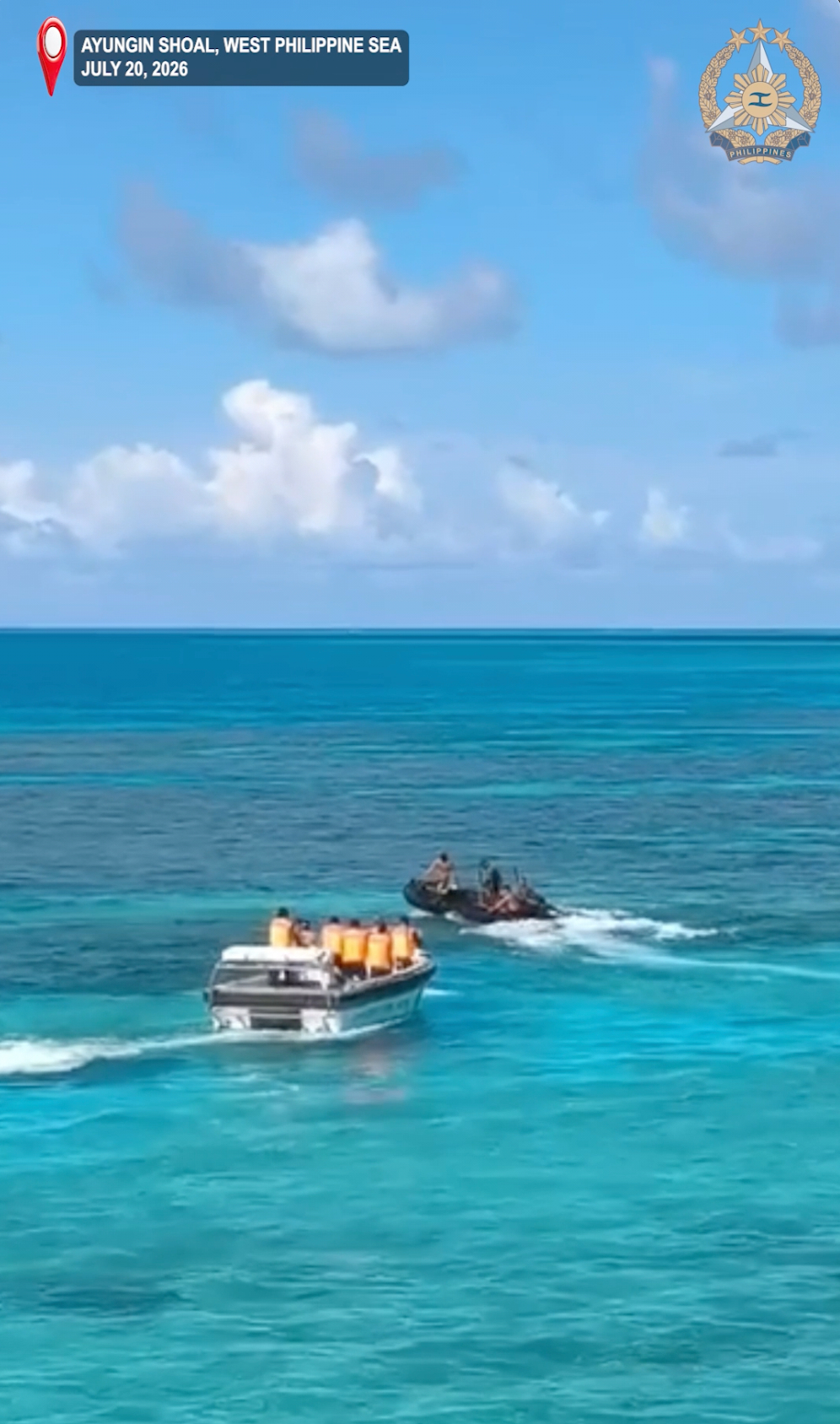 China Coast Guard personnel (L) on a rigid-hull inflatable boat, chase Philippine Navy personnel aboard a rubber boat at Second Thomas Shoal, locally known as Ayungin Shoal, in the disputed South China Sea on July 20, 2026. (Armed Forces of the Philippines via AP)
“We stand by our Philippine Allies and laud their professionalism and restraint,” he said.
Beijing’s Double Game
Thayer said the Chinese regime’s actions “appear contradictory, if not hypocritical,” given that the Philippines holds the 2026 chairmanship of the Association of Southeast Asian Nations (ASEAN).
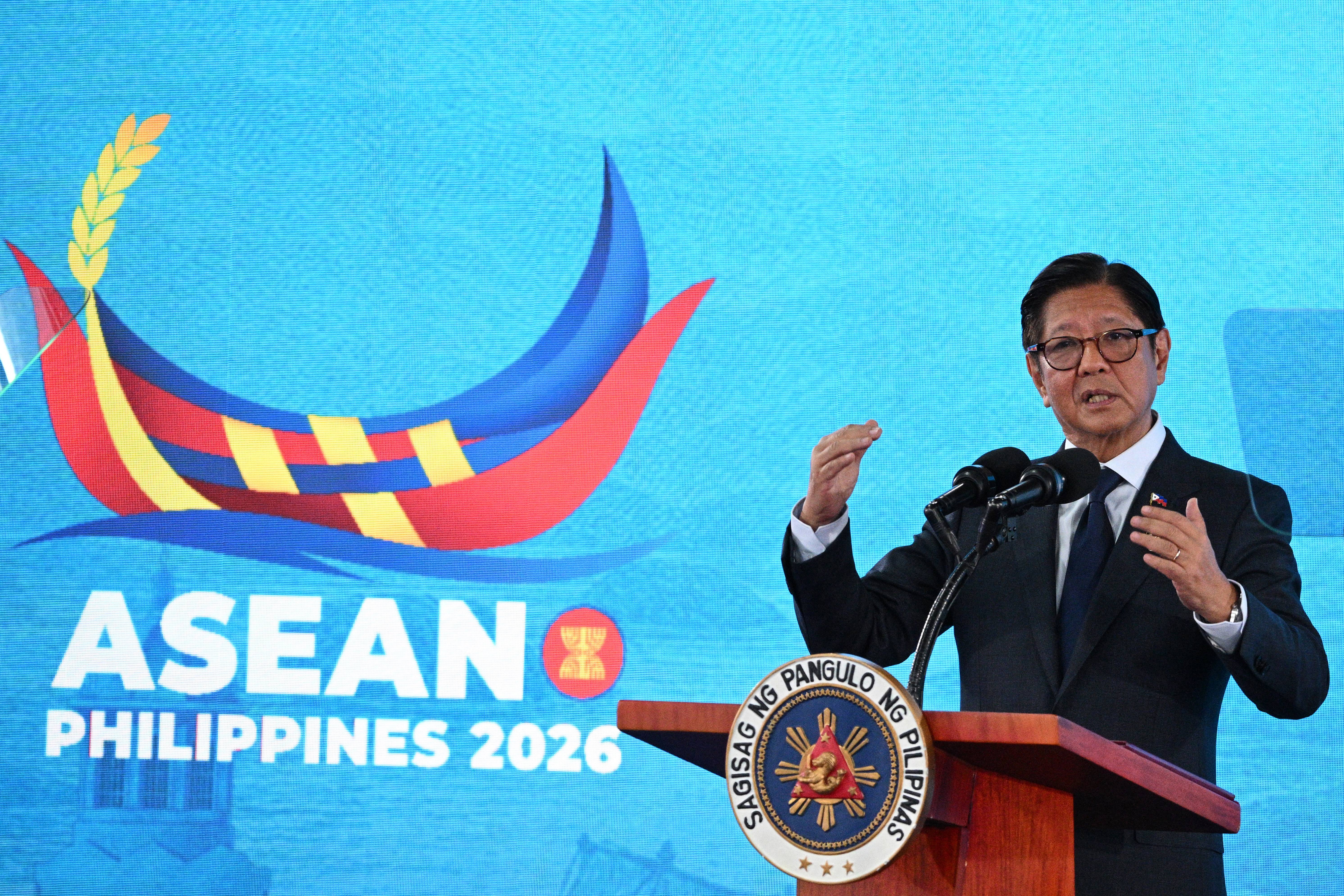 Philippine President Ferdinand Marcos Jnr. takes part in a press conference during the 48th Association of Southeast Asian Nations (ASEAN) summit in Cebu, central Philippines, on May 8, 2026. (Ted Aljibe/AFP via Getty Images)
“[These actions] simultaneously isolate the Philippines by playing on differences among ASEAN member states.”
The Code of Conduct is a set of rules for managing South China Sea disputes that ASEAN and China pledged in 2002 to work toward. However, the pact has not been finalized, as the Chinese Communist Party (CCP) has resisted making it binding or defining its scope.
Gray-Zone Calculus
Chester Cabalza, president and founder of the Manila-based think tank International Development and Security Cooperation, said the CCP’s latest move amounts to a gray-zone attack—an aggressive and coercive action designed to intimidate an opponent while staying below the threshold of warfare—on Manila’s vessels at sea.
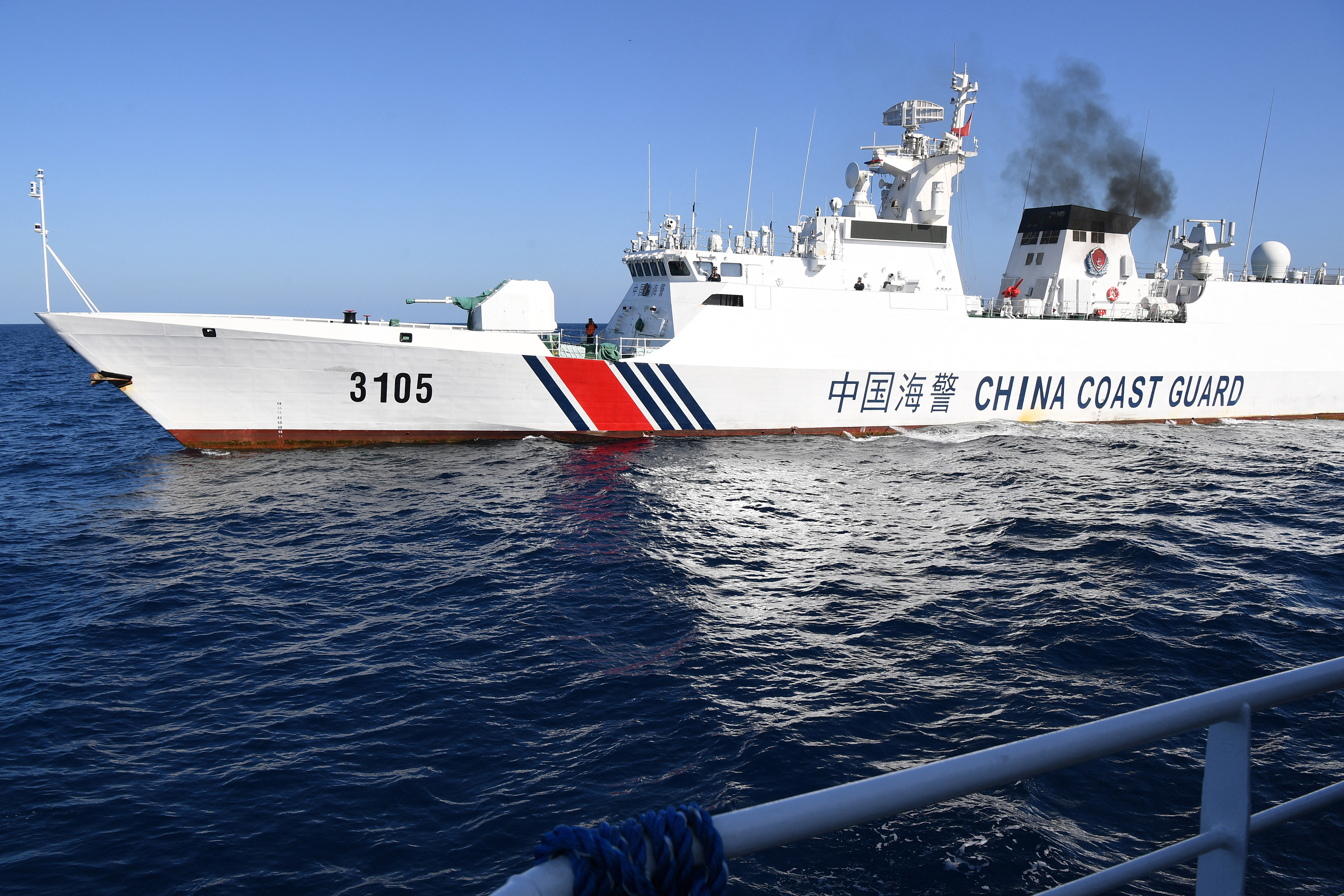 A Chinese coast guard ship shadows the Philippine Bureau of Fisheries and Aquatic Resources ship BRP Datu Tamblot near the China-controlled Scarborough Shoal, in disputed waters of the South China Sea, on Feb. 15, 2024. (Ted Aljibe/AFP via Getty Images)
Thayer said Beijing has concluded that it can pressure the Philippines with tactics short of war without risking a U.S. military response, as the 1951 U.S.-Philippines Mutual Defense Treaty has not been invoked in response to incidents at Second Thomas Shoal.
“China is likely emboldened to continue its calibrated acts of low-level coercion against the Philippines to instigate Filipino domestic opposition to the pro-American stand of [Philippine] President [Ferdinand] Marcos Jr.,” he said.
Thayer said Beijing is also expected to seize on U.S. President Donald Trump’s preoccupation with Iran and the drawdown of U.S. forces and missile-defense capabilities in Southeast Asia.
Challenging US Dominance
Cabalza said China’s live-fire drills send a message of hegemony, but it will be read differently by the Philippines and its allies and partners in the region.
“It calls more attention to the U.S. military balance to lessen maritime friction,” he said.
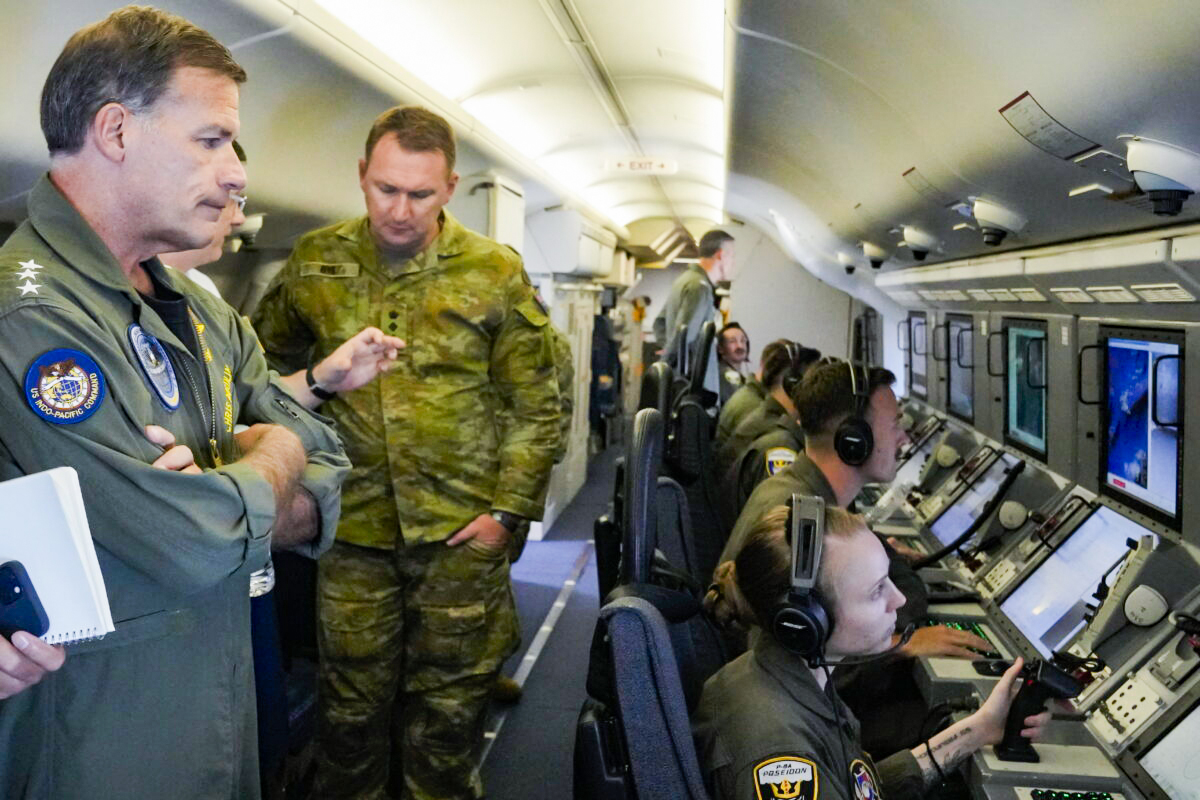 Admiral John C. Aquilino (L), commander of the U.S. Indo-Pacific Command, looks at videos of Chinese structures and buildings on board a U.S. P-8A Poseidon reconnaissance plane flying at the Spratly Islands in the South China Sea, on March 20, 2022. (Aaron Favila/AP Photo)
“China’s action will only reinforce the decisions by Japan, Australia, and the Philippines to step up defense spending and acquire the capabilities to counter China,” he said.
In August, Canberra and Manila held the 3rd Australia-Philippines Defense Ministers’ Meeting in Darwin, where both sides pledged closer security ties and welcomed enhanced maritime cooperation with Japan and the United States.
The ministers also voiced serious concern over dangerous conduct by Chinese vessels toward Philippine ships.
Other countries will not take sides but will “urge China and the United States to work out their differences through diplomacy,” Thayer said.
 Friends Read Free
Copy
Facebook
Tweet
Friends Read Free
Copy
Facebook
Tweet