


From a traditional Chinese medicine (TCM) perspective, the musculoskeletal system and the brain are not entirely separate but connected through an underlying energetic system. Thus, both can be cared for simultaneously.
I once treated a 95-year-old woman whose knee pain made walking difficult, and whose cognition had also been slowly declining. She had reached the point where she no longer recognized her family, had a vacant expression, and rarely spoke.
TCM recognizes five distinct energetic systems related to different organs. One type of kidney energy, known as kidney essence, nourishes the bones, tendons, and brain marrow.
From this perspective, weakness in the legs and lower back, and a decline in brain function, can be addressed by replenishing kidney essence and strengthening a warming energy in the kidneys, known as kidney yang.
I treated her with a potent and well-known herbal medicine—You Gui Wan—to replenish kidney essence and warm her kidney yang.
After treatment, her knees and legs became stronger. She also began recognizing people again and could remember what had just happened. She was more alert and even began telling some of her favorite corny jokes again.
While I am not suggesting that this formula can reverse dementia—she never fully returned to her previous level of functioning—the improvements she made were a great comfort to her family.
Because TCM views the body as interconnected systems, it can offer treatments that support underlying weakness, and Chinese medicine is always tailored to the individual patient.
At-Home Help for Knees
Knee pain is not always caused solely by cartilage wear. If you have knee pain, consider which of these areas most closely reflects your overall symptoms:
-
Uneven load distribution through the pelvis and legs, contributing to knee pain or an unsteady gait.
-
Chronic tension in the head and neck, which may be accompanied by mental fogginess or difficulty concentrating.
-
Fatigue, poor appetite, or weakness in the lower back and knees.
1. Rebalance Lower-Body Load
Knee pain may be related to pelvic or hip misalignment, or imbalances in the tension, length, or strength of muscles and soft tissues on each side of the body.
These issues can make the legs appear different in length and cause body weight to shift toward one side when walking.
TCM holds that when the bones are properly aligned and the tendons are supple, qi (vital energy) and blood can flow more smoothly. Stuck qi or blood causes pain and illness.
To determine whether you have a leg-length discrepancy, compare the position of your inner ankle bones while lying on your back, the position of your heels while lying face down, and whether the wear patterns on the soles of your shoes are similar. For a more robust assessment, see my previous article on uneven leg length.
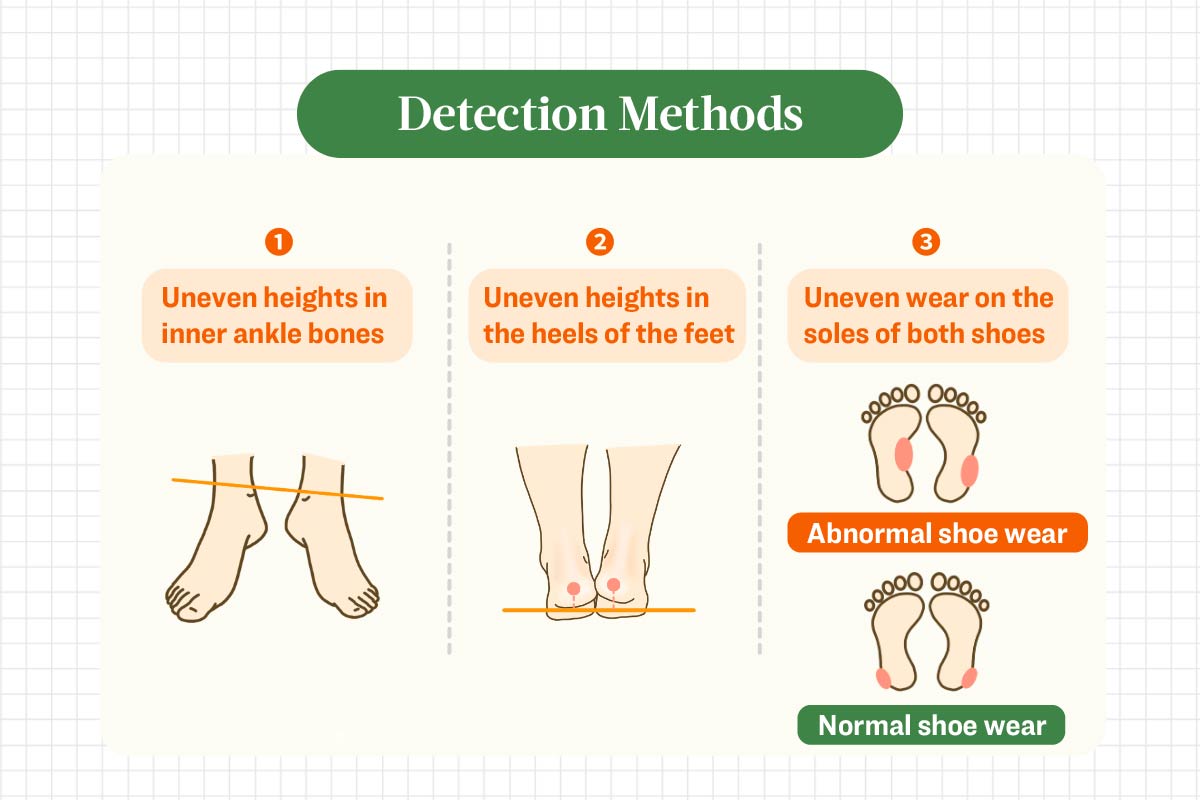
However, these observations cannot distinguish between a structural leg-length discrepancy, caused by an actual difference in bone length, and a functional leg-length discrepancy, caused by imbalances involving the pelvis, hips, muscles, or other soft tissues.
If the difference is pronounced or accompanied by knee pain, lower back pain, or an unsteady gait, seek further evaluation from a qualified professional rather than attempting to correct it yourself with shoe inserts or other means.
2. Relieve Head and Neck Tension
Chronic tension in the head and neck can contribute to knee pain. Two self-massage methods can help alleviate head and neck tension:
Finger-Combing the Scalp: Spread all 10 fingers naturally and use the pads of your fingers to comb backward from the front hairline, passing over the crown to the back of the head and continuing down the back of the neck. Repeat 36 times.
In TCM, finger-combing the scalp is done to stimulate important channels of energy in the head—the Governor vessel, Bladder meridian, and Gallbladder meridian—allowing blood and qi to flow to the head and face. It can also help relax tension in the head and neck and increase mental alertness.
Massaging Crown and Base of Skull: After finger-combing the scalp, you can massage the crown of your head and two points at the base of your skull 36 times each. The crown point, known as the Hundred Meetings (Bai Hui, GV20), is at the center top of the head in line with the tops of the ears.
The points at the base of the skull, known as the Wind Pool (Feng Chi, GB20), are in the hollows at the base of the skull near the hairline. Apply enough pressure to produce a mild aching sensation, but not sharp pain.
The Wind Pool acupoints are used to promote the flow of qi through the head and neck.
Massaging these two acupoints together helps alleviate frequent mental fogginess, difficulty concentrating, and tension in the head and neck.
3. Support the Spleen and Kidney Systems
In TCM, the spleen system relates to cognition. So strengthening the spleen as well as the kidneys is important.
A well-functioning spleen and stomach are responsible for transforming food into qi and blood, which nourish the body.
According to TCM, stimulating the Leg Three Miles acupoints is a simple way to help strengthen the spleen.
Gently Tap the Leg: The Leg Three Miles acupoints (Zu San Li, ST36) are at the top of the shins. To locate them, find the depression on the outside of the knees below the knee caps. Measure about four finger-widths below this depression, then move about one finger-width outward from the shinbone.
Gently tap the area with a cupped palm or massage it with your fingertips until it feels slightly warm.
Stimulate the Soles of the Feet: Before bed, rub your hands together until they feel warm, then repeatedly massage the Bubbling Spring (Yong Quan, KI1) acupoint on the sole of each foot with your palms.
The Bubbling Spring acupoint is located roughly one-third of the way down the sole from the toes. It helps to stimulate kidney energy.
In addition to rubbing the area directly, heel raises can engage the soles and stimulate this acupoint.
Heel Raises: Hold the back of a sturdy chair with both hands, slowly raise their heels, hold for up to two seconds, then lower them gradually. Repeat eight to 10 times.
This exercise strengthens the calves and improves ankle mobility, which helps maintain stability while standing and walking.
Stop immediately if you experience knee or ankle pain or feel unsteady while performing the exercise.
Massaging the Bubbling Spring acupoint before bed, combined with heel raises during the day, can help keep the ankles and calves active while supporting the kidney.
What About Glucosamine?
Many middle-aged and older adults take glucosamine to support knee health. However, new research has raised concerns about whether it could be adversely affecting the brain.
A study examining animal experiments and human health records found that, among people with mild cognitive impairment or Alzheimer’s disease, glucosamine supplementation may be associated with faster disease progression.
The findings offer a reason to review supplement use with a doctor, especially after a diagnosis of cognitive impairment. They do not mean everyone should stop taking it.
Keep the big picture in mind. How you walk, how steady and comfortable you feel, and whether your memory has changed all matter when choosing care for the knee.
Views expressed in this article are the opinions of the author and do not necessarily reflect the views of The Epoch Times. Epoch Health welcomes professional discussion and friendly debate. To submit an opinion piece, please follow these guidelines and submit through our form here.