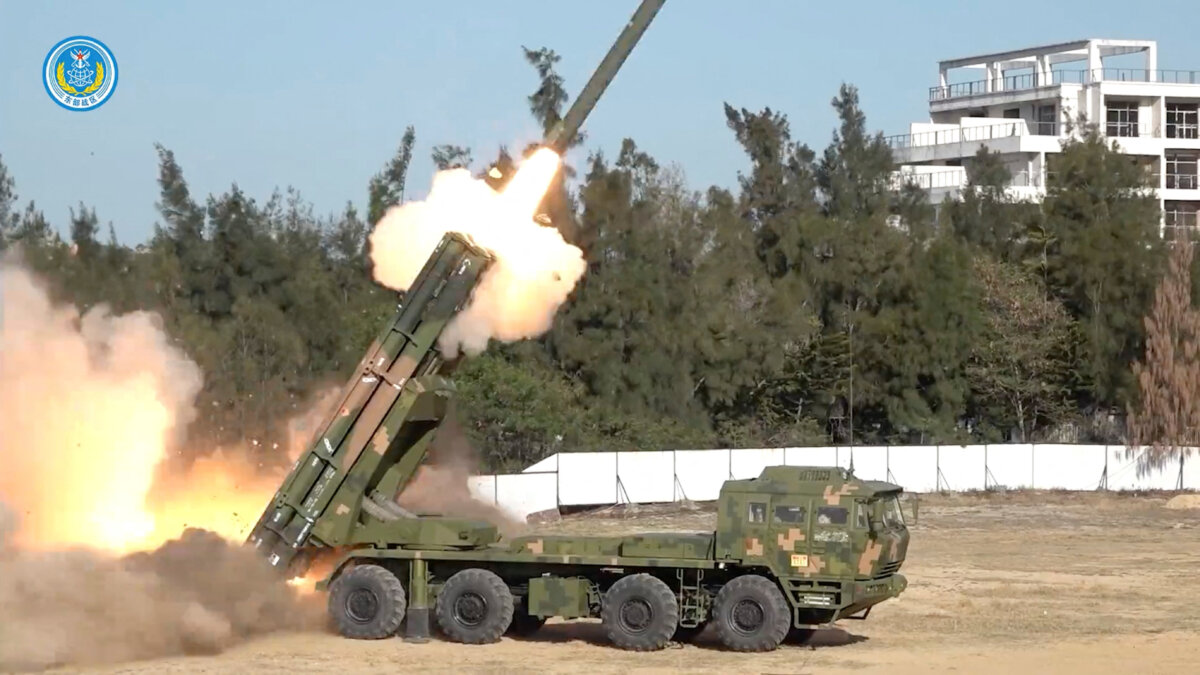
Beijing has begun another round of live-fire military exercises along the Chinese coast, which analysts say could be aimed at influencing Taiwan’s upcoming local elections.
The drills would take place Oct. 12–17 in at least five of China’s maritime areas, which cover most of the mainland’s coastline.
They were announced shortly after Taiwanese President Lai Ching-te’s National Day address on Oct. 10.
In his address, Lai said Taiwan values peace but will not abandon freedom. He warned that “peace cannot rely solely on wishes, and tolerance cannot become a pretext for aggressors to encroach ever further.”
Lai also invoked the Biblical concept of a “city upon a hill,” saying Taiwan will become “a key force in safeguarding peace and stability in the Indo-Pacific.”
Addressing the Chinese Communist Party (CCP) in Beijing, he said that “force cannot override rules” and that Taiwan is “open to exchanges but will not accept subordination.”
The CCP claims Taiwan as part of China and has threatened to seize the island through military action. Taiwan has rejected the regime’s claim and maintains de facto independence, with its own military, constitution, and democratically elected government.
Shen Ming-shih, a research fellow at Taiwan’s Institute for National Defense and Security Research, and U.S.-based Chinese author and political commentator Chen Pokong told The Epoch Times that the drills could be a show of force directed at influencing Taiwan’s upcoming Nov. 28 election.
They said the exercises were unlikely to have a substantial effect on the military situation across the strait.
“The CCP has conducted even more intense operations around Taiwan before,” Chen Pokong said. “It has done everything, including military exercises to encircle Taiwan, but ultimately returned empty-handed.”
Shen said that the CCP routinely uses its military activities to push its political message: that there is no Taiwanese independence under its “One China Principle.”
The drills allow Beijing to claim, both domestically and internationally, that it has responded firmly to Lai’s speech, Shen said.
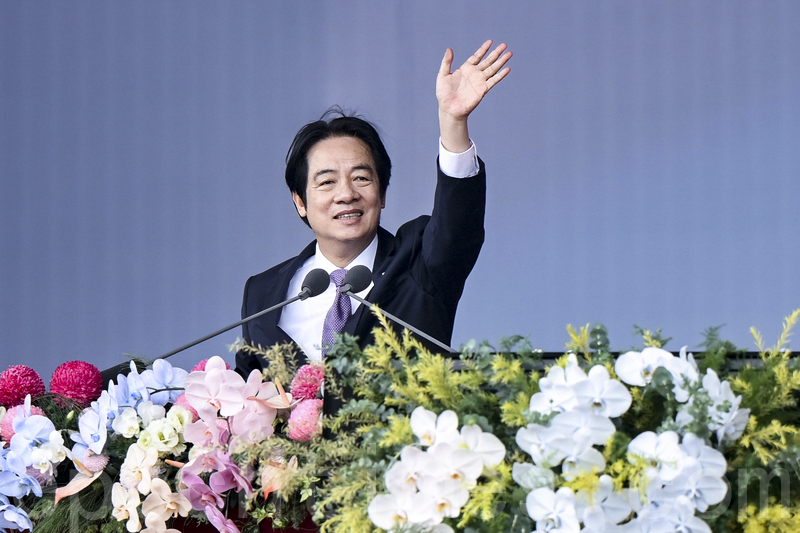 Taiwanese President Lai Ching-te delivers his address during National Day celebrations in front of the Presidential Office in Taipei on Oct. 10, 2026. (Sung Pi-lung/The Epoch Times)
Shen also said Beijing’s grey-zone tactics aimed at Taiwan could reinforce other countries’ perception of the CCP as a bully, and encourage greater international support for the self-governing island.
Beijing’s Military Exercises
The China Maritime Safety Administration announced the live-fire exercises, military training, and other activities on Oct. 10.
On Oct. 11, Chinese Defense Ministry spokesperson Chen Xi said that military exercises are routinely conducted around Taiwan to “safeguard the safety and well-being of the Taiwanese people” as a “justifiable” deterrence against advocates of Taiwan independence, referring to Lai.
Beijing’s Taiwan Affairs Office also criticized Lai’s National Day speech on Oct. 10, accusing him of disregarding facts, reversing right and wrong, and exaggerating the threat from China.
Taiwan’s Mainland Affairs Council responded that evening, accusing Beijing of maliciously attacking Lai’s speech and repeating its longstanding but contested “One China Principle.”
Taiwan’s Foreign Ministry on Oct. 11 urged Beijing to recognize the differences between the two sides’ democratic and authoritarian systems, as well as the fact that they are not subordinate to each other. It also urged Beijing to stop drills that could heighten cross-strait tensions, according to Taiwan’s national news agency CNA, citing the ministry’s press release.
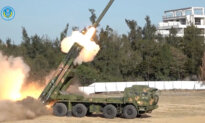
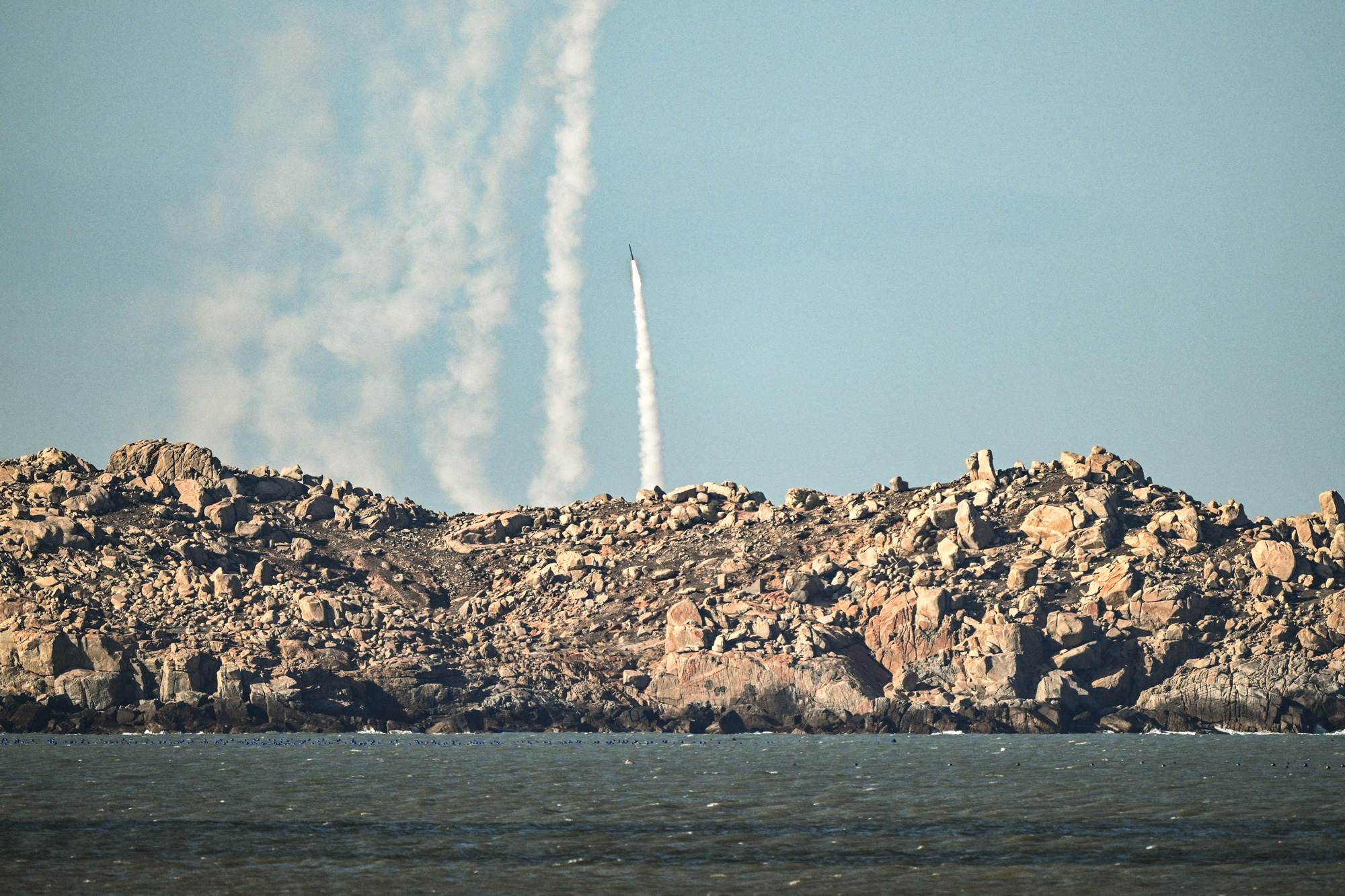 The Chinese military fires a rocket into the air as it conducts military drills on Pingtan Island, which sits across the Taiwan Strait from Taiwan, in Fujian Province, China, on Dec. 30, 2025. Taiwan faces military pressure from China, which claims that the island should fall under its governance, despite China never ruling the island. (Adek Berry/AFP via Getty Images)
Military Pressure Stops Short of Open Conflict
Chen Pokong said Beijing’s military activity in the strait has become routine, but that it remains distinct from actual war.
Beijing operates between claims of peace and open conflict, he said, using military demonstrations and psychological pressure to intimidate Taiwan.
“If it enters a state of war, the CCP will have to calculate whether it can win and which countries might intervene to help defend Taiwan,” he said, noting the CCP’s lack of allies.
Shen said that developments in China’s domestic politics following the Fifth Plenum and the course of U.S.–China relations will have a greater bearing on stability in the Taiwan Strait.
He pointed in particular to another potential meeting between U.S. President Donald Trump and Chinese leader Xi Jinping at the upcoming Asia-Pacific Economic Cooperation (APEC) meeting in Shenzhen in November.
Shen said that any major escalation in the Taiwan Strait would complicate the potential engagement. Chen Pokong similarly argued that Beijing has no incentive for military escalation right now ahead of the potential meeting with Trump.
Tang Bing and Luo Ya contributed to this report.
 Friends Read Free
Copy
Facebook
Tweet
Friends Read Free
Copy
Facebook
Tweet