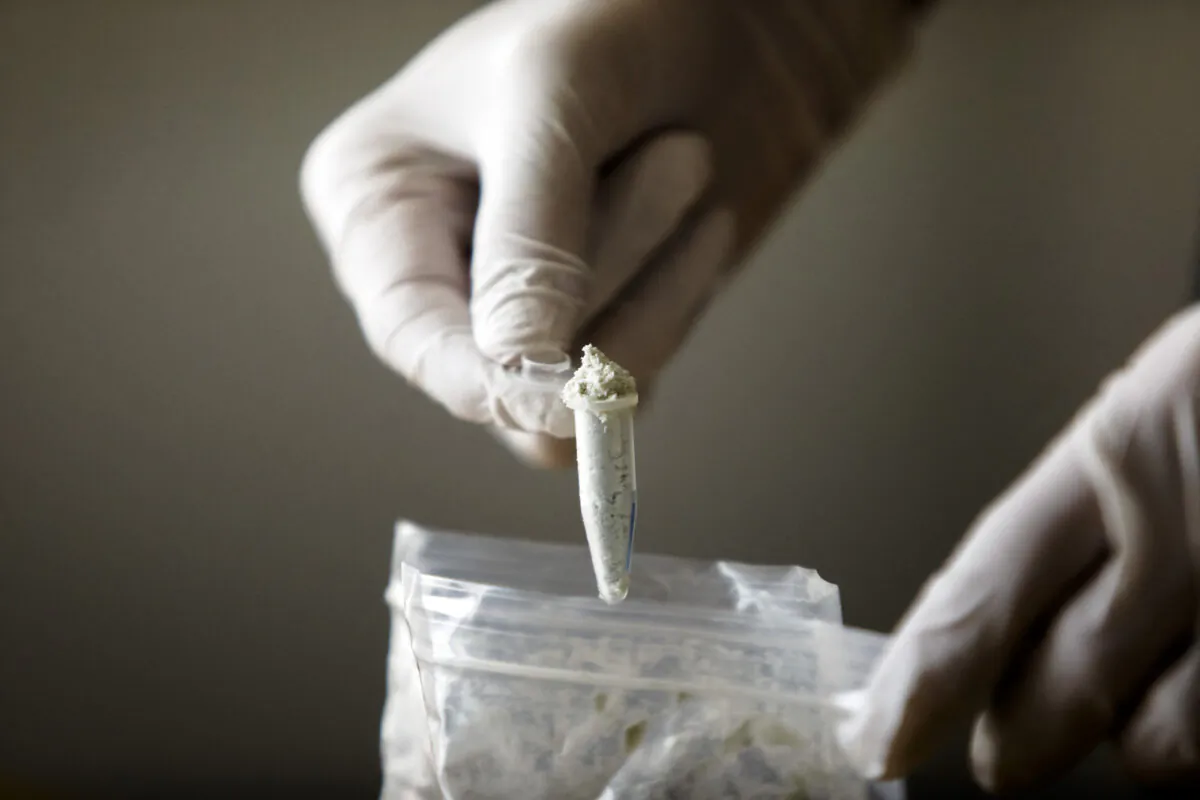

China has added more chemicals to its export control list for drug precursor substances ahead of a high-stakes meeting between President Donald Trump and Chinese leader Xi Jinping in Washington.
The Chinese commerce ministry announced on Sept. 22 that it added two new substances to the list of chemicals subject to export controls, requiring exporters to obtain licenses to ship to the United States, Mexico, and Canada.
The move comes ahead of Xi’s state visit to the United States. Xi is due to meet with Trump at the White House on Sept. 24, marking their second meeting this year.
The two leaders last met during Trump’s visit to Beijing in May, when they agreed to build a “constructive relationship of strategic stability on the basis of fairness and reciprocity,” according to the White House.
Following the meeting in Beijing, China expanded its drug precursor export control list by adding three more chemical substances. Its National Narcotics Control Commission also issued a notice warning of eight chemicals that could be used to make synthetic drugs.
The Trump administration has repeatedly urged Beijing to do more to stem the flow of precursor chemicals for synthesizing the deadly opioid fentanyl into the United States.
China is a major source of precursor chemicals used to produce illicit fentanyl. After returning to the White House for a second term last year, Trump imposed fentanyl-related tariffs on China, Mexico, and Canada over their alleged failure to stem the flow of illicit drugs into the United States. The tariffs were subsequently struck down by the U.S. Supreme Court in February.
Fentanyl deaths in the United States rose steeply around 2016. Then deaths skyrocketed from 2021 to 2023 along with a record surge of border crossings, and at its peak, the fentanyl crisis was linked to 76,226 deaths in 2022, more than quadruple the figure from 2016. The United States started seeing a reversal in 2024, coinciding with changed border policies, and fentanyl-linked deaths in 2024 were estimated to be 48,422.
The United States has also been engaging Chinese officials to counter the fentanyl crisis since the mid-2010s, resulting in the restriction of several chemicals over the years.
Notably, Beijing broke off all major engagement with the United States in 2022, citing then-House Speaker Nancy Pelosi’s (D-Calif.) visit to Taiwan, including ceasing cooperation on curbing fentanyl-related exports. It resumed engagement in November 2023 after the United States removed sanctions on the Chinese Ministry of Public Security’s Institute of Forensic Science for human rights abuses in Xinjiang.
In November 2025, Beijing imposed export restrictions on 13 fentanyl precursor chemicals to the United States, Mexico, and Canada after Trump met with Xi on the sidelines of the APEC summit in South Korea.
It remains unclear whether the upcoming meeting in Washington will address the flow of precursor chemicals into the United States, as neither Beijing nor Washington has specified which issues will be on the leaders’ agenda.
U.S. Secretary of State Marco Rubio told reporters after a meeting with Chinese Foreign Minister Wang Yi in Manila, Philippines, on July 22 that he expects Xi to have a positive visit.
Rubio acknowledged the major differences between Washington and Beijing and emphasized that it is their job to manage them to ensure “they never get out of control.”
“We’re, obviously, always going to defend our national interest,” he said at the time. “And I expect they’ll do the same, as they define it. But I think there are some areas of potential cooperation.”
Michael Zhuang, Catherine Yang, and Reuters contributed to this report.
 Friends Read Free
Copy
Facebook
Tweet
Friends Read Free
Copy
Facebook
Tweet