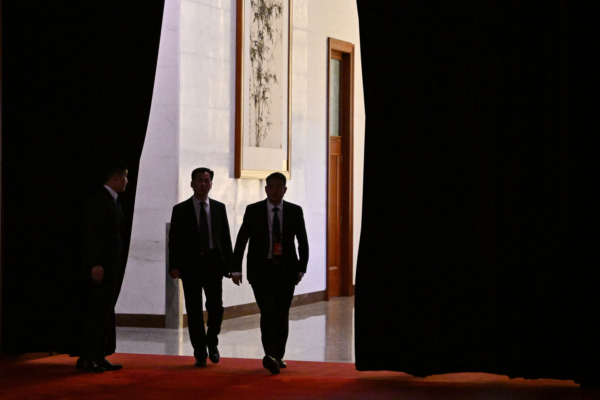
More than a decade after the Chinese Communist Party (CCP) launched its signature “Eight-Point Regulation” campaign to curb official misconduct, Beijing says it’s still uncovering tens of thousands of violations every month, with the overwhelming majority involving lower-level officials.
New figures released by China’s top anti-corruption watchdog on May 25 show that the CCP investigated 21,889 cases related to violations of the rules in April alone, while 27,852 people were subjected to disciplinary measures or other forms of punishment.
The data, published by the Central Commission for Discipline Inspection (CCDI) and the National Supervisory Commission, mark the 152nd consecutive month that the Chinese regime has publicly released such statistics.
While the CCDI framed the campaign as evidence of continued anti-corruption enforcement, critics and observers interviewed by The Epoch Times said the figures instead highlight the entrenched nature of corruption inside the CCP’s political system—and suggest that the campaign increasingly serves as a tool of political control rather than genuine reform.
Lower-level Officials Dominate Cases
According to the official report, 18,649 officials received formal Party or administrative disciplinary proceedings in April.
Lower-level officials accounted for the overwhelming majority of cases. The CCDI reported investigating 20,485 township-level and village-level cadres or lower-ranking personnel, representing 93.6 percent of all cases handled during the month.
By comparison, only one provincial- or ministerial-level official was investigated, along with 108 department-level officials and 1,295 county-level cadres.
Beijing is expanding its anti-corruption drive deeper into county governments and township administrations in 2026, after years of focusing more heavily on higher-ranking officials inside the Party hierarchy.
Among the violations cited were failures related to governance and policy implementation, including what the CCDI described as “inaction,” “reckless action,” “fake action,” and behavior that undermined “high-quality development.” Those cases accounted for 9,448 incidents, or more than 83 percent of all cases categorized under formalism and bureaucracy.
The CCDI also highlighted misconduct involving lavish lifestyles and misuse of public resources. Cases involving improper gift-giving, unauthorized banquets, and illegal distribution of benefits or subsidies made up the majority of violations tied to “hedonism” and extravagance.
‘Officials Are Performing for Superiors’
Several China-based analysts spoke to The Epoch Times about the report and the CCP’s ongoing campaign, on condition of anonymity or only revealing their surnames out of fear of reprisal.
Wu, a CCP history scholar, said many of the problems cited in the report reflect deeper dysfunction within the CCP’s bureaucracy.
“The terms ‘inaction,’ ‘reckless action,’ and ‘fake action’ are very revealing,” he told The Epoch Times. “Many grassroots officials don’t necessarily lack the ability to do their jobs. They simply don’t dare act, don’t want to act, or only perform for inspection teams from above.”
Wu described a culture in which local departments prepare staged displays whenever senior officials visit.
“Before leaders arrive for inspections, departments send messages telling staff to ‘perform well,’ avoid showing anything negative, dress properly, and make sure female staff look attractive,” he said. “It’s all theater. Leaders come, they eat and drink, and people arrange young women to sit with them. Nobody really cares about the Eight-Point Regulation. People are just getting through the day.”
Wu argued that many of the abuses blamed on lower-level officials are rooted in policies designed by higher authorities.
“Grassroots cadres certainly have problems,” he said. “But the people who truly control resources, projects, approvals, and personnel decisions are not only at the grassroots level. Many problems at the local level originate from policies imposed from above. The policies themselves were tools for financial corruption. But in the end, lower-level officials are held responsible.”
Wang, an online commentator from Hubei Province, China, told The Epoch Times that the monthly reports reveal that corruption remains widespread despite more than a decade of campaigns.
“Gift-giving, banquets, and formalism keep increasing no matter how hard authorities suppress them,” he said. “From [the CCP’s top] Politburo members down to township and village officials, corruption exists everywhere. Even top leaders are involved.”
Wang said that senior elites remain largely insulated from accountability, as the “law rarely truly reaches the powerful.”
“Institutional corruption is the biggest corruption,” he said.
Wang added that ordinary Chinese people increasingly view the anti-corruption campaign as political intimidation rather than genuine reform.
“Every month, so many people are investigated,” he said. “I believe the goal is more about political deterrence than fighting corruption. Anti-corruption is the slogan. Intimidation is the real purpose.”
A Threat to the Regime?
Fang, an insider from within the CCP, told The Epoch Times that many officials in the regime privately question the true purpose of the ongoing campaign.
“These problems are everywhere at the grassroots level. Some people get investigated, others don’t,” he said. “Many officials working in government offices are now asking the same question—What exactly does the leadership want?”
According to Fang, many inside the CCP no longer believe the campaign is fundamentally about eliminating corruption.
“If anti-corruption goes too far, it becomes anti-regime,” he said. “If everyone gets arrested, who will keep the regime running?”
China first introduced the Eight-Point Regulation in 2012 shortly after Chinese leader Xi Jinping came to power, presenting it as a signature effort to improve Party discipline and curb official excess.
Since then, the CCDI has published monthly reports detailing violations involving banquets, gift-giving, misuse of public funds, formalism, and bureaucratic misconduct.
The latest report did not disclose the identities or details of the provincial-level official investigated in April, nor did it release a full list of cases. The same categories of misconduct continue appearing in official reports month after month.
Sun Chen contributed to this report.
 Friends Read Free
Copy
Facebook
Tweet
Friends Read Free
Copy
Facebook
Tweet