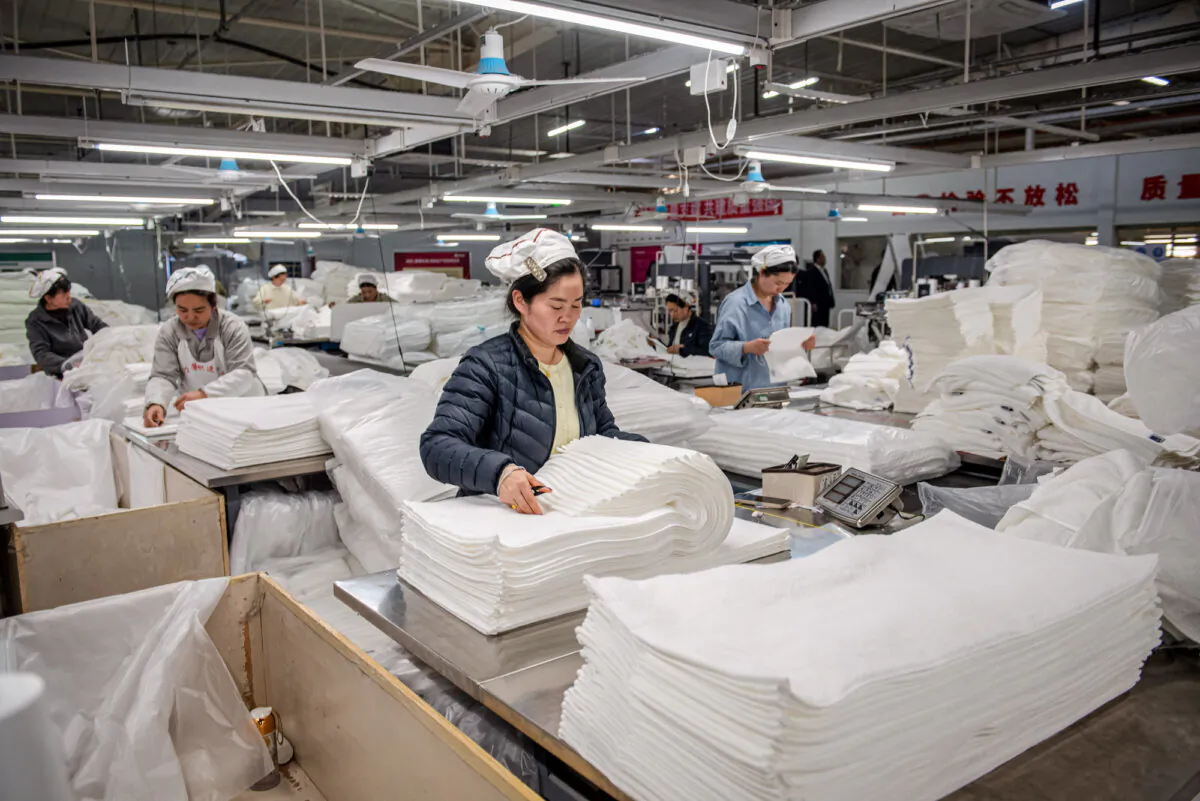

As China’s economy continues to deteriorate and U.S.–China trade tensions deepen, manufacturers are accelerating an exodus from China to Southeast Asia and Central Asia, reshaping supply chains that once anchored global production, according to multiple industry insiders.
Labor-intensive and mid- to low-tech manufacturing chains are moving to Southeast Asia, while some energy-intensive industries are extending into Central Asia. Some Chinese business owners have obtained foreign passports and now manage their Chinese factories remotely from abroad.
The sources did not provide their full names out of safety concerns.
Mr. Wang, a member of the Zhejiang Provincial Chamber of Commerce, told The Epoch Times that Zhejiang Province has seen a sharp acceleration in factory relocations in the past five years.
“I know that in the first 10 months of this year, at least more than 60 companies in the province moved their operations to Vietnam or Malaysia because they couldn’t get orders,” he said. “And there’s another group quietly building factories in Vietnam that the chamber doesn’t know about, so the real number may be over 100 or even higher.”
He added that some Zhejiang factory owners now live for long periods in Europe or Southeast Asia, managing their companies remotely while obtaining residency or citizenship in those countries.
Official data underscores the trend. In the first half of 2025, China reported 30,014 newly established foreign-invested enterprises, an 11.7 percent increase year-on-year, but actual utilized foreign investment fell by 15.2 percent over the same period. In other words, the amount of money invested by foreign investors fell despite the growth in the sheer number of new firms.
For some exporters, relocating is not new. It is simply accelerating.
“Some companies in our industry began setting up production units in Hanoi and Haiphong in Vietnam as early as 2018 to take on orders from Europe and the United States,” Mr. Zhao, a machine-parts manufacturer in Zhejiang Province, told The Epoch Times.
After the COVID-19 pandemic, foreign clients demanded geographic diversification, according to Zhao. He said his own company negotiated overseas assembly operations in 2023, and the new site is already operational.
Trade Tensions, Shrinking Orders
The relocation trend is not limited to Zhejiang Province. Jiangsu and Guangdong, two of China’s main export hubs, are facing the same pressures as foreign orders decline.
Mr. Fang, whose family belonged to the powerful Rong Yiren business clan, told The Epoch Times, “Zhejiang companies are relocating overseas mainly because their clients are requiring production sites in different countries, [and] compared to China, land and labor costs in those places are relatively more manageable.”
Foreign buyers across industries are reducing purchases from China. “This round of the trade war has affected the entire supply chain,” he said. “In some sectors, the withdrawal of foreign companies is very obvious, and many upstream and downstream firms have gone bankrupt, cutting off the supply chain.”
Several Japanese and Korean companies near Ningbo have cut procurement from China and now require suppliers to set up locations in Vietnam or Thailand, according to Fang.
In Suzhou and Kunshan, two major manufacturing hubs in the Yangtze River Delta region, foreign investors are evaluating which production lines to move abroad.
Mr. Gu, who runs an electromechanical original equipment manufacturer factory in Kunshan, told The Epoch Times that European orders have fallen since 2022. Customers demanded multi-country redundancy, so his company built a branch in Thailand. “The equipment and design are still provided by the headquarters [in China], while the factory in Thailand handles the intermediate production steps,” he said.
Gu explained that many long-term foreign buyers who used to rely on China are now shifting to Vietnam, Malaysia, and India. This leads to Chinese manufacturers relocating there in order to secure orders.
Vietnam Emerges as the Biggest Winner
Vietnam has become the primary destination for Chinese textile, electronics assembly, home goods, and footwear production, with most new factories clustered in northern industrial zones.
Mr. Huang, a Taiwanese businessman in Vietnam, told The Epoch Times: “After they start production locally, hiring assembly workers goes quickly, but the calibration of key equipment is still done by Chinese technicians. These Chinese factories are setting up in Vietnam to shorten export times to the European and American markets, and also to spread out risk amid uncertainty.”
According to data from the Taipei Economic and Cultural Office in Vietnam, Vietnam imported $101.4 billion worth of goods from China in the first seven months of 2025, which constitutes more than 40 percent of its total imports, making China its largest supplier.
After Vietnam, Cambodia has become a hub for Chinese garment manufacturers. Former Chinese business journalist Mr. Chen told The Epoch Times, “Chinese investments are mostly structured as joint operations in which Chinese investors hold shares, and the raw materials are sourced from Zhejiang and Guangdong [in China].”
He noted that Indonesia attracts resource- and energy-heavy industries such as nickel smelting because Chinese manufacturers can more easily export from Indonesia to Europe and the United States.
According to a report by Washington-based nonprofit C4ADS, Chinese companies control about 75 percent of Indonesia’s nickel-smelting capacity, and some of those companies are backed by the Chinese state.
Central Asia’s Role in Energy, Materials
While light manufacturing has flowed into Vietnam and Cambodia, heavier industries are expanding westward into Central Asia. Those Chinese manufacturers are choosing Kazakhstan and Uzbekistan.
“Kazakhstan and Uzbekistan are attracting chemical, building-materials, and metal-processing companies,” Chen said. “Chinese firms produce basic materials there and then ship them by rail to western China.”
Kazakhstan is now China’s largest investment destination in Central Asia, receiving an estimated $23 billion in the first half of 2025, according to data cited by Chinese state-backed media.
China’s Manufacturing Shift
Chinese scholar Mr. Su told The Epoch Times that he recently noticed in China that many store-bought goods are no longer made in China.
“Products under the same brand may now come from Vietnam, Indonesia, or Mexico,” he said.
Su argued that China’s manufacturing changes reflect deeper supply-chain restructuring. Companies are recalibrating around labor availability, raw materials, energy costs, and market access.
“I don’t think China’s economy is going back to the way it was,” he said. “For at least the next 20 years, if you want to blame someone, blame the policymakers.”
Su said he believes that the most important change is not just where products are made, but how China’s position in the global supply chain is being reshaped. He said he anticipates that multi-country production layouts will redefine factory structures, labor patterns, and market dynamics over the next two decades.
Xin Ling contributed to this report.
 Friends Read Free
Copy
Facebook
Tweet
Friends Read Free
Copy
Facebook
Tweet