Chinese leader Xi Jinping made a rare public visit outside Beijing, traveling to the Xiong’an New Area in Hebei Province on March 23 with three of the Chinese Communist Party’s (CCP’s) top officials, where he defended the controversial high-tech city development project as “entirely correct” amid growing skepticism over its progress.
According to Chinese state media Xinhua News Agency, Xi was accompanied by Premier Li Qiang, Xi’s chief of staff Cai Qi, and Vice Premier Ding Xuexiang during inspections of state-owned energy giant China Huaneng Group and a campus of Beijing No. 4 High School in Xiong’an.
At a symposium later that day, Xi reiterated that the regime’s decision to establish Xiong’an as a high-tech hub for relocating what the authorities call “non-government functions” from Beijing was “entirely correct,” adding that related work had been “solid and effective.”
The remarks come as analysts and residents increasingly question the pace and viability of the massive development, first announced in 2017 as a flagship initiative intended to ease overcrowding in Beijing and drive regional growth.
Political Signaling
Some analysts interpret Xi’s public defense of the project as a sign of internal pressure.
U.S.-based China current affairs commentator Tang Jingyuan told The Epoch Times that Xiong’an is closely tied to Xi’s political legacy, making criticism of the project politically sensitive.
“Any questioning of Xiong’an can be seen as a challenge to Xi himself,” Tang said. “His strong defense suggests he is facing doubts, including within the Party.”
Xi has visited Xiong’an multiple times over the past decade, but his 2023 trip, accompanied by the same three senior officials, was widely viewed as a display of consolidated authority following the CCP’s 20th National Congress, according to Tang, who said that the latest visit reflects a similar earlier show of unity amid the CCP’s recent purges.
Despite official claims of steady progress, relocation efforts to Xiong’an have moved slowly.
The area was designated nearly nine years ago as a central hub to take on nongovernmental functions from Beijing, requiring government agencies, state-owned enterprises, universities, and residents to relocate. So far, however, only a limited number of major institutions have made the move.
Beijing’s official mouthpiece People’s Daily reported on Dec. 30, 2025, that eight major state-owned enterprises have relocated to Xiong’an, while the permanent population stands at around 1.4 million—well below earlier projections of up to 5 million residents.
During a previous visit in 2023, Xi warned against “relocations on paper only,” signaling concerns that some entities were resisting or circumventing relocation orders.
A local, speaking to The Epoch Times on March 24 under the condition of anonymity due to fear of reprisal, pointed out that Xi’s recent visit seemed intended to reassure displaced workers, highlighting issues such as incomplete infrastructure and limited amenities.
“Living facilities are still not well developed,” the local said. “There’s really not much here.”
Public Skepticism
While Chinese state media continue to promote Xiong’an as a “millennium plan,” signs of limited activity have fueled public skepticism.
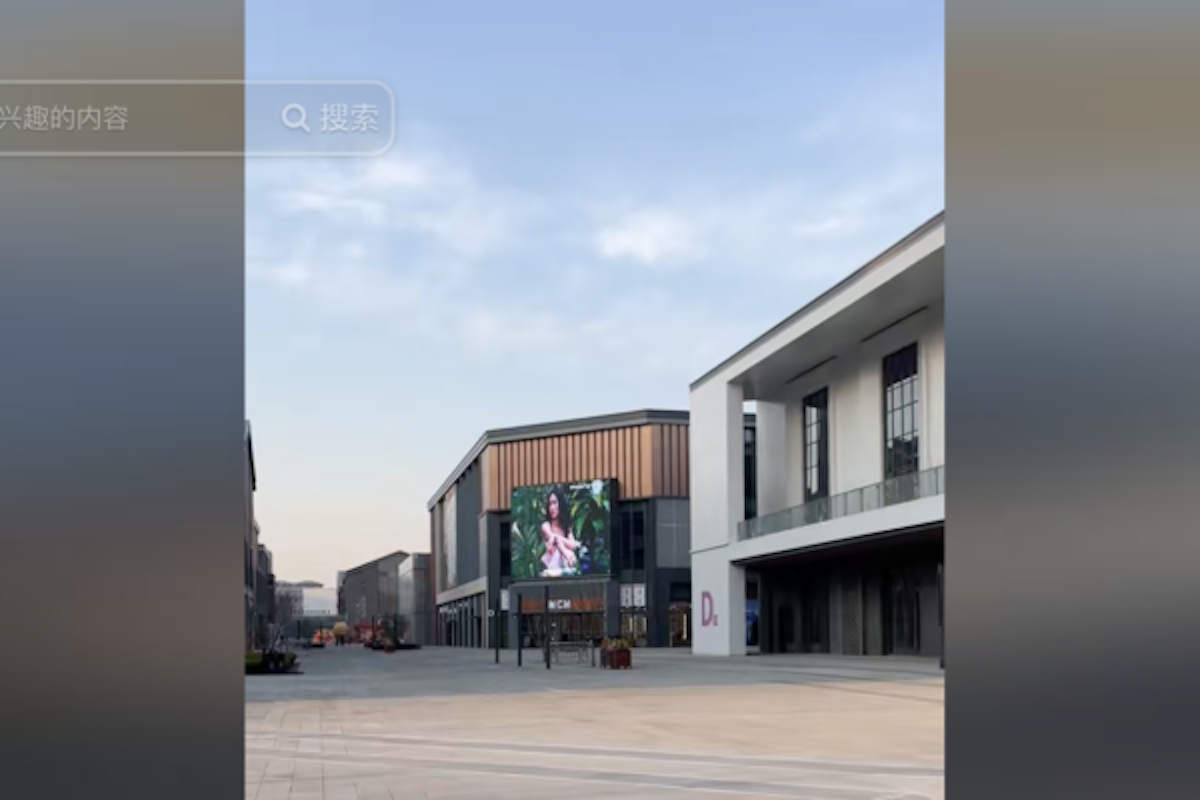
Videos circulating on Chinese social media platforms show largely empty streets and sparsely populated residential complexes, despite an investment of approximately 800 billion yuan (about $110 billion), according to Beijing Daily via the Chinese news portal Sina. Some Chinese online bloggers have acknowledged that criticisms about the project are widespread online, even if such views are not prominently featured on state-controlled platforms.
Progress on major projects has also lagged. Four Beijing-based universities selected for early relocation have begun construction on new campuses in Xiong’an, but only a small portion of the planned facilities has been completed.
Reluctance among staff to relocate remains a challenge. One university administrator in Beijing, speaking on condition of anonymity, told The Epoch Times that many employees are unwilling to move, citing concerns about quality of life and access to services.
“The city looks modern, and transportation seems convenient,” the administrator said. “But it lacks a sense of daily life. For serious medical care, you still have to go back to Beijing.”
He added that some institutions have pressured staff to relocate, warning of possible termination of employment for those who refuse, while offering temporary rotation arrangements as a compromise.
“If it were truly an attractive place to live, would people need to be forced to go?” the administrator said.
U.S.-based Chinese political commentator Cai Shenkun said on X that Xiong’an is Xi’s “most cherished millennium plan,” and that the CCP leader’s renewed focus on the project indicates he senses the high-tech hub may be “heading toward failure.”
Ning Haizhong and Luo Ya contributed to this report.
 Friends Read Free
Copy
Facebook
Tweet
Friends Read Free
Copy
Facebook
Tweet