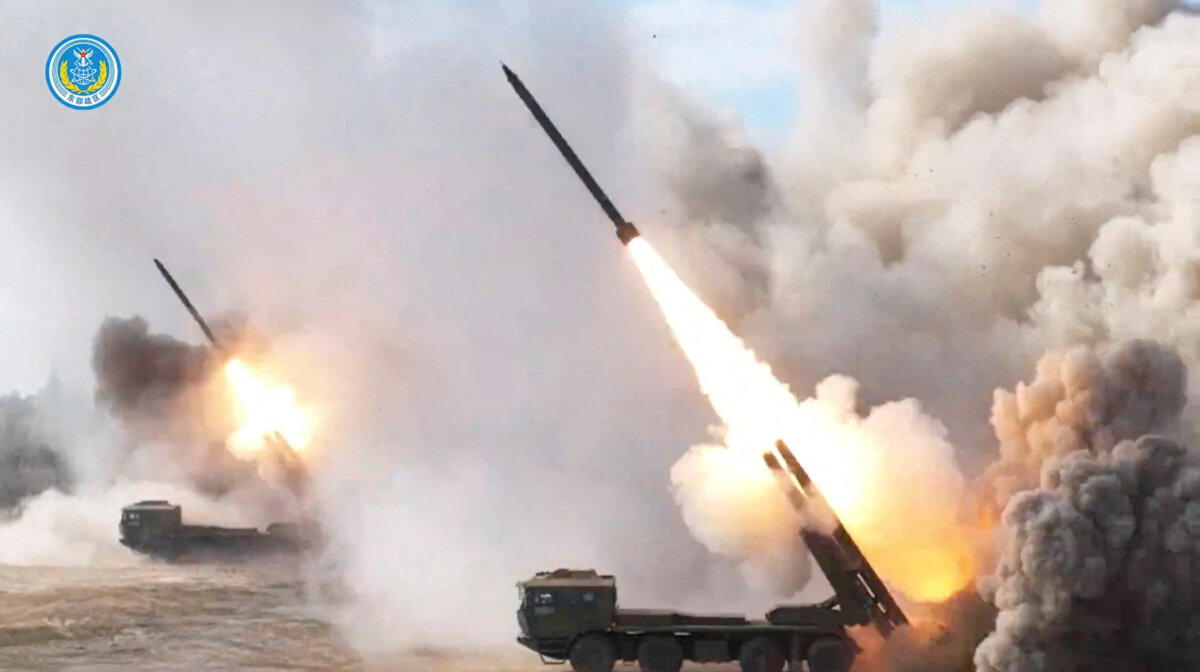

The U.S. State Department has called on the Chinese regime to stop military pressure on Taiwan, after Beijing fired missiles and sent a large number of warplanes and naval vessels near the island in its live-fire military drills earlier this week.
“China’s military activities and rhetoric toward Taiwan and others in the region increase tensions unnecessarily,“ Tommy Pigott, spokesperson for the State Department, said in a statement on Jan. 1.
He urged Beijing to exercise restraint and “engage in meaningful dialogue” instead.
“The United States supports peace and stability across the Taiwan Strait and opposes unilateral changes to the status quo, including by force or coercion,” Pigott added.
The comments came a day after China’s military wrapped a two-day exercise encircling Taiwan.
The Chinese Communist Party (CCP) views self-ruled Taiwan as a breakaway province, despite never having governed the archipelago of 23 million people, and refuses to rule out the use of force to achieve that goal.
The latest round of drills brought China’s forces closer to Taiwan’s main island than ever before.
Starting on Dec. 29, 20205, the People’s Liberation Army (PLA) deployed its navy, air force, rocket force, and coast guard to simulate a blockade of Taiwan. On Dec. 30, 2025, China launched 27 rockets toward the Taiwan Strait, according to the defense ministry in Taipei. Ten of them fell into the sea within 24 nautical miles of Taiwan’s coast—a sensitive zone that Taiwan has closely monitored.
Taiwan’s military detected 207 sorties by Chinese military aircraft operating around the island over 48 hours leading up to early Dec. 31, 2025.
The PLA’s activities forced dozens of commercial flights within Taiwan to be canceled, and some international flights scrapped planned stopovers in Taiwan, though no international flights were fully canceled, Taiwan’s aviation authorities said on Dec. 30, 2025, according to the official Central News Agency.
The war games came a week after the Chinese leadership promoted a commander overseeing military operations in the Taiwan Strait to a full general rank, and two weeks after the United States greenlit a record $11 billion arms sales package for Taiwan.
The escalating tensions in the Taiwan Strait—a key global shipping route—have sparked international concerns. Countries including the United Kingdom, Australia, and the European Union have condemned Beijing’s military maneuvers.
Anxiety about a full-scale Chinese invasion has escalated in recent years as the CCP ramped up military pressure on Taiwan. That includes flying warplanes near Taiwan on a nearly daily basis and carrying out large-scale military drills in the Taiwan Strait, designed to demonstrate the regime’s might and wear down the island’s defense.
Shortly after its armed forces wrapped up the maneuvers, CCP leader Xi Jinping used his New Year address broadcast across the nation on Dec. 31, 2025, to reiterate the intention to seize the self-governing democracy, saying that “reunification” is “unstoppable.”
On Jan. 1, the defense ministry in Taipei reported the detection of three Chinese military aircraft, 17 Chinese navy vessels, and eight Chinese official ships in the waters surrounding Taiwan.
The Chinese leadership still expected to be “able to fight and win a war on Taiwan by the end of 2027,” according to the Pentagon’s latest assessment.
While Chinese leaders view their military capabilities as improving, they “remain unsure of the PLA’s readiness to successfully seize Taiwan while countering U.S. involvement,” the congressionally mandated report states.
Frank Fang contributed to this report.
 Friends Read Free
Copy
Facebook
Tweet
Friends Read Free
Copy
Facebook
Tweet