
Chinese human rights lawyer Qin Weijin was released from prison on Sept. 12 after being imprisoned for 30 months, during which he was diagnosed with lung cancer and underwent two rounds of chemotherapy, according to fellow lawyer Qin Yongwei and the China Human Rights Service Center.
Now seriously ill and unable to return to legal practice, Qin has filed an administrative reconsideration application with China’s Ministry of Justice challenging the revocation of his lawyer’s license.
He is also asking authorities to review the legal provisions used to revoke his license, according to documents cited by the China Human Rights Service Center.
Qin, a lawyer in southern China’s Guangxi Province, has for years supported colleagues who faced official pressure.
Several rights groups and online platforms, including the Information Center of the Rights Defense Network, which monitors human rights inside China, say his prosecution was politically motivated and that the original allegations against him lacked evidence. Chinese authorities, however, convicted him in May 2025 of “picking quarrels and provoking trouble,” a broadly worded criminal offense under Chinese law.
Cancer Diagnosis in Prison
Qin’s health has deteriorated severely since his imprisonment.
The China Human Rights Service Center said Qin was diagnosed with lung cancer on Aug. 8, while he was still incarcerated.
Qin Yongpei, a fellow Guangxi rights lawyer who recently visited him, told the Chinese-language edition of The Epoch Times that Qin Weijin now weighs only about 40 kilograms (88 pounds), has almost no appetite, and is too weak to walk normally. He is largely dependent on his wife’s meager pension and has little money for medical treatment, according to Qin Yongpei.
Qin Weijin was diagnosed with lung cancer while at Yizhou Prison in Guangxi, according to the China Human Rights Service Center. He received two rounds of chemotherapy at the prison hospital but later refused further treatment because he was concerned about the medical conditions and feared he could die in prison.
“He has become a shadow of his former self. He has little strength and now spends most of his time in bed at home,” Qin Yongpei said.
Targeted for Supporting Human Rights Lawyers
Qin Weijin, born in 1962, previously worked in China’s judicial system, serving as a judge and court division head before becoming a lawyer. He later headed Guangxi Qiantong Law Firm in Liuzhou.
His involvement in China’s rights-defense movement became more prominent following the nationwide clampdown on human rights lawyers that began in July 2015.
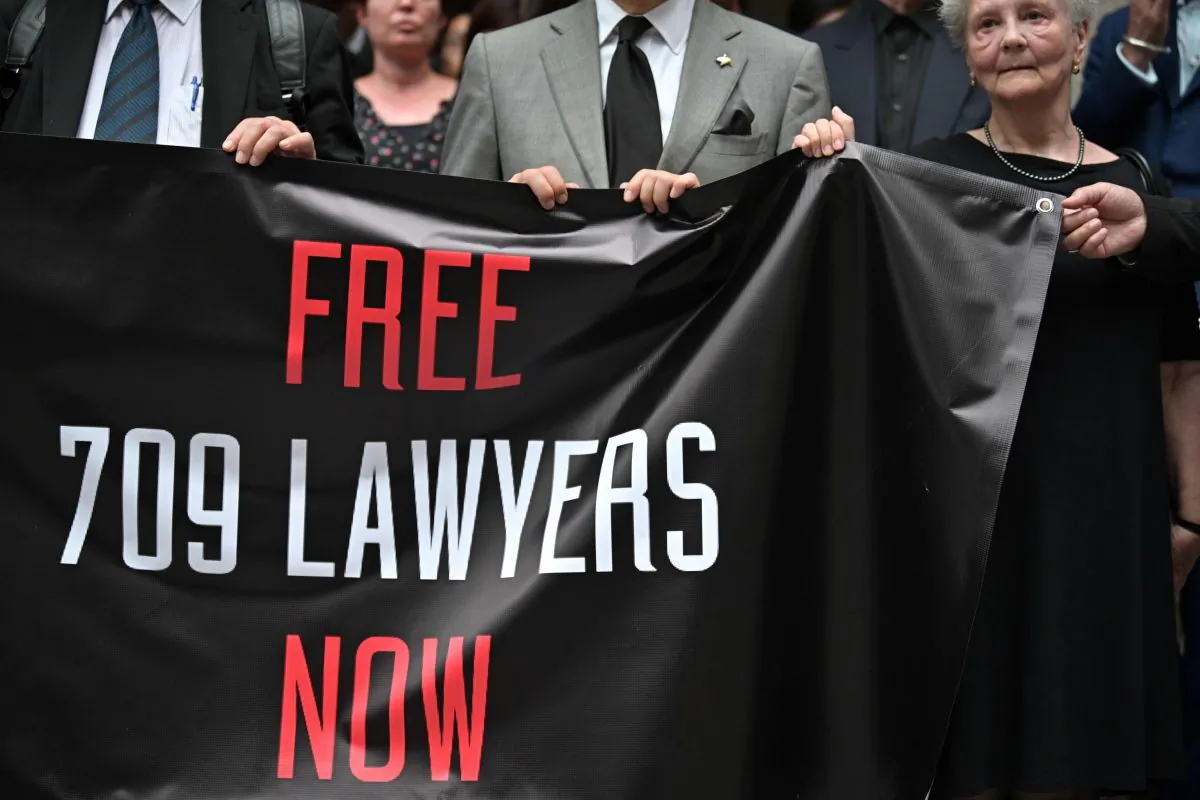
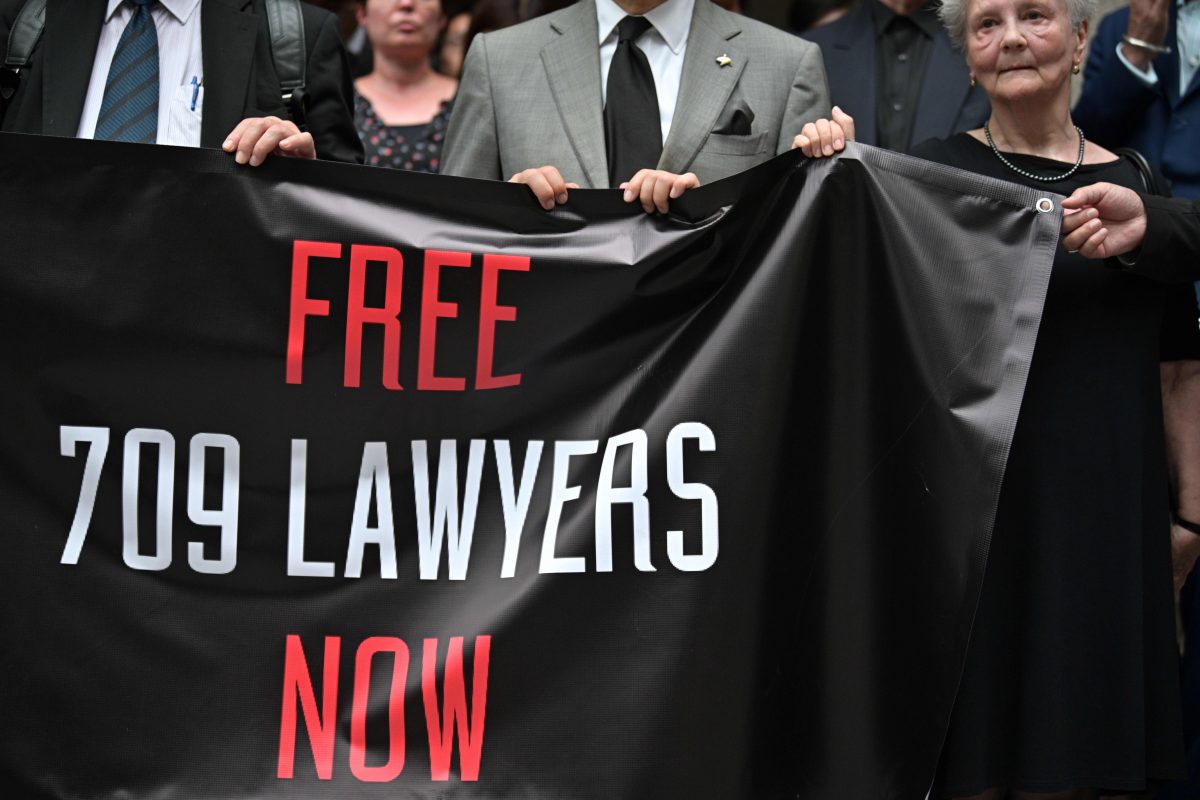
Known as the “709 crackdown,” the campaign began on July 9, 2015, when Chinese authorities detained or interrogated hundreds of human rights lawyers, legal assistants, and activists across the country. The campaign was named after the date on which it began.
According to the U.S. Congressional-Executive Commission on China, the clampdown affected more than 300 lawyers, legal professionals, and rights advocates. Some were detained or prosecuted, while others later faced surveillance, harassment, or professional sanctions.
Qin Weijin was not among those detained in the initial sweep. He subsequently joined public statements supporting lawyers who came under pressure from authorities.
In 2016, he participated in a joint statement supporting Guangxi lawyer Wu Liangshu, whom the Rights Defense Network said was assaulted by court police after attempting to file a case at a court in Nanning. He also supported Sichuan lawyers Zhan Zhaocheng and Liu Xun, who were prosecuted on charges related to allegedly obstructing testimony.
In 2018, Qin Weijin joined efforts supporting Guangdong rights lawyer Sui Muqing after authorities revoked Sui’s license to practice law.
Qin Weijin’s continued involvement in such cases eventually made him a target himself, according to the China Human Rights Service Center.
Arrested on One Charge, Convicted on Another
Police in Liuzhou detained Qin Weijin on March 15, 2024, initially accusing him of “inciting ethnic hatred and ethnic discrimination,” according to the China Human Rights Service Center.
On May 25, 2025, Qin Weijin was sentenced to two years and six months in prison for “picking quarrels and provoking trouble.”
Article 293 of China’s Criminal Law defines the offense as several forms of conduct, including assaulting or pursuing others, damaging or taking property, and causing serious disorder in public places. The provision has frequently been used in politically sensitive cases involving Chinese dissidents.
Qin Yongpei said he believed prosecutors ultimately charged Qin Weijin with a different offense because there was no evidence that he had made statements inciting ethnic hatred. He described the case as a typical example of the authorities’ practice of using trumped-up accusations to persecute outspoken rights lawyers.
License Revoked During Imprisonment
While Qin Weijin was serving his sentence, the Guangxi regional Justice Department revoked his lawyer’s license on Aug. 20, 2026, citing his criminal conviction. Article 49 of China’s Lawyers Law requires revoking a lawyer’s license when the lawyer receives criminal punishment for an intentional crime.
Qin Weijin is now challenging that decision through China’s administrative review system.
In his application to the Ministry of Justice, he asks that the Guangxi Justice Department’s decision be revoked and that his license and eligibility to practice law be restored. He has also requested that questions concerning Article 49 of the Lawyers Law be referred to the Standing Committee of the National People’s Congress for legal and constitutional review.
Decade of Pressure on Rights Lawyers
Qin Weijin’s case shed light on a broader pattern of how the Chinese regime has been pressuring China’s rights-defense lawyers since the 709 campaign.
Human Rights Watch said in 2025, marking the 10th anniversary of the clampdown, that Chinese authorities continued to target lawyers who challenged official abuses, including through the revocation or cancellation of professional licenses.
Lawyers for Lawyers, the International Bar Association’s Human Rights Institute, and The 29 Principles, a UK-based organization that advocates for the independence and protection of lawyers, have condemned these measures, saying they have discouraged lawyers from taking on politically sensitive cases or publicly supporting colleagues facing official pressure.
Wu Shaoping, head of the overseas China Human Rights Lawyers Alliance, told the Chinese-language edition of The Epoch Times that Qin Weijin’s imprisonment and illness illustrate the risks lawyers face when they challenge official actions.
He also said pressure extends beyond the legal profession to people across Chinese society who publicly challenge government policies or official conduct.
For Qin Weijin, the immediate concerns are more personal. After 30 months in prison and a diagnosis of lung cancer, he has returned home in severely weakened condition, without the professional license that once allowed him to represent clients.
Wu said Chinese authorities should bear responsibility for Qin’s treatment and called for greater international attention to China’s human rights situation.
Zhang Zhongyuan and Hong Ning contributed to this report.
 Friends Read Free
Copy
Facebook
Tweet
Friends Read Free
Copy
Facebook
Tweet