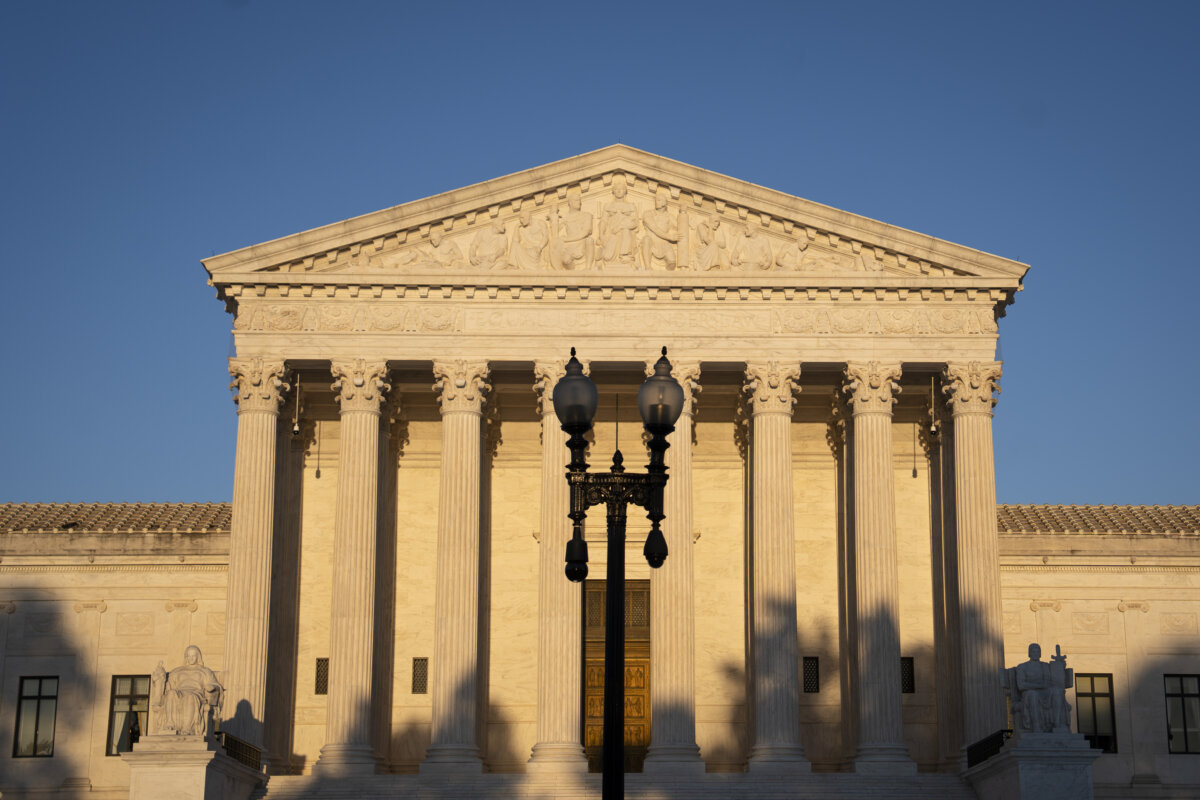

The U.S. Supreme Court on Tuesday allowed the Trump administration to resume deporting illegal immigrants to countries to which they have no connection, granting a request to put on hold a lower court order.
The high court, while issuing the pause, said that it will hear arguments on the case in December to come to a final conclusion next year.
Justices Elena Kagan, Sonia Sotomayor, and Ketanji Brown Jackson said they would have denied the Trump administration’s application to stay the lower court order, issued by a judge on the U.S. District Court of Massachusetts in February.
The Supreme Court granted the Justice Department’s request to put on hold Boston-based U.S. District Judge Brian Murphy’s ruling that the Department of Homeland Security’s (DHS) policy is unlawful as the appeals process plays out.
In the brief order, the Supreme Court said the justices would consider whether the lower court had jurisdiction over the petitioners’ claims against the administration, if the court had authority to issue the order, and whether the federal government’s guidance on removing illegal immigrants to third-countries is unlawful. Other claims can be submitted in the meantime, the court added.
The justices did not provide a reason for why the lower court order was stayed.
Previously, the Supreme Court has allowed President Donald Trump’s administration to carry out the third-country deportation policy while it’s being challenged in lower courts.
In written arguments before the high court last week, the Trump administration said the policy has been used to deport thousands of illegal immigrants to Mexico, multiple African countries such as Rwanda and Liberia, and some Latin American nations after the illegal immigrants’ home countries refused to take them back.
“Third-country removals require careful negotiation with foreign governments, which are rarely enthusiastic about accepting foreign citizens (especially criminals), and often requires obtaining travel documents and devoting significant manpower to the staging of flights to protect government officers and flight crews,” U.S. Solicitor General D. John Sauer said in the Sept. 24 petition on behalf of the Trump administration.
Further, Sauer argued that court orders that could scrap the policy would produce “massive costs on the government” because it would then require more diplomatic engagement with other nations whose officials “may be all the more skeptical of our removal efforts given the disruption.”
Elaborating on the possible costs, Sauer said DHS informed the Trump administration “that in addition to already cancelling a flight to three countries with 70 criminal aliens, it has had to pull nearly 150 aliens from removal flights to at least four different countries” due to the lower court rulings.
His petition was in reference to a Sept. 18 ruling from the U.S. First Circuit Court of Appeals that ruled against the DHS’s removals guidance, which stipulated that the deportations can be carried out insofar as the third-countries won’t torture or persecute the deportees.
The lawsuit against the Trump administration was initially filed by a Cuban national, named only as “D.V.D,” who has “severe mental illness” and is receiving psychiatric treatment. His lawyers wrote to the high court Sept. 28 that D.V.D. fears that the Trump administration’s policy would send him to a country where he cannot receive treatment.
The lawyers further argued that if the plaintiff was deported to Mexico, as an example, he would face “a high risk of kidnapping, extortion, violence, and other harms.”
 Friends Read Free
Copy
Facebook
Tweet
Friends Read Free
Copy
Facebook
Tweet