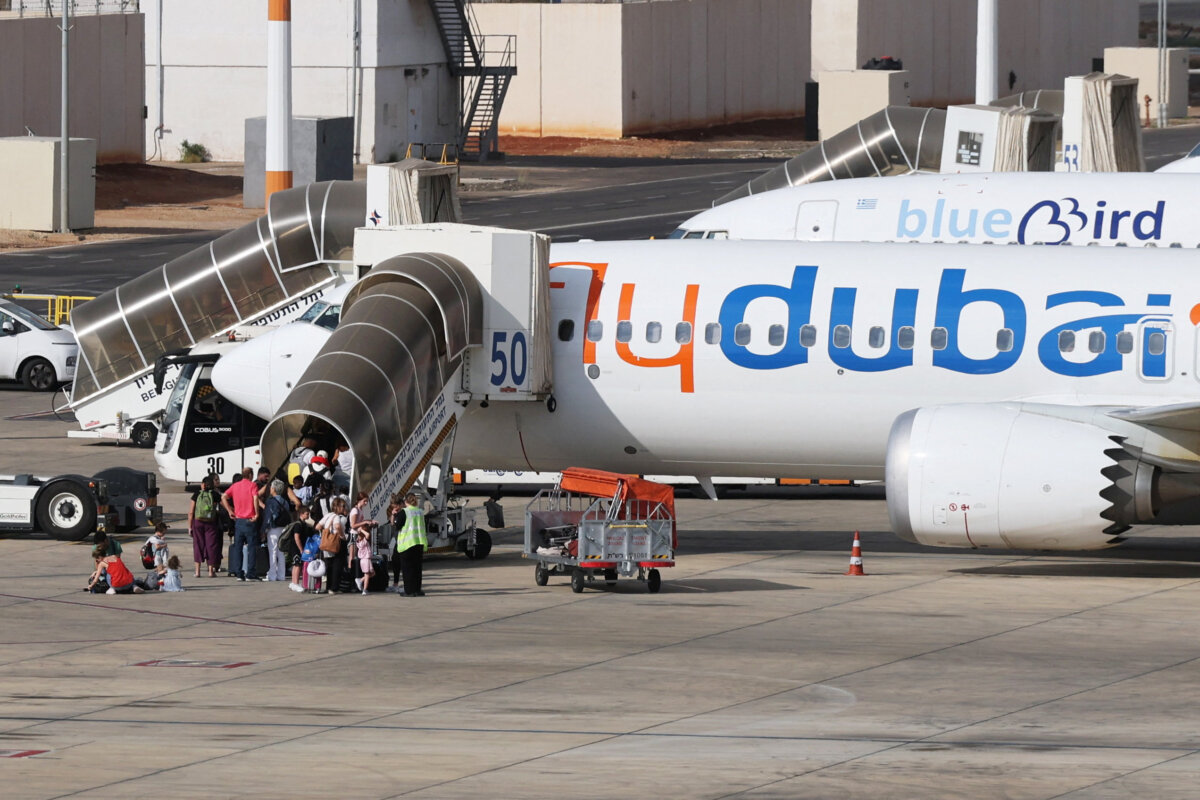

An Israeli passenger who helped save a FlyDubai flight from crashing after the pilot was stabbed by the co-pilot is crediting a Canadian-made television show for inspiring his actions.
Yaniv Hayun, one of 174 Israeli passengers aboard flight FZ1073 travelling from the United Arab Emirates to Israel on Sept. 30, told Israeli Prime Minister Benjamin Netanyahu in a video distributed by Netanyahu’s office that watching the docuseries “Air Crash Investigations” helped him control the aircraft during the cockpit fight.
“Mayday,” also known as “Air Crash Investigations,” launched in 2003 and is filmed in west Toronto. Over 23 years, the series has produced 297 episodes, combining dramatic reconstructions, interviews, investigative reports, and animations to examine and explain aviation incidents.
Hayun, 50, said he recalled from the show that he should pull back on the aircraft’s control stick to level it.
Flight FZ1073 reached Israel safely after passengers and crew foiled the co-pilot’s attempt to crash the aircraft, Israeli officials said. The struggle began when the co-pilot stabbed the pilot and sent the jet plunging nearly 14,000 feet in under 30 seconds. The pilot managed to click the release to open the cockpit door, allowing Hayun and three other Israeli passengers to subdue the co-pilot before pulling up the jet’s steering control. A second air crew aboard helped land the plane safely in Saudi Arabia.
‘Mayday’ Co-Creator Responds
Andre Barro, a co-creator of the show, told The Epoch Times that pilots and airlines have long told producers they use episodes for training or to discuss how to handle emergencies. However, Hayun’s account was the first incident he knew of in which someone credited “Mayday” with helping them know what to do during a real-life emergency.
“I find that quite extraordinary,” Barro said in an email.
Barro said he was struck by Hayun’s ability to recognize an impending emergency and respond quickly. He said the incident suggested viewers sometimes retained “more information from a television show than we imagine.”
“What the series has always shown is how human crews sometimes find creative ways to solve extremely critical situations,” he said.
Greg Gransden, who researched and wrote for Mayday for years, said he was “absolutely flabbergasted” by Hayun’s actions, and had never anticipated viewers would apply lessons from the show in a real emergency.
“It’s clear that Mayday has a powerful effect on people,” he said by email.
Gransden said the production team took “very special care” to depict cockpit procedures accurately, including which levers and buttons were used by the flight crew.
That attention to detail required researchers and writers to work through highly technical material, including investigative reports.
Methods
Barro said the idea for the show took shape in 2003 after a friend, a television producer and pilot in France, gave him a box of aircraft black-box transcripts.
Barro, an international producer, read them while flying home to Montreal and later called his friend to suggest developing a television series.
Cineflix, his employer at the time, supported the idea and its development.
Researchers built contacts with aviation safety investigators, consulted publicly available official reports and interviewed survivors, pilots, crew members and investigators. Their findings helped directors and production teams reconstruct events.
“We tried never to invent important facts or guess what happened,” Barro said, adding the team dramatized some minor details for television.
Barro attributed the show’s longevity partly to its production team and its factual approach to explaining aviation incidents. He said realistic re-enactments draw viewers into the events, while investigations explain what went wrong.
The reliance on actual events and investigations gave audiences “a mix of high adrenaline, reality and journalistic television,” he said. He described the show’s enduring appeal as a combination “of human drama, investigation and learning.”
Gransden joined Mayday as a researcher in 2003 after a friend from film school who worked as a producer contacted him. She knew he had taken flying lessons in high school and had an aviation background.
That experience helped him understand the technical reports and convey what crews experienced during emergencies.
“I know what it feels like to land a plane. I know what it feels like to be in a plane that’s spinning out of control … [or] that’s stalled in mid-air,” he said.
For Barro, the series’ appeal extended beyond the mechanics of an accident. The investigations revealed how people responded under extreme pressure, giving the episodes the “compelling” human stories that helped sustain the show for more than two decades.
 Friends Read Free
Copy
Facebook
Tweet
Friends Read Free
Copy
Facebook
Tweet