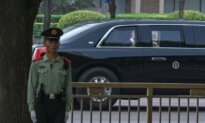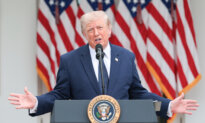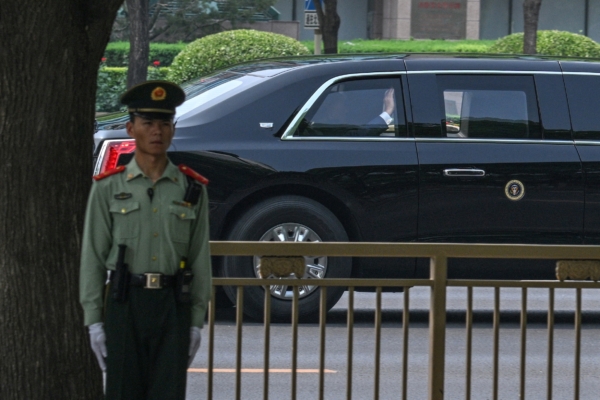
Competing narratives emerged from the Beijing summit between U.S. President Donald Trump and Chinese leader Xi Jinping, as the two governments issued sharply different accounts of what was discussed during their May 14 meeting.
The meeting, held at the Great Hall of the People, included senior officials from both sides covering foreign affairs, defense, and economic policy. The Chinese delegation included 13 officials, while the American side included 11, according to Chinese state broadcaster CCTV.
Xi said regarding U.S.–China relations that “cooperation benefits both, while conflict hurts both.”
Trump said relations between the two countries are “going to be better than ever before.”
However, the two governments offered different accounts of what was discussed.
Differences in Messaging
According to Chinese state media Xinhua News Agency, Xi told Trump that Taiwan is “the most important issue” in U.S.–China relations.
Xi warned that if the Taiwan issue is not handled properly, it could lead to confrontation or even conflict. He also reiterated Beijing’s position that “Taiwan independence” is incompatible with peace and stability in the Taiwan Strait.
However, a White House post on X focused on broader international issues, including Iran, the Strait of Hormuz, and economic cooperation.
The discrepancy underscores what China observers describe as competing messaging strategies between Washington and Beijing.
Su Tzu-yun, a research fellow at Taiwan’s Institute for National Defense and Security Research, told The Epoch Times the dispute over Taiwan has not changed.
He said Beijing repeatedly frames Taiwan as the central issue in bilateral relations and uses it to shape public perception.
Su also suggested that China may be emphasizing Taiwan to divert attention from other sensitive topics discussed during the talks, including nuclear issues, Iran, and trade. He added that existing U.S. commitments, including the Taiwan Relations Act and related policy frameworks, continue to provide stability for Taiwan’s position.
One day before the summit, a bipartisan group in the U.S. House of Representatives introduced a resolution reaffirming long-standing U.S. commitments to Taiwan.
The measure emphasized that the Taiwan Relations Act (TRA), the Three Communiqués, and the Six Assurances remain the foundation of U.S. policy, and should not be treated as bargaining chips in diplomacy.
Since 1979, the TRA has been a cornerstone of U.S.–Taiwan relations. It has enabled robust unofficial ties while supporting the evolution of Taiwan’s democracy and its development into a critical economic partner for the United States.
Complementing the TRA are the Six Assurances (formally conveyed to Taiwan in 1982), which reinforce America’s commitment to Taiwan’s security and self-determination. These assurances explicitly state that the United States did not agree to set a date for ending arms sales to Taiwan, did not agree to consult the Chinese Communist Party in advance on arms sales to Taiwan, did not agree to mediate between Taiwan and the Chinese Communist Party (CCP), did not agree to revise the TRA, did not agree to take any position on sovereignty over Taiwan; and will not pressure Taiwan to negotiate with the CCP.
U.S.–China relations on the Taiwan issue are also shaped by the Three Joint Communiqués, which form the diplomatic foundation of the U.S. “One China” policy. They are the 1972 Shanghai Communiqué (Nixon’s visit), the 1979 Joint Communiqué on the Establishment of Diplomatic Relations with the CCP, and the Aug. 17, 1982, Communiqué, where the United States stated it would gradually reduce arms sales to Taiwan.
Taiwan’s Ministry of Foreign Affairs also said China remains “the sole risk to regional peace and stability” and pledged continued cooperation with the United States and other partners.
Trade Signals
Chinese state media Xinhua News Agency reported that Xi told Trump during closed-door discussions that recent economic talks had produced “generally balanced and positive results.”
U.S. Treasury Secretary Scott Bessent and Chinese Vice Premier He Lifeng also met in South Korea earlier this week in a separate round of economic discussions.
Following Trump’s meeting with Xi, China’s Ministry of Commerce said Beijing was willing to expand areas of cooperation while narrowing differences with Washington, according to Xinhua News Agency.
While China’s official readout briefly mentioned Middle East issues, the White House placed significant emphasis on Iran, the Strait of Hormuz, and global energy security.
The White House also said Xi signaled interest in increasing purchases of U.S. oil to reduce China’s reliance on the strategic waterway.
The White House also further highlighted cooperation on fentanyl precursor controls and increased Chinese purchases of American agricultural products.
Trump’s visit was accompanied by more than a dozen U.S. business leaders from sectors including technology, finance, semiconductors, aerospace, and agriculture. NVIDIA CEO Jensen Huang joined the delegation at the last minute.
William Chih-tung Chung, an associate research fellow at Taiwan’s Institute for National Defense and Security Research, told The Epoch Times that the large business presence reflects Washington’s push for increased Chinese purchases of American goods, particularly agricultural and commercial products.
Tang Bing and Luo Ya contributed to this report.
 Friends Read Free
Copy
Facebook
Tweet
Friends Read Free
Copy
Facebook
Tweet