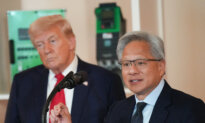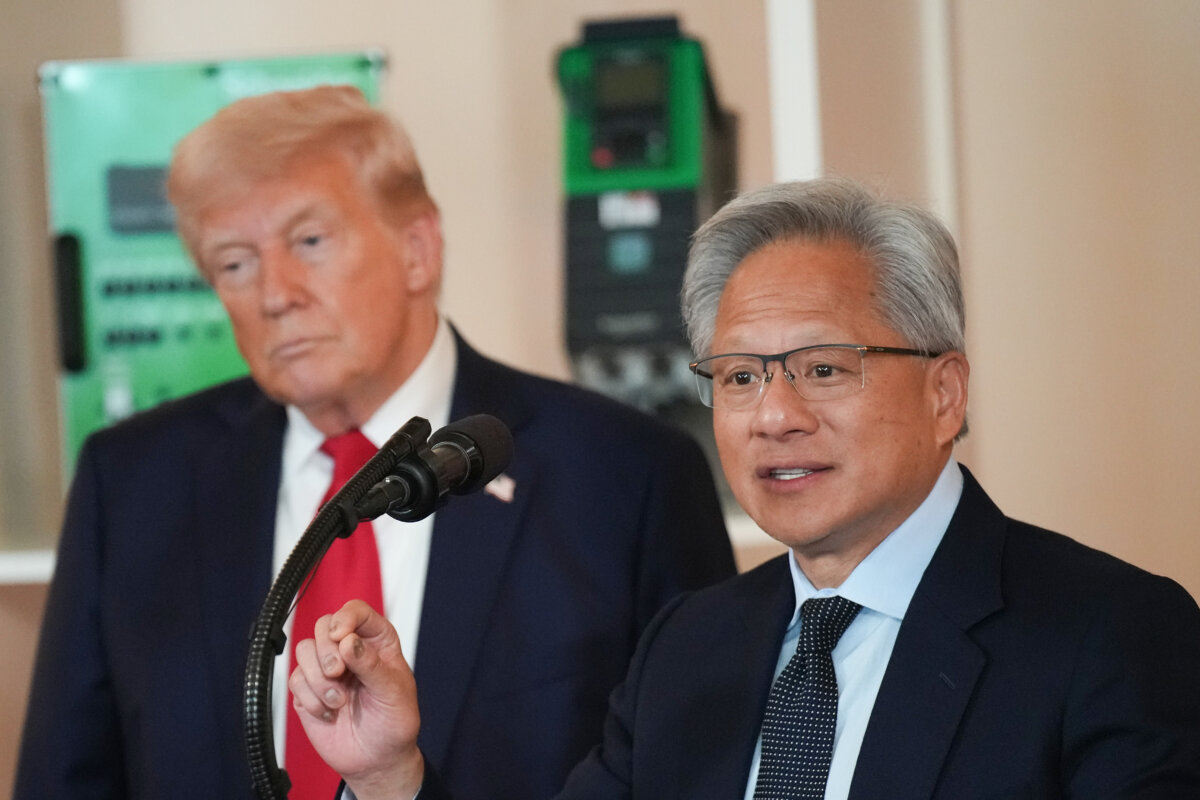
U.S. President Donald Trump said Nvidia CEO Jensen Huang was with him aboard Air Force One as he traveled to Beijing on May 13, adding he would urge Chinese leader Xi Jinping to “open up” to U.S. business.
Trump, on May 12, departed Washington for his May 13–15 China trip, which will be his first presidential visit to Beijing since taking office for a second term in January 2025.
In a May 13 post on Truth Social, Trump said that Huang “is currently on Air Force One” to join him on a two-day state visit to China.
Trump said he would also be joined in China by major business and tech figures, including Tesla’s Elon Musk, Apple’s Tim Cook, and BlackRock’s Larry Fink. Bosses from Blackstone Boeing, Cargill, Citi, GE Aerospace, Goldman Sachs, Micron, and Qualcomm are also going to Beijing.
In the social media post, the U.S. president said he was bringing the business figures to the “Great Country of China” and would be asking Xi to “‘open up’ China so that these brilliant people can work their magic, and help bring the People’s Republic to an even higher level!”
In a May 13 post on X, Musk said, “Just Jensen and I are on [Air Force One].”
Nvidia has struggled to get regulatory permission to sell its powerful H200 artificial intelligence chips in China.
The H200 chip is more advanced than anything China can currently manufacture domestically, especially given export controls that prevent Chinese companies from purchasing the most advanced semiconductor manufacturing equipment.
In January, Huang told reporters at Taipei’s downtown Songshan Airport that the license for H200 is being finalized.
“And I’m hoping that also the Chinese government would allow Nvidia to sell the H200, so they have to decide. And I’m looking forward to a favourable decision,” he told reporters at the time. “I think that H200 is very good for American technology leadership. It’s also very good for the Chinese market. And the customers would very much like to have H200.”
The United States imposed export controls on the sale of Nvidia’s most advanced AI chips to China, seeking to limit its tech progress, particularly in applications that could help its military.
Last year, the Trump administration formally green-lit Nvidia’s H200 chip sales to China, despite concerns that the Chinese communist regime could use the technology to supercharge its military.
Trump said in a Dec. 8 post on Truth Social that he would allow the chip sales in exchange for a 25 percent fee for the U.S. government and that H200 chips must go to “approved customers in China.”
“This policy will support American Jobs, strengthen U.S. Manufacturing, and benefit American Taxpayers,” Trump wrote.
The decision to sell Western chips to the Chinese communist regime has drawn criticism from former Trump White House strategist Steve Bannon.
On his War Room podcast on March 21, Bannon said that the Chinese Communist Party “should have no access whatsoever to anything in the ecosystem of AI including the chips.”
“[Trump is] absolutely correct that we have to be the dominant player,” he said. “The Chinese Communist Party is using every means possible to get the chips from Jensen Huang, [you] got to cut that off 100 percent.”
In January, John Moolenaar, chairman of the Select Committee on China, sent a letter to U.S. Secretary of Commerce Howard Lutnick saying that Nvidia products were used by Chinese AI company DeepSeek and then procured by the People’s Liberation Army (PLA).
He said that company records showed that Nvidia staff helped DeepSeek achieve major gains in training efficiency. He also said Nvidia later moved to make DeepSeek easier to deploy through its enterprise software ecosystem.
“China has more than enough domestic chips for all of its military applications, with millions to spare. Just like it would be nonsensical for the American military to use Chinese technology, it makes no sense for the Chinese military to depend on American technology,” Nvidia said in a statement at the time.
Catherine Yang, Troy Myers, and Reuters contributed to this report.
 Friends Read Free
Copy
Facebook
Tweet
Friends Read Free
Copy
Facebook
Tweet