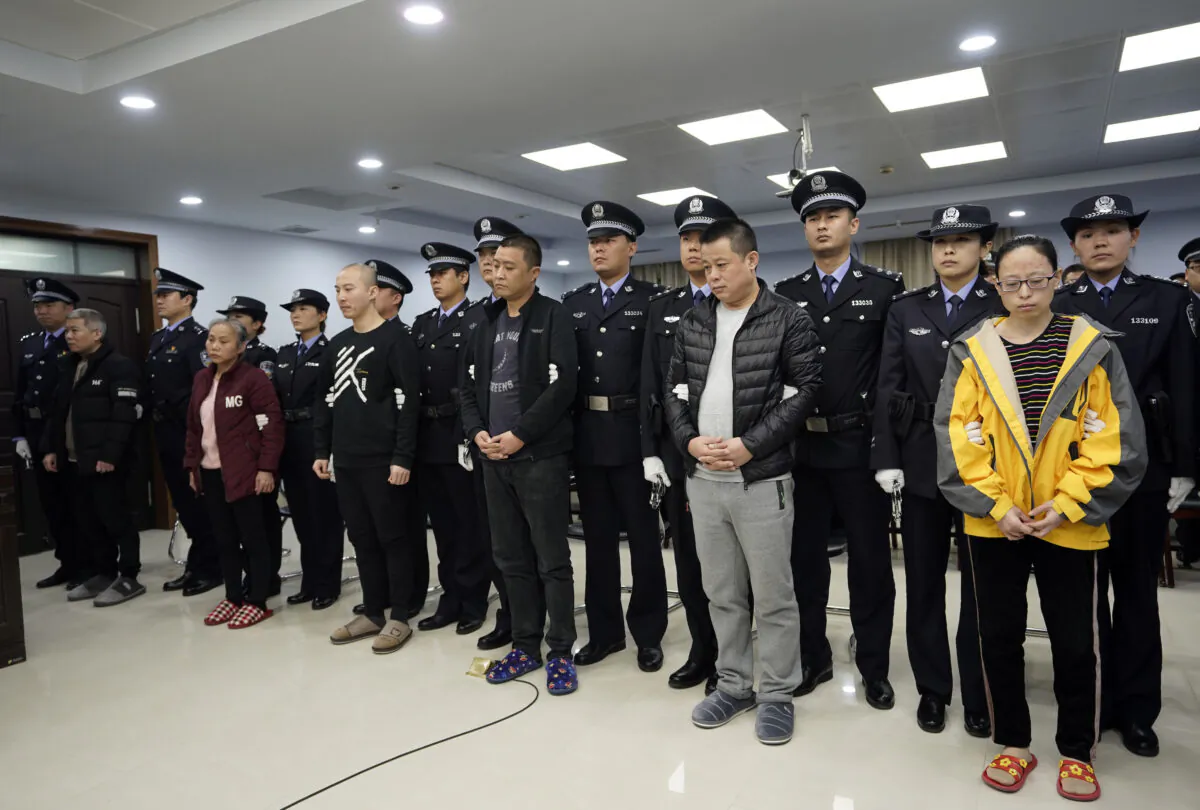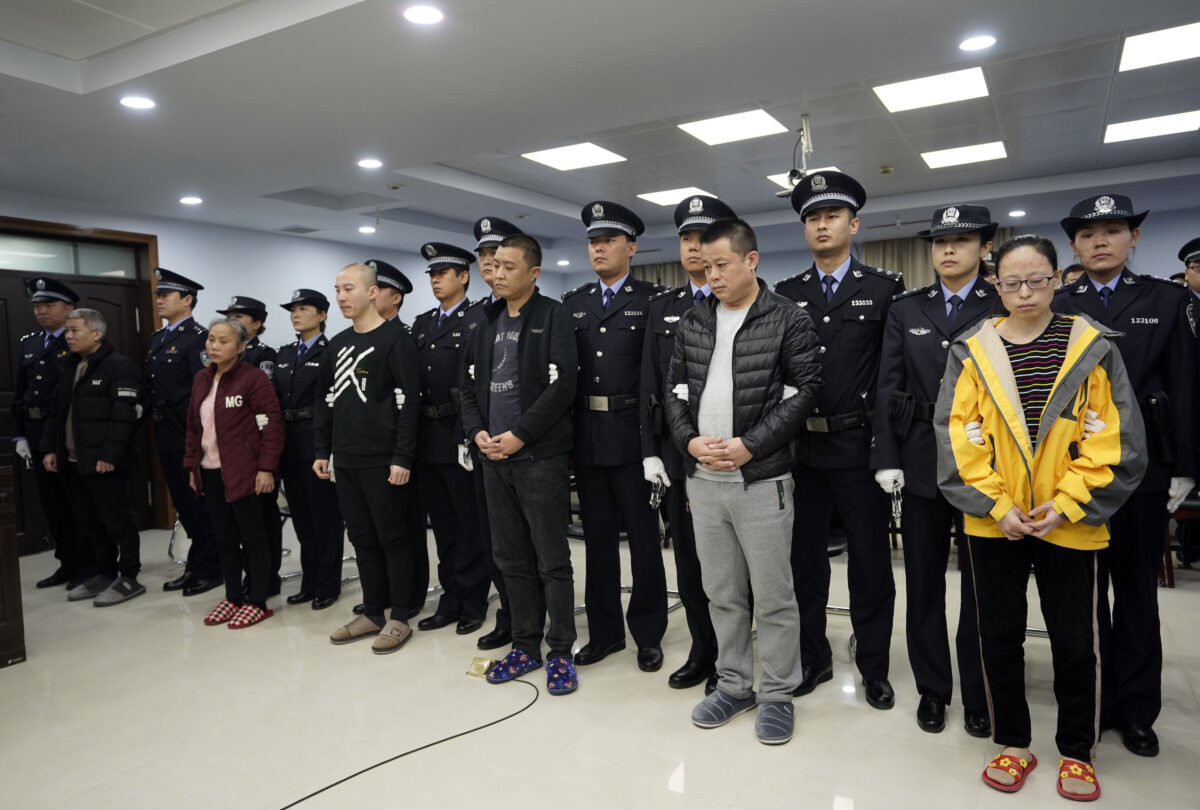

Chinese regime officials in Anhui Province have announced a series of organized crime cases spanning multiple cities and dating back as far as the mid-1990s, prompting public discussion over whether long-running criminal networks operated with protection from local officials.
The Anhui Provincial Public Security Department recently disclosed four “typical cases” involving alleged organized crime groups in the province. The cases span sectors including construction, mining operations, township-level contracting, and illegal debt collection.
According to Chinese state media People’s Daily, the groups allegedly operated for years—in some cases more than a decade or two—before being dismantled and prosecuted.
Organized Crime in Key Industries
In Hefei city, officials said a group led by an individual surnamed Wang had been active since around 2008, allegedly using violence and intimidation tactics to monopolize earthworks projects.
In Huaibei city, an organization run by two brothers operated in and around mining areas beginning as early as 1995, controlling coal-related and engineering contracts.
In Suzhou city, a case involving an individual surnamed Zhang centered on illegal debt collection activities.
Regime officials said all individuals involved have now been sentenced.
The official descriptions of the groups used terms such as “long-term entrenched presence,” “forced contract grabbing,” and “establishing illegal authority,” particularly in resource-intensive sectors such as mining, township development, and construction.
The long time span of the cases—some extending across multiple local government administrations—has fueled online discussion in China about whether organized crime networks may have had protection from local officials.
Several insiders spoke to The Epoch Times on condition of anonymity or only publishing their surnames out of fear of reprisal.
A former grassroots police officer in Anhui province, surnamed Zhou, told the publication that there was a close and sometimes transactional relationship between Chinese police and criminal figures.
“In some cases, police and gang members are connected,” Zhou said. He alleged that minor incidents were often ignored, while more serious cases were resolved under pressure by identifying scapegoats rather than fully investigating higher-level suspects.
“If something becomes a public issue online, they might just arrest a few low-level enforcers to close the case,” he said, adding that in his experience, local police often knew which groups were responsible based on patterns of behavior in their jurisdiction.
His account could not be independently verified by The Epoch Times.
Allegations of Local Protection Networks
An Anhui-based rights advocate, surnamed Jia, told The Epoch Times that criminal organizations were particularly active in poorer counties in the province.
Linquan County had a history of drug-related activity and limited policing resources, he said, while in other areas local criminal networks allegedly maintained ties with officials who provided protection in exchange for financial benefits.
He also alleged that some law enforcement officials had been investigated or removed in connection with such networks.
A retired Chinese public servant told The Epoch Times the relationship between organized crime and corrupt officials has long been intertwined in China’s local governance.
“In places with crime, there are also corrupt police,” he said, describing what he described as a system of mutual benefit, where law enforcement and criminal figures both gained from cooperation through protection, financial payments, or case manipulation.
He also argued that, in his view, organized crime groups could not have operated for decades without some form of official protection, especially when they reached large scales involving dozens or even hundreds of members.
“In reality, these networks cannot survive for 20 years without a protective umbrella from the police and Chinese Communist Party officials,” he said.
While the Chinese regime had previously acknowledged the existence of organized crime and launched nationwide anti-crime campaigns, the retired public servant said that enforcement at the local level can be inconsistent and vulnerable to corruption.
Wang Yibo contributed to this report.
 Friends Read Free
Copy
Facebook
Tweet
Friends Read Free
Copy
Facebook
Tweet