
The European Union on Nov. 3 hailed the “progress” that has been made amid the ongoing dispute between the Netherlands and China over chipmaker Nexperia.
Maros Sefcovic, the European commissioner for trade and economic security, said that he “welcomed progress on Nexperia, key to restoring a semiconductor supply chain.”
“Close coordination with the Dutch government and constructive engagement with China. Our work continues towards lasting stability, without export control barriers and with a diversified EU ecosystem,” the European Union’s chief trade negotiator wrote on X.
He did not elaborate on the precise nature of the progress he said had been made.
Following the Dutch government’s seizure of Nexperia on Sept. 30 over concerns about the potential transfer of crucial technology to its Chinese parent company, the Chinese Communist Party (CCP) cut off exports of the company’s finished chips, which are mostly packaged in China.
During a press briefing on Nov. 4, China’s commerce ministry accused the Dutch government of being uncooperative and of having “interfered” in Nexperia’s affairs and disregarded Beijing’s demands during consultations.
The CCP said these actions by the Dutch government would negatively affect the global semiconductor supply chain.
That blanket ban on exports was slightly eased following U.S. President Donald Trump’s Oct. 30 meeting with CCP leader Xi Jinping, when Beijing said it would “consider” exemptions to the ban.
A ‘Highly Exceptional’ Step
The Dutch government took what it called the “highly exceptional” step of seizing control of Nexperia on Sept. 30, freezing assets and replacing its Chinese executives.
The intervention gives the government the power to reverse or block management decisions it sees as harmful.
Nexperia, which manufactures semiconductors for cars and consumer electronics, is owned by Jiaxing-based company Wingtech.
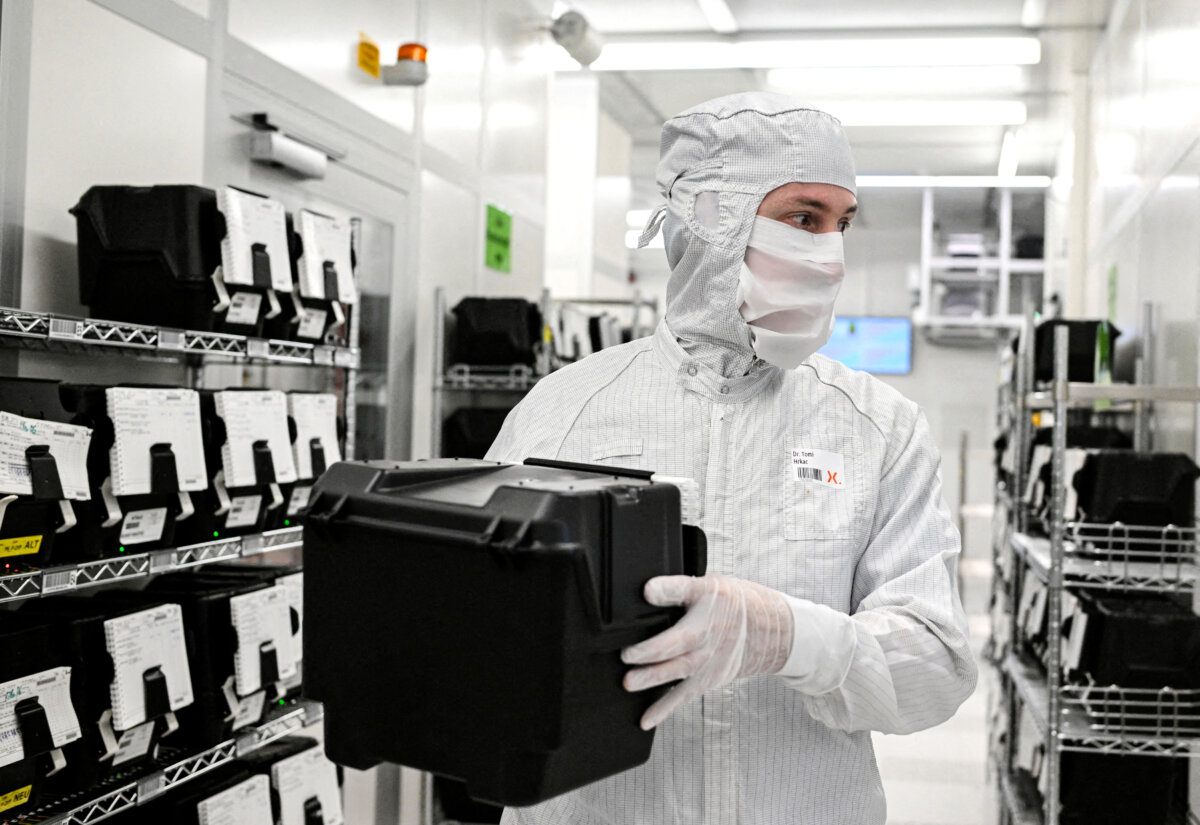
It is one of the world’s largest producers of simple computer chips, including diodes and transistors. Although they are not cutting-edge, these chips are essential for Europe’s automotive and industrial supply chains. Up to 80 percent of Nexperia’s products are packaged in China before redistribution.
Dutch authorities acted after former Chinese CEO Zhang Xuezheng allegedly began transferring key operations, data, and equipment from Europe to China. On Oct. 1, the Dutch government froze assets across 30 Nexperia entities worldwide and removed Zhang from his post.
Wingtech was once private but is now partially state-owned, placing it directly under CCP control. Wingtech acquired Nexperia in 2018 for more than $3 billion, China’s largest cross-border semiconductor acquisition at the time.
Nexperia has long faced scrutiny in the West. The UK government in 2022 ordered it to divest itself of a Newport wafer plant, and Dutch authorities reviewed its 2023 acquisition of the startup Nowi.
The U.S. Department of Commerce added Wingtech to its “Entity List” in December 2024 for assisting the acquisition of entities with sensitive semiconductor capabilities. Under new “50 percent ownership” rules introduced by the Bureau of Industry and Security in mid-2025, Nexperia automatically fell under U.S. trade restrictions as a wholly owned subsidiary of Wingtech.
Auto Industry Response
Several car manufacturers, including Volkswagen and Mercedes-Benz, have said that the dispute has thus far not affected production.
Mercedes-Benz CEO Ola Kaellenius said that there were signs that an understanding was closer to being reached among China, Europe, and the United States.
The German carmaker has sufficient chips for now, Kaellenius said.
A Volkswagen spokesperson said on Oct. 30: “The supply shortage at the Dutch chip manufacturer Nexperia continues, for the time being, to have no impact on production at the vehicle manufacturing plants of the Volkswagen brand in Germany.
“In view of the dynamic situation, however, short-term impacts on the production network of the Volkswagen Group cannot generally be ruled out.”
The spokesperson said that the company remained in close contact with suppliers as it examines alternatives.
The CEO of Stellantis, maker of Jeep and Fiat, criticized Europe’s supply chain vulnerabilities on Nov. 4, saying they were putting the company at a competitive disadvantage to rivals in China.
“Today our system means we have zero autonomy as an industry,” Antonio Filosa said. “Look at the Nexperia chip crisis. Look at the April rare earth crisis that we went through very painfully.”
A spokesperson for the Dutch Ministry of Economic Affairs said that negotiations are still ongoing.
“We remain in contact with our Chinese and international partners, hoping to find a constructive solution that benefits Nexperia and both economies,” the spokesperson said.
The Epoch Times contacted Nexperia, Wingtech, and the Dutch Ministry of Economic Affairs for comment and did not receive a response.
Reuters and Michael Zhuang contributed to this report.
 Friends Read Free
Copy
Facebook
Tweet
Friends Read Free
Copy
Facebook
Tweet