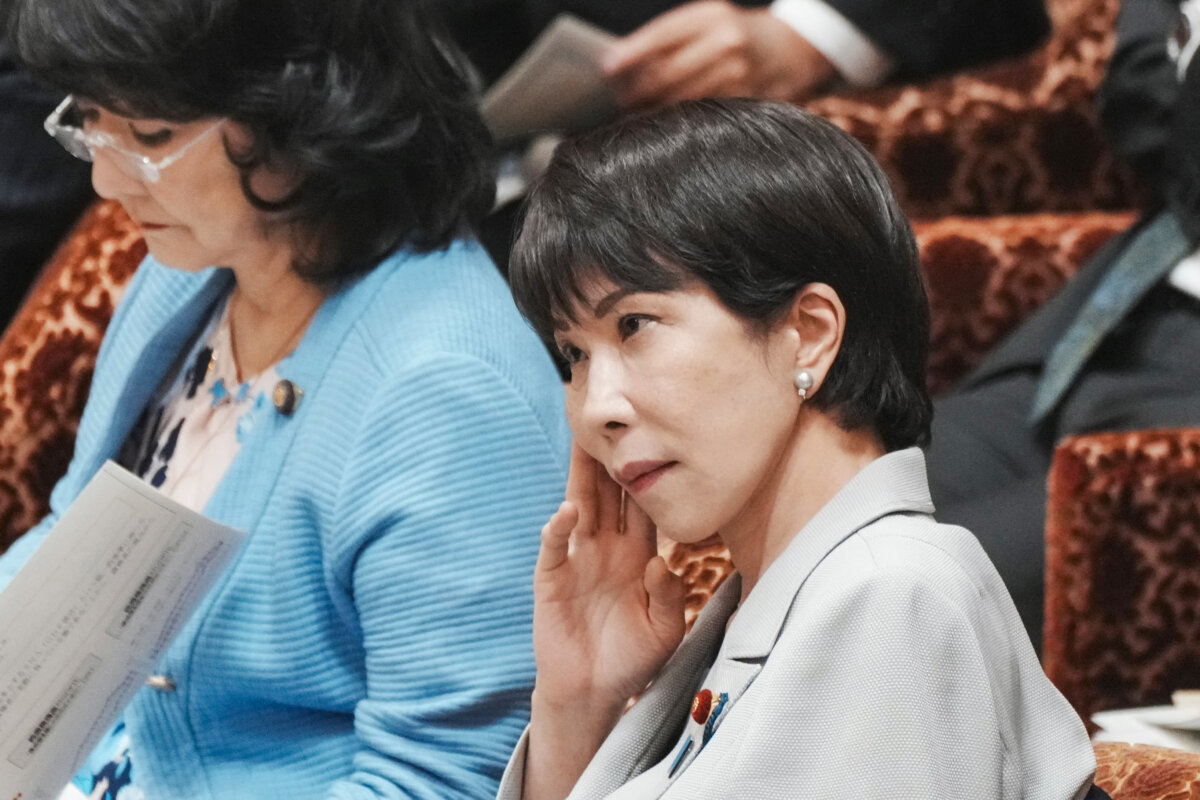

A senior Chinese diplomat’s violent threats directed at Japanese Prime Minister Sanae Takaichi have sparked a fresh firestorm in Tokyo, prompting calls for the diplomat’s expulsion from Japan.
At a meeting on Nov. 11, Japan’s ruling Liberal Democratic Party (LDP) adopted a resolution demanding a decisive response to comments made by Xue Jian, the Chinese consul-general in Osaka, in Western Japan.
Xue’s remarks amount to “an insult” not only to the Japanese prime minister but also to the entire nation of Japan and its people, severely damaging Japan–China relations, according to the resolution compiled by the LDP’s foreign affairs committee and foreign affairs research commission.
The resolution called on the Japanese government to declare Xue “persona non grata,” a move that would enable his expulsion under international law, if Beijing fails to take appropriate measures to resolve the issue.
The latest diplomatic altercation between the two nations started last week after Takaichi told a parliamentary committee that military attacks against Taiwan would likely constitute “a survival-threatening situation” for Japan, a classification that could compel Tokyo to mobilize its military in defense of Taiwan.
The Chinese Communist Party (CCP) views the self-ruled Taiwan as part of its territory, to be taken by force if necessary. To pressure the self-governed democracy to accept communist rule, the regime has been sending warplanes near the island on a nearly daily basis and carrying out large-scale military exercises in the Taiwan Strait, escalating concerns about a potential conflict.
Shortly after Takaichi’s comments on Taiwan, the Chinese diplomat, in a social media post, shared an article about her remarks and wrote, “the dirty neck that sticks itself in must be cut off.” In a separate post on X, he said considering an attack on Taiwan a threat to Tokyo is “a path of death” that some “stupid politicians in Japan would choose.”
That triggered a formal protest from Tokyo. The Japanese government’s top spokesperson condemned the statement as “extremely inappropriate” coming from someone of Xue’s seniority.
The death threat post, which Beijing claimed was made in a personal capacity, was subsequently taken down, but it stoked outrage among Japanese lawmakers.
Jun Azumi, the secretary-general of the main opposition Constitutional Democratic Party, described the Chinese diplomat’s statement as “disappointing.” Azumi, a member of Japan’s lower house, said at a briefing on Nov. 11 that Xue’s comment would serve no benefit to the relationship between Japan and China.
Naoki Hyakuta, who heads the minor opposition Conservative Party, expressed concerns that Xue’s statement could incite extreme action against Takaichi by Chinese residents or others in Japan.
Despite facing backlash, Chinese authorities and state media have dialed up their verbal attacks against the Japanese prime minister.
In a Nov. 12 statement, a spokesperson for China’s embassy in Japan likened Takaichi’s reference to “survival-threatening situations” to Japan’s invasion of northeast China’s Manchuria during World War II.
In an editorial published on Nov. 11, state broadcaster CCTV accused Takaichi of “crossing the line” with Beijing on Taiwan issues and causing “extremely bad” effects.
One social media account affiliated with CCTV said in a separate commentary posted on Weibo and several other popular Chinese social media platforms that if the prime minister continues with such remarks, she “might have to pay the price.”
At a press conference on Nov. 12, Taiwan Foreign Minister Lin Chia-lung cautioned that the Chinese diplomat’s remarks risked stirring up anti-Japanese sentiment among Chinese people and must be addressed.
“If this isn’t handled properly, it could escalate significantly,” he said. “So it cannot be treated as an isolated incident or just a personal remark.”
Reuters contributed to this report.
 Friends Read Free
Copy
Facebook
Tweet
Friends Read Free
Copy
Facebook
Tweet