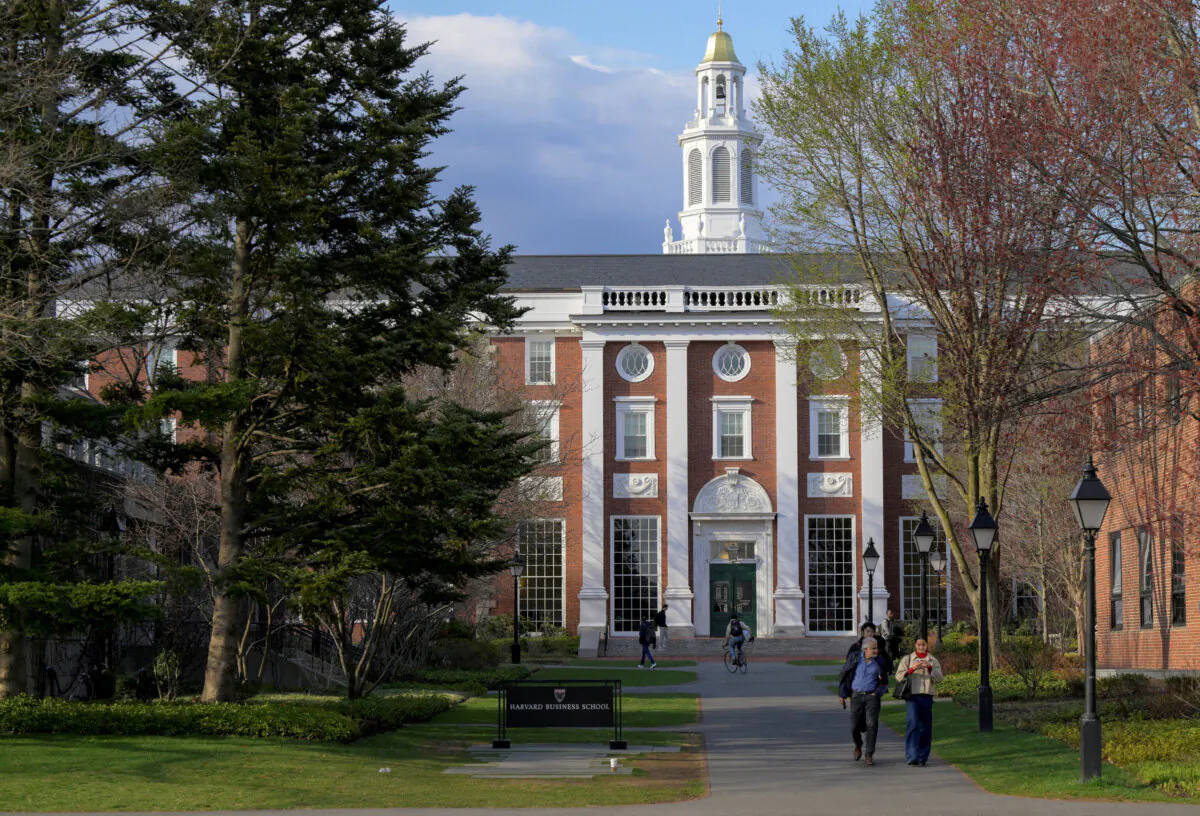

Lawmakers in the House of Representatives are demanding transparency from Harvard University over partnerships with sanctioned groups, including those involved in the Chinese regime’s forced organ harvesting and its genocide against Uyghurs in China’s Xinjiang region. In particular, the lawmakers highlighted the university’s partnerships with blacklisted Chinese entities.
Reps. John Moolenaar (R-Mich.), Tim Walberg (R-Mich.), and Elise Stefanik (R-N.Y.)—chairs of the House Select Committee on the Chinese Communist Party (CCP), House Committee on Education and the Workforce, and the House Republican Conference, respectively—sent the letter to Harvard University President Alan Garber on May 19, requesting documents and testimony by June 2.
Harvard did not respond to an inquiry from The Epoch Times by publication time.
Xinjiang Paramilitary Group
Lawmakers raised concerns over Harvard’s participation in providing training to Xinjiang Production and Construction Corps (XPCC), which the United States sanctioned in 2020 for “serious rights abuses against ethnic minorities” in the Xinjiang region.
“On multiple occasions, Harvard hosted and trained members of the sanctioned, paramilitary organization XPCC—one of the primary implementers of the CCP’s genocide against the Uyghur people,” lawmakers said.
“Harvard stated that its training was designed to help ‘participating policymakers … translate the lessons from the course into tangible, effective policies,'” the letter reads. “But to XPCC, ‘effective policies’ are those that succeed in repressing the Uyghur people.”
Harvard’s first association with the XPCC was in 2019, before the sanctions, and an archived statement from a Harvard China Health Partnership (HCHP) conference thanks the XPCC for its participation. The line has since been removed.
The lawmakers note that although Harvard did not mention XPCC in statements about subsequent HCHP conferences, Chinese agencies issued statements that name XPCC as a participant in both the 2023 and 2024 HCHP conferences, and HCHP published a photo that blurs out four panelists’ names.
The lawmakers said XPCC has used “health care-related efforts” to further its persecution. For instance, it questioned more than 1,000 Uyghurs and published results in a study that was later retracted by the BMC Public Health journal for ethical violations.
Forced Organ Harvesting
U.S. and international bodies have recognized that the Chinese regime is perpetrating forced organ harvesting from live prisoners of conscience and have urged caution in supporting China’s transplant industry.
Given the longstanding issues, lawmakers raised concerns over recent organ transplant research that Harvard conducted in collaboration with Chinese partners. They listed seven papers published between 2022 and 2024, including one titled, “Transplantation of a beating heart: A first in man.”
In 2006, whistleblowers revealed to The Epoch Times that the CCP was directing surgeons to remove organs from followers of the peaceful spiritual practice Falun Gong, killing them in the process, to sell the organs for profit. One hospital worker said that her surgeon ex-husband had participated in this persecution as early as 2001 and that thousands of people had been killed. The same year, Canadian lawyers David Matas and David Kilgour published an independent report alleging that this was happening on a large scale and detailing their investigation.
In 2016, the House passed a resolution recognizing the CCP’s forced organ harvesting, and in 2019, an independent tribunal in London concluded that forced organ harvesting has taken place in China for years “on a significant scale” and constitutes “crimes of humanity … beyond a reasonable doubt.”
The House recently passed two bills aimed at criminalizing participation in forced organ harvesting. The Falun Gong Protection Act (H.R. 1540) would sanction those implicated in the forced harvesting of organs of Falun Gong practitioners. The Stop Forced Organ Harvesting Act (H.R. 1503) would sanction and fine or incarcerate anyone implicated in organ transplant abuse.
Research Collaborations
Lawmakers also demanded answers over research collaborations that concern military applications. They listed as examples: micro-robotics research with Tsinghua and Zhejiang universities, U.S. Air Force-funded alloy research with Huazhong University, U.S. Air Force-funded research on polymer science with a Zhejiang University professor, and research funded by the Defense Advanced Research Projects Agency concerning artificial intelligence and optical chip applications with researchers at Tsinghua University.
Tsinghua University, Zhejiang University, and Huazhong University are not sanctioned entities, but are state-owned institutions with open ties to the Chinese military.
Another project on robots for deep-sea exploration “included scientists from the Beihang University, which is one of the [People’s Republic of China’s] ‘Seven Sons of National Defense,'” the letter reads, referring to a group of seven Chinese universities with firm ties to the Chinese Ministry of National Defense and the defense industry.
The lawmakers are concerned that this is a national security risk, as it “trains researchers” at institutions linked to the Chinese regime “in scientific areas that could be critical in a future conflict” and “provides the [People’s Republic of China] with insight into U.S. military priorities.”
Lawmakers also said that Harvard has worked on several projects funded by the Iran National Science Foundation, an Iranian regime agency subject to sanctions beginning in 2024. One of these projects was in partnership with a professor at China’s Zhejiang University.
 Friends Read Free
Copy
Facebook
Tweet
Friends Read Free
Copy
Facebook
Tweet