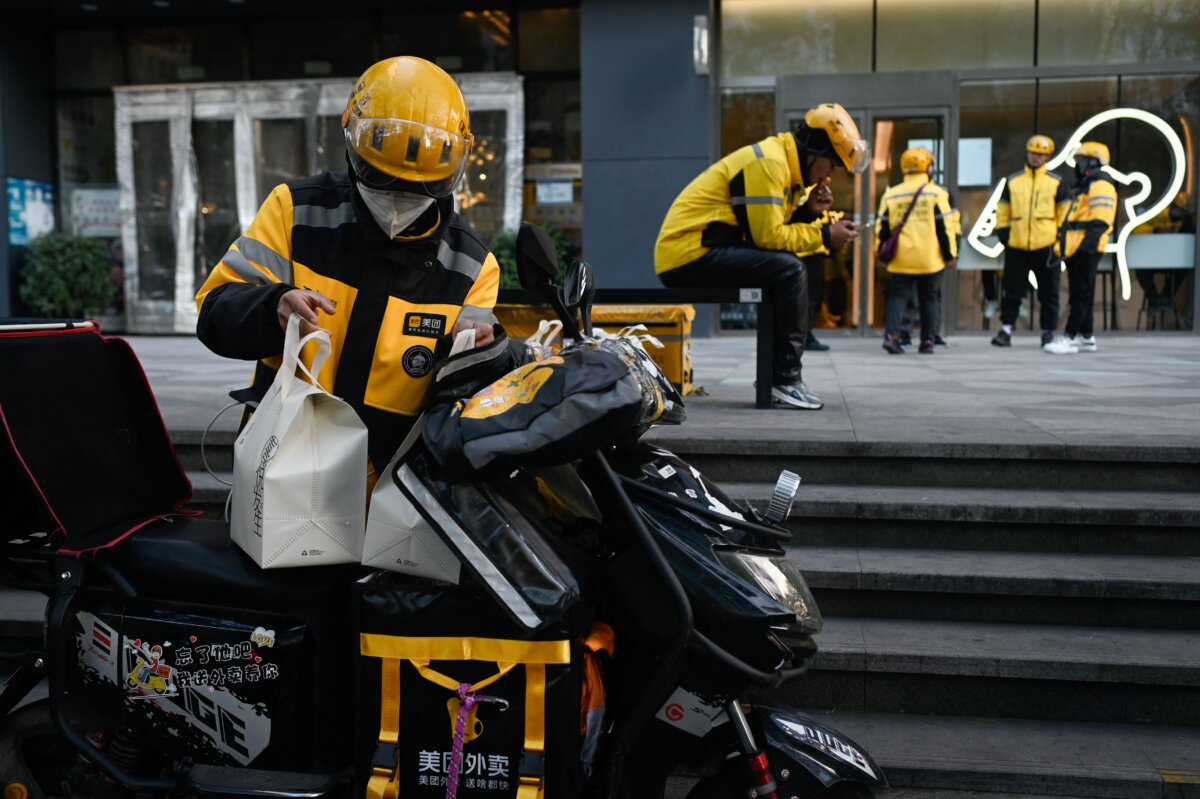

More and more Chinese food delivery riders are taking their young children with them while delivering food as the economic situation in China continues to worsen, according to posts on social media and riders who have spoken with The Epoch Times about their plight.
Amid China’s continuing economic downturn and persisting high unemployment, an increasing number of middle-class Chinese people have lost their jobs and joined the ranks of food delivery riders to make a living.
According to the latest official data released by the Chinese communist regime in 2023, there are approximately 12 million delivery riders registered on online delivery platforms nationwide. In the documentary “2026 Survival Report on Chinese Food Delivery Workers,” released in April by the Sanlian Life Lab, a major publisher in China, the number of delivery riders is reported to have reached more than 13 million.
Many of the delivery riders are gig workers and have very few benefits and little welfare provided to them by the food delivery platforms or the state. Some of the delivery riders have staged protests in recent years to demand basic rights.
Tian Jing, a delivery rider in Guangzhou, Guangdong Province, who used a pseudonym out of fear of reprisal, told The Epoch Times that she began working as a delivery rider last year. Since she had no one to look after her 2-year-old, she took the child along on her rounds.
“The child acts up sometimes, but it’s unavoidable,” she said.
“I’m delivering food only to earn enough for groceries. Of course, it’s tough on the child having to run around with me. Nowadays, every industry is incredibly competitive. It’s impossible to find a job with standard office hours.”
Xiaofang, a delivery rider in Jiangmen, Guangdong Province, who used a pseudonym out of fear of reprisal, told The Epoch Times that “delivering food with a child in tow is exhausting,” noting that she is raising the child entirely on her own, as her family could not help at all.
She said that orders are scarce now and the rates are low; sometimes she will not receive a single job for a full hour.
“I have a child to support, and I’m broke, so I come out to do the delivery, knowing that every little bit I can earn helps,” she said.
Xiaofang said she only manages to earn 30 yuan to 40 yuan ($4.43 to $5.91) per day.
“The economy has been bad these past few years,” she said. “Each year is worse than the last and no job pays well anymore.”
Amid a persistent sluggish economy, in 2026, the Chinese regime set the growth target at 4.5 percent to 5 percent, the lowest since 1991.
Yang Hua, a single mother in Langfang, Hebei Province, who used a pseudonym out of fear of reprisal, told The Epoch Times that she divorced in 2023 when her child was just 1 year old. After losing her job in 2024, she began working as a food delivery rider.
She noted that the delivery business is tough right now. Last year, orders were plentiful and she would receive a steady stream of requests the moment she stepped out the door. But this year, orders have dropped off.
“It’s likely that there are more people delivering food now, while fewer people are ordering it,” she said.
Yang said that delivering food while carrying a child on her back makes her afraid to ride too fast, which often results in late deliveries and wage deductions. Not long ago, a male colleague of hers who was also working with his child in tow was docked 50 yuan ($7.39) for late delivery, she said.
“It was snowing slightly that day, and with ice on the roads,” she said. “He didn’t dare ride too quickly with his kid.”
Fathers Deliver Food With Children in Tow
Video posts of male food delivery riders taking their children with them on social media have attracted public attention and sparked heated discussion about the riders’ hardships.
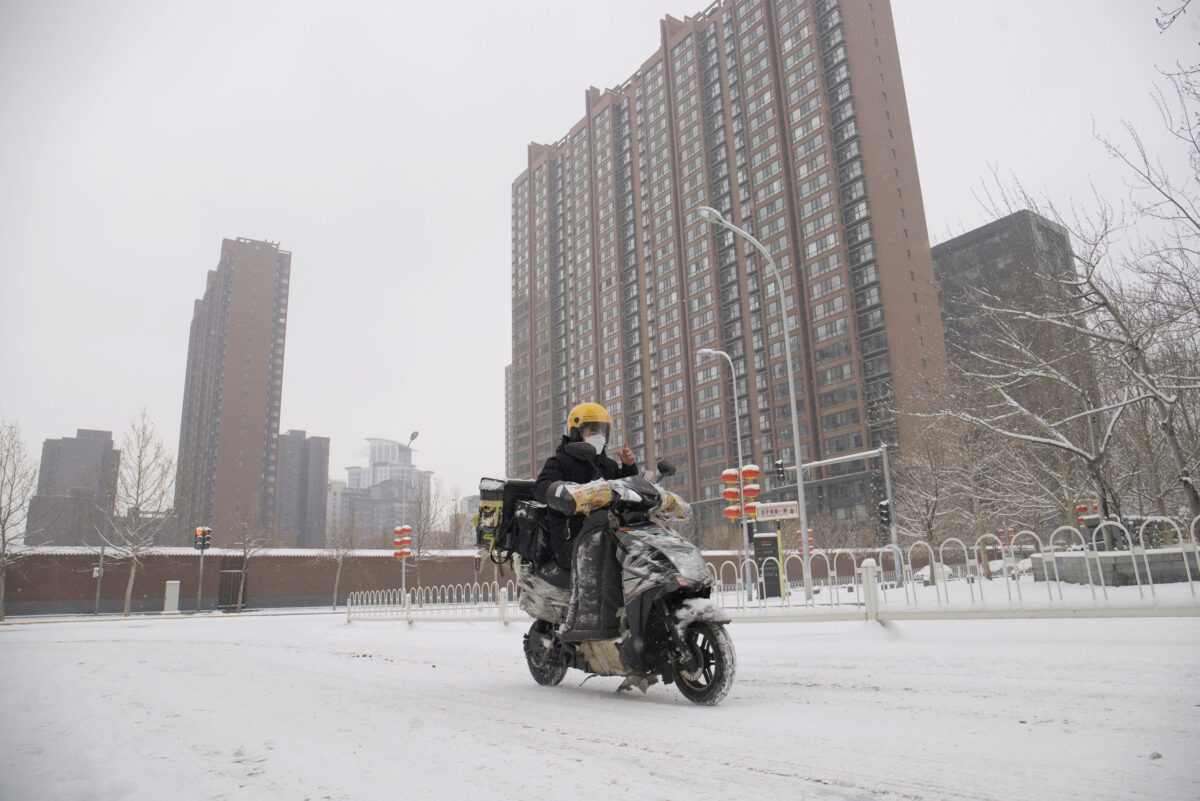
One of the posts shows a delivery rider in Guangxi Province on April 3 taking two children while making deliveries—one seated in front of his bike and the other strapped to his back.
Another one shows that on Jan. 17, a food delivery rider in Guangxi Province delivered orders in the frigid cold during winter, bringing his child along with him.
Another popular video post shows a male food delivery worker in Kunming, Yunnan Province, having a meal at a restaurant while carrying a child on his back during a break between deliveries on Nov. 30, 2025.
Su He, a delivery rider in Guangzhou, Guangdong Province, who used a pseudonym out of fear of reprisal, told The Epoch Times that he is from Zhaoqing, Guangdong Province. He said his child’s mother left them, so he had to take care of the child while making deliveries.
Su said that making money has become increasingly difficult, and he has had to sometimes deliver food overnight with his sleeping child in tow.
He made every effort to keep the child within sight, Su said. Whenever he went inside to pick up an order, he would typically ask someone at the shop to keep an eye on the child for him. He has not sent his child to kindergarten because of the cost.
“Right now, delivering food pays only [3,000 yuan to 4,000 yuan ($443 to $591)] a month,” Su said.
As the economic situation continues to worsen in China, he said that even college students, previously one of the main customer groups, have stopped ordering food delivery.
“Orders are scarce now, and the competition is fierce,” he said. “In the past, I could work over 10 hours a day carrying my child on my back, but now, I’m lucky if I can get in just a few hours of work a day.”
Sanlian Life Lab’s “2026 Survival Report on Chinese Food Delivery Workers” depicts the plight and struggles of the Chinese delivery riders. The documentary has attracted wide public attention but has been banned by the Chinese regime. The documentary can still be found on overseas online platforms such as X and China Digital Times.
Tang Bing and Guo Xiaohua contributed to this report.
 Friends Read Free
Copy
Facebook
Tweet
Friends Read Free
Copy
Facebook
Tweet