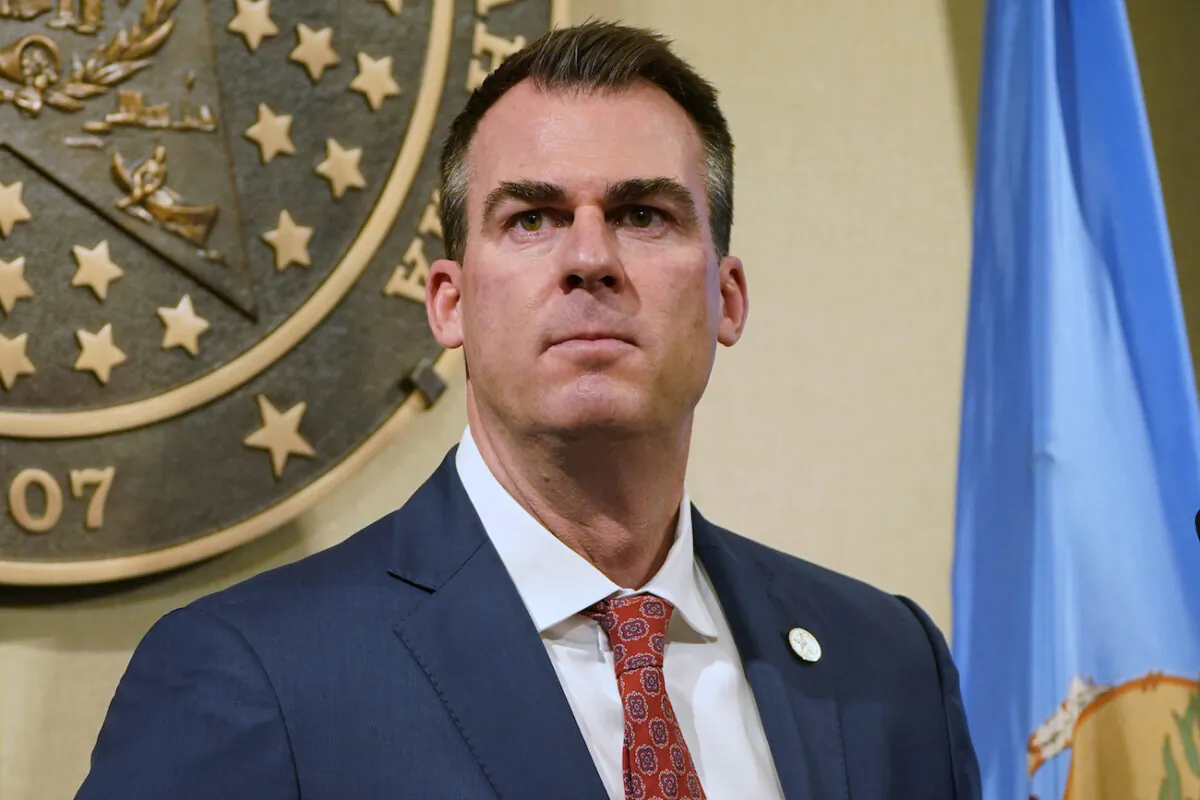


Oklahoma Gov. Kevin Stitt said China has been trying to exert influence at the state level across the United States, which he has rejected while also creating his own international strategy to avoid reliance on China-made imports.
“They’re going to the states now because Congress is so dysfunctional,” Stitt said in an interview on EpochTV’s “American Thought Leaders” program that aired on Aug. 1. “It’s so political. It’s so partisan that they’re literally coming directly to the states.”
Regarding Beijing’s attempts to influence him, Stitt said he has effectively blocked them.
“They don’t reach out to me,” he said. “I’ve shut them down.”
Stitt, now serving his second term as governor after winning reelection in 2022, recalled the supply chain disruptions that occurred during the COVID-19 pandemic. In response, he said, he had his advisers look into the issue. According to him, those disruptions would be 20 times worse in the event of a conflict between China and Taiwan.
In June 2024, Stitt issued an executive order to secure Oklahoma against threats posed by foreign adversaries, particularly the Chinese Communist Party. The order mandates that the Office of Management and Enterprise Services conduct a wide range of tasks, including an annual statewide risk assessment to identify vulnerabilities, such as cybersecurity threats, and risks to the electric grid, water infrastructure, and supply chains.
The order also instructs the Office of Management and Enterprise Services to audit critical state procurements and directs state agencies to reduce reliance on single-source procurement.
“It’s a national interest for us to bring the supply chain closer to home,” Stitt said. “It also helps us target certain things and promote economic development in our state.”
International Strategy
Stitt said that while securing his state from Chinese regime aggression, he has implemented an international strategy. He has met with 80 different ambassadors to put his state on their radar and signed memoranda of understanding (MOUs) with multiple countries, including the UK and Denmark.
In December 2024, Stitt, accompanied by officials from the Oklahoma Commerce Department, traveled to Taiwan, South Korea, and Japan for a trade mission. In Taiwan, he met with Taiwanese President Lai Ching-te, and the two sides signed an MOU to strengthen collaboration in the energy and aerospace sectors.
Stitt said his Asian trip was about helping U.S. allies “unplug from their reliance on China,” including their reliance on China’s oil, gas, or agricultural products, given that Oklahoma is one of the top natural gas-producing and crude oil-producing states.
“They need to know that they’ve got an ally that they can support,” Stitt said. “That’s part of the reason we make those trips, to see how we can help, what their needs are.”
Earlier this year, the Oklahoma Legislature passed a resolution expressing support for the state’s continued partnership with Taiwan and celebrating the 46th anniversary of the Taiwan Relations Act.
Taiwan and the United States are currently not diplomatic allies, since Washington switched its diplomatic recognition from Taiwan to China in 1979. Nonetheless, under the Taiwan Relations Act of 1979, the United States remains Taiwan’s most important ally and main arms supplier.
‘Critical Mineral Capital’
Stitt said he has been working to position Oklahoma as the “critical mineral capital of the United States.”
In May, Emirates Global Aluminium, which is based in the United Arab Emirates, agreed to invest $4 billion in the construction of an aluminum smelting facility in Oklahoma, the first of its kind in the United States in 45 years. It is to be built at the Port of Inola, east of Tulsa.
According to an MOU signed by Stitt and the company’s CEO, the smelter’s annual capacity would be about 544,000 metric tons. Oklahoma state officials said in May that the project would generate about 1,000 direct jobs and 1,800 indirect jobs.
In 2024, China produced 43 million metric tons of aluminum—about 60 percent of global output—up from just 4 million in 2004.
“The United States is the one that has developed a lot of these processes, mineral to magnet processes,” Stitt said. “We lost all this manufacturing expertise, critical mineral manufacturing, over to China. … And so now we know the mistake of that, and we’re trying to bring that back.
“We have [companies like] USA Rare Earth, Green Li-ion, and Blue Whale. We’ve got all the battery companies coming. We’ve got new battery companies that are making lithium and phosphorus-type materials that are going to go into the new type of batteries instead of the cobalt-nickel type stuff.”
Green Li-ion, headquartered in Singapore, has a plant located in Atoka, Oklahoma, that produces battery-grade cathode and anode materials from spent batteries. In June 2024, Stitt and other state leaders participated in the grand opening ceremony of the plant.
Blue Whale Materials, which announced its investment in Oklahoma in 2023, has a lithium-ion battery recycling facility in Bartlesville, Oklahoma.
In January, Stitt took to X to announce that USA Rare Earth had manufactured its “first batch of rare earth magnets” at its plant in Stillwater, Oklahoma.
“This is a major win—helping America secure the critical mineral supply chain from the Chinese Communist Party,” Stitt wrote.
 Friends Read Free
Copy
Facebook
Tweet
Friends Read Free
Copy
Facebook
Tweet