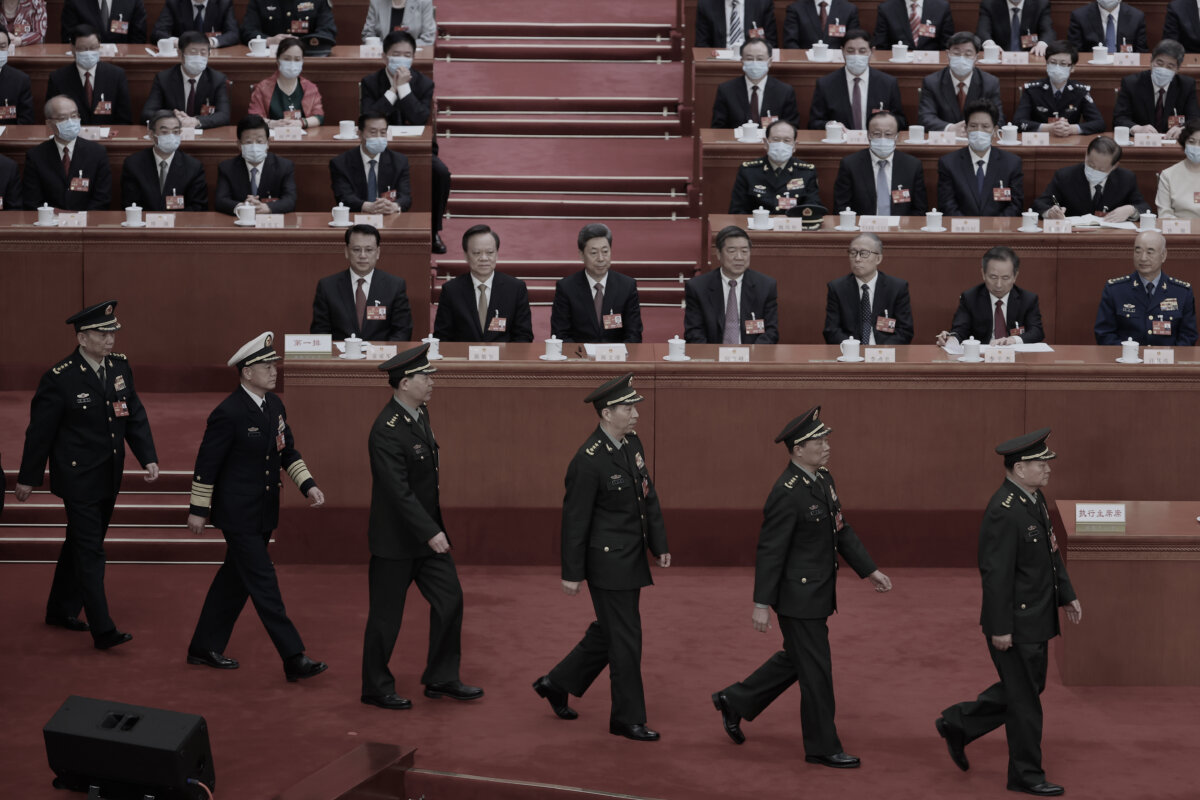
The Chinese Communist Party (CCP) opened the Fourth Plenary Session of its 20th Central Committee in Beijing on Oct. 20, touting plans to map out China’s economic blueprint for the next five years.
However, the focus of the four-day meeting has been overshadowed by an unprecedented purge within the top ranks of the regime’s military and ruling elite.
Mass Expulsion of Top Generals Before Key Meeting
Just days before the plenary session, nine top military officials, including Vice Chairman of the Central Military Commission (CMC) He Weidong, were expelled from the CCP and stripped of their military ranks.
Their expulsions are expected to be formally confirmed at the ongoing plenary session, and with its 205 full members and 171 alternate members, the CCP’s 20th Central Committee will now need to fill at least 12 high-ranking vacancies.
Several other senior figures, including former Minister of Agriculture and Rural Affairs Tang Renjian, former Shanxi Province Gov. Jin Xiangjun, and CMC logistics chief Zhang Lin, have also been dismissed or investigated in recent months.
‘Fujian Clique’ and Taiwan Invasion Plan
Two purged officials, He and former Gen. Lin Xiangyang, commander of the Eastern Theater Command, were once key architects of China’s “Taiwan strategy.”
Their downfall, analysts say, signals both a deepening purge within the People’s Liberation Army (PLA) and potential disruption to China’s ability to coordinate any large-scale military action around Taiwan.
Most of the purged officers, including He and Lin, once served in the former 31st Army Group headquartered in Xiamen, Fujian Province, directly across the strait from Taiwan. The unit, dissolved during earlier military reforms, long served as a training ground for Taiwan-focused operations and produced many officers later promoted under Xi. Their shared background in Fujian, where Xi spent much of his early political career, earned them the nickname “the Fujian clique.”
He, for instance, directed the high-profile military drills that surrounded Taiwan after former House Speaker Nancy Pelosi’s 2022 visit to Taipei, Taiwan, a show of force that elevated him to CMC vice chairman two months later.
Replacement Process Raises Questions
The purge has triggered questions over how the CCP will fill so many senior posts at once, especially in the military.
Shen Ming-Shih, a researcher at Taiwan’s Institute for National Defense and Security Research, told The Epoch Times that the CCP’s replacement process is complicated because most ousted members were from the armed forces. Under CCP rules, full members are typically replaced by alternates in order of ranking, but many of the next alternates are not from the military.
“For example, after [former Adm.] Miao Hua was removed, if his successor in the Political Work Department is not a Central Committee alternate, that means he can’t automatically be promoted to a full member,” Shen said. “The Party may have to wait until the 21st Party Congress to formalize these changes.”
This could leave key military commanders in charge of major units without formal Central Committee status, which is an unusual and politically sensitive situation, according to Shen.
Possible Reshuffle of Top Military Body
China observers are also watching whether Chinese leader Xi Jinping will reorganize the CMC itself.
With He’s removal and the previous removals of CMC members Li Shangfu and Miao Hua, the CMC has shrunk from seven members to four. Because He was also a member of the Politburo, the CCP’s second-highest leadership panel, his removal also reduces the Politburo to 23 members from 24.
Whether the vacant vice chairman position will be filled remains uncertain. CCP Minister of National Defense Dong Jun has not yet been elevated to the CMC, fueling speculation that he could be promoted during or after the plenary session. Some believe that the replacement might come from current CMC members Liu Zhenli or Zhang Shengmin.
Collapse of Trust Within Military
According to analysts, the purge exposes a deep crisis in Xi’s command over the armed forces.
In an opinion article for the Chinese edition of The Epoch Times, China current affairs commentator Yuan Bin wrote that the downfall of nine generals on the same day proves that Xi’s years-long anti-corruption campaign within the military has failed.
“Never before has a chairman of the CMC held such absolute power yet been so inept and muddle-headed in commanding the military as Xi Jinping,” he wrote.
“Never before have senior generals paid such blatant lip service while defying the Party leader behind his back. And never before has the military descended into such internal chaos. It shows just how deeply rotten the CCP’s authoritarian system has become.”
Similarly, Taiwanese political commentator Hung Yao-nan wrote in Taiwan’s Newtalk that the latest shake-up amounts to “a political nuclear explosion.”
“From the CMC vice chairmen to the Rocket Force, Navy, Armed Police, Eastern Theater Command, and joint operations centers—nearly every core command has collapsed overnight,” Hung wrote. “All nine purged generals were handpicked by Xi himself. This is no longer an anti-corruption drive. It is power devouring itself.”
A Political Stress Test for Xi’s Leadership
The sweeping military purge indicates a broader crisis of confidence inside the CCP’s upper echelons, analysts said.
While state propaganda frames the plenary session as focused on economic planning, many see it as a political stress test for Xi’s ability to maintain control amid growing signs of instability at the top of the communist regime’s party-state apparatus.
Ning Haizhong and Luo Ya contributed to this report.
 Friends Read Free
Copy
Facebook
Tweet
Friends Read Free
Copy
Facebook
Tweet