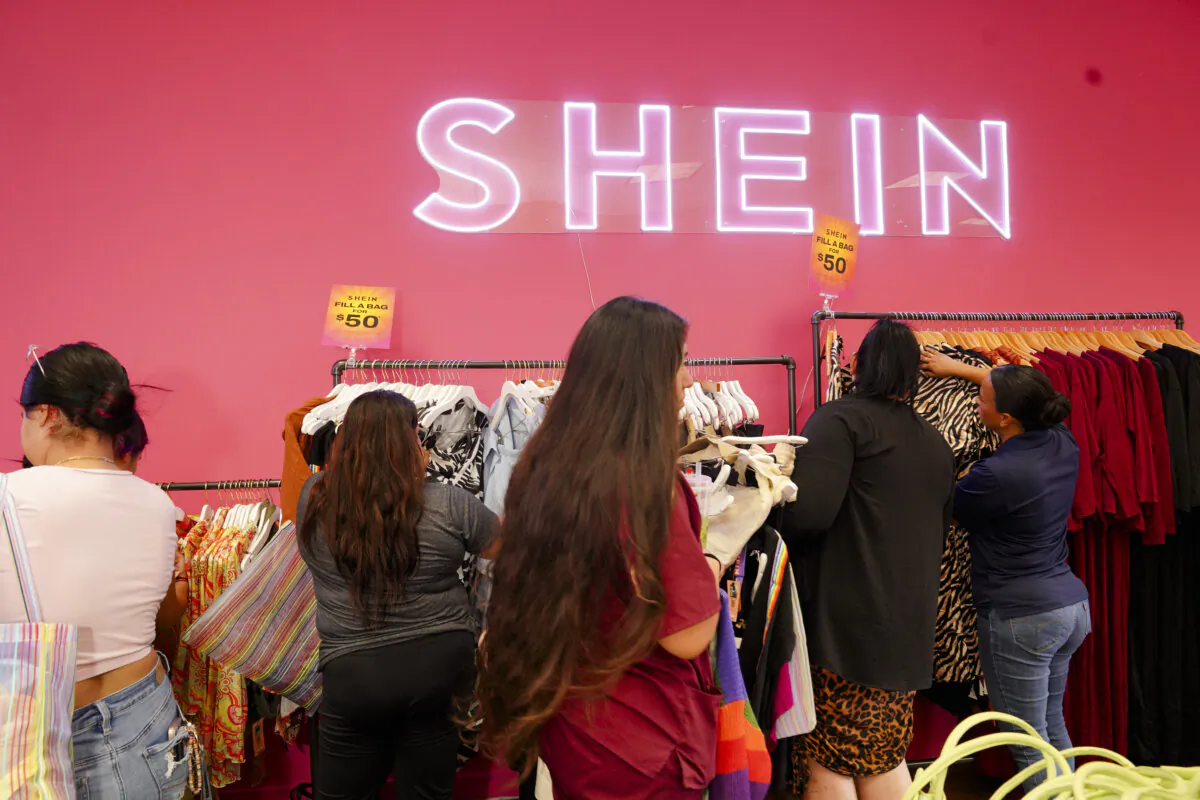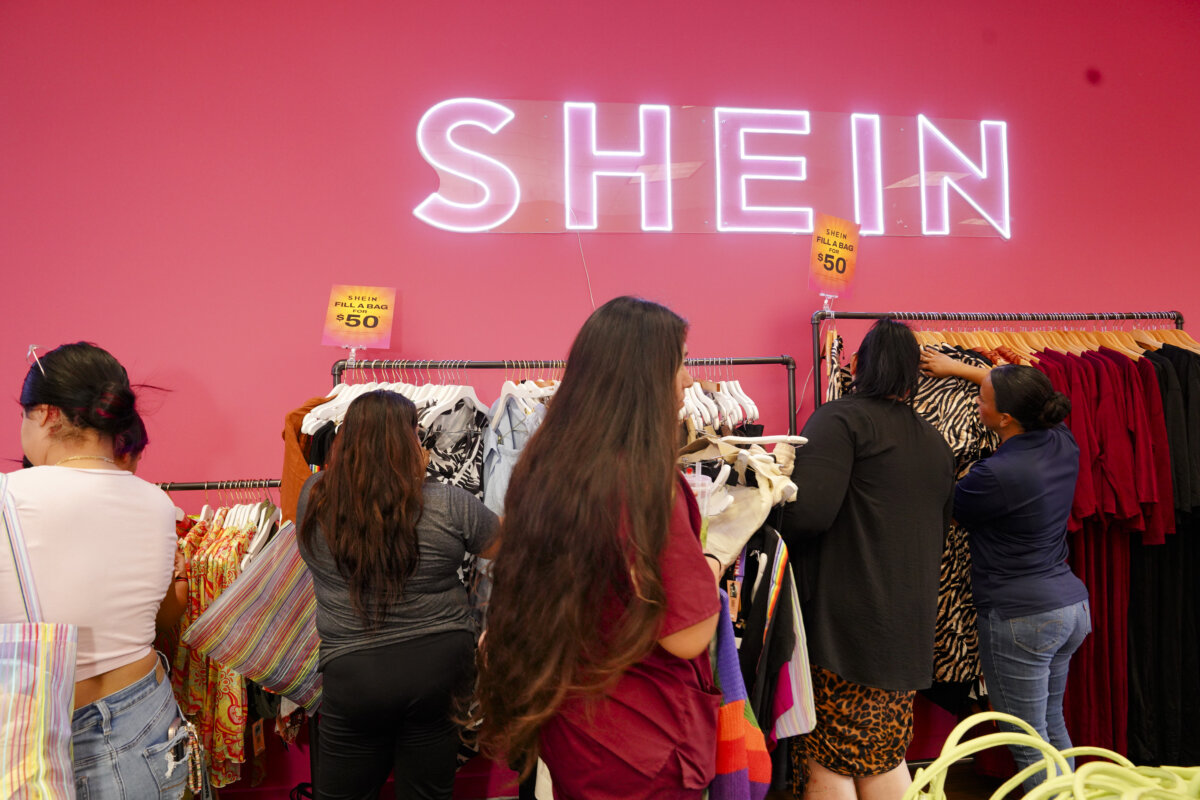

Two Chinese-linked fast-fashion platforms brought their global corporate war to London’s High Court on May 11, as Shein accused rival Temu of copyright infringement “on an industrial scale,” even as both companies face mounting scrutiny from American lawmakers, law enforcement, and intelligence officials over forced labor, data security, and counterfeit goods.
The two-week London trial opened with Shein’s attorney Benet Brandreth telling the court that Temu systematically copied thousands of Shein’s product photographs to advertise knockoff clothing on its platform—a calculated move, Brandreth argued, to “piggyback” on a more established competitor.
“This was an attempt to steal a march on an existing participant in the market,” Brandreth told the court, noting that Temu sought to gain an unfair competitive advantage.
Temu denied the allegations and countered with its own claim: Shein’s lawsuit is not a genuine intellectual property action but a legal weapon designed to suppress competition.
Temu, owned by PDD Holdings and headquartered in Dublin with significant operations in China, has counter-claimed that Shein broke UK competition law by locking fast-fashion suppliers into exclusive agreements—allegations Shein denies. In a significant courtroom development, Brandreth disclosed that Temu had dropped its defense on Shein’s copyright claims over nearly 2,300 photographs taken by Shein employees, comparing the move to a defendant pleading guilty at the last moment.
A Global Legal War
The London proceeding is the latest front in a cross-border legal conflict spanning the UK, the United States, and the European Union.
In Washington, federal courts have been handling parallel lawsuits since 2023.
Temu filed first, in December 2023, accusing Shein of employing “mafia-style intimidation” against suppliers—including alleged detention of vendor representatives, confiscation of their phones, and threats against businesses that continued serving Temu. Shein called the claims “without merit” and countersued in August 2024, accusing Temu of facilitating counterfeit goods and misappropriating proprietary data.
In September 2025, a federal judge dismissed Temu’s antitrust and trade secret claims, ruling that the alleged misconduct occurred in China and fell outside U.S. jurisdiction, although copyright and trademark claims were allowed to proceed.
Both cases were subsequently consolidated into a single proceeding.
‘Chinese Communist Retail Platforms’—Washington’s Verdict
What the London courtroom frames as a commercial dispute, U.S. national security officials and lawmakers have framed in sharper terms—and with the same target on both companies.
Sen. Tom Cotton (R-Ark.) called Shein and Temu “Chinese communist retail platforms” in a December 2025 letter to then-Attorney General Pam Bondi, urging the Department of Justice and the Department of Homeland Security to conduct immediate warehouse inspections, seizures, and criminal investigations.
The letter cites an August 2025 report finding that nearly half of 51 products purchased from Temu, Shein, and AliExpress were likely counterfeits, including cosmetics, toys, pharmaceuticals, and luxury goods. Cotton noted that President Donald Trump’s closure of the de minimis exemption, which allowed packages valued under $800 to enter the United States duty-free and largely not inspected, had fundamentally shifted the enforcement landscape.
“Their goods are no longer slipping through ports,” he said. “They are sitting on American soil under U.S. jurisdiction.”
Forced Labor: Congressional Findings on Record
The bipartisan House Select Committee on the Chinese Communist Party reached conclusions about both companies in its 2023 interim report.
Then-Chairman Mike Gallagher (R-Wis.) called the findings “shocking,” stating that Temu was “doing next to nothing to keep its supply chains free from slave labor,” while both platforms had built business models around the de minimis loophole to dodge import taxes and evade scrutiny.
The committee found that the two companies together were likely responsible for more than 30 percent of all packages shipped daily to the United States under the de minimis provision. The report states that Temu had no system to ensure compliance with the Uyghur Forced Labor Prevention Act, making it all but guaranteed that goods produced with forced labor were entering American homes.
In 2024, Shein disclosed that it had found two cases of child labor in its supply chain, one of which involved an 11-year-old child.
Digital Espionage and State-Led Litigation
The threat American officials identified extends beyond counterfeit goods into the personal data of millions of American consumers. In March 2026, the FBI issued a public service announcement warning about data security risks from foreign-developed mobile apps with ties to China, noting that such platforms are subject to Chinese national security laws that can compel them to hand over user data.
Multiple U.S. state attorneys general have filed suit against Temu and Shein, alleging that the apps operate as dangerous malware and spyware that steal user data.
Arizona Attorney General Kris Mayes filed suit against Temu for violations of the Arizona Consumer Fraud Act in December 2025, stating, “The Temu app can infect users’ devices with malware to steal their private data while carefully hiding its tracks.”
In February, Texas Attorney General Ken Paxton filed suit against Shein for selling toys made with toxic chemicals and exposing American data to the Chinese Communist Party. He also filed suit against Temu, alleging that it operates as “Chinese Communist spyware disguised as a shopping app” and engages in deceptive trade practices. In January, Texas Gov. Greg Abbott banned Shein and Temu from all state-issued devices and government networks.
The Identity Question and European Pressure
Both companies have structured their corporate identities to suggest distance from Beijing—a posture under increasing challenge.
Shein relocated its headquarters from Nanjing, China, to Singapore in 2022. However, in February 2026, its founder made his first-ever public address in Guangdong Province, pledging major investment in China’s supply chain and, observers noted, openly embracing the company’s Chinese roots after years of careful ambiguity.
Temu’s parent, PDD Holdings, similarly relocated its principal offices to Dublin while maintaining substantial Chinese operations.
European regulators have matched Washington’s trajectory. The European Commission found in July 2025 that Temu was breaching EU rules by failing to prevent illegal product sales.
France separately sought to suspend Shein’s operations over the discovery of banned items sold through its marketplace, and Germany launched an antitrust investigation into Temu in October 2025.
The EU is set to close its de minimis exemption. Beginning on July 1, 2026, goods entering the EU in small consignments and valued at less than 150 euros (about $176) will be subject to a fixed 3 euro ($3.51) customs duty.
 Friends Read Free
Copy
Facebook
Tweet
Friends Read Free
Copy
Facebook
Tweet