
TAIPEI, Taiwan—Taiwan’s top security official warned on April 8 about China’s “united front’ operations against the island, as Taiwan’s main opposition leader is in China and meeting with Chinese Communist Party (CCP) officials.
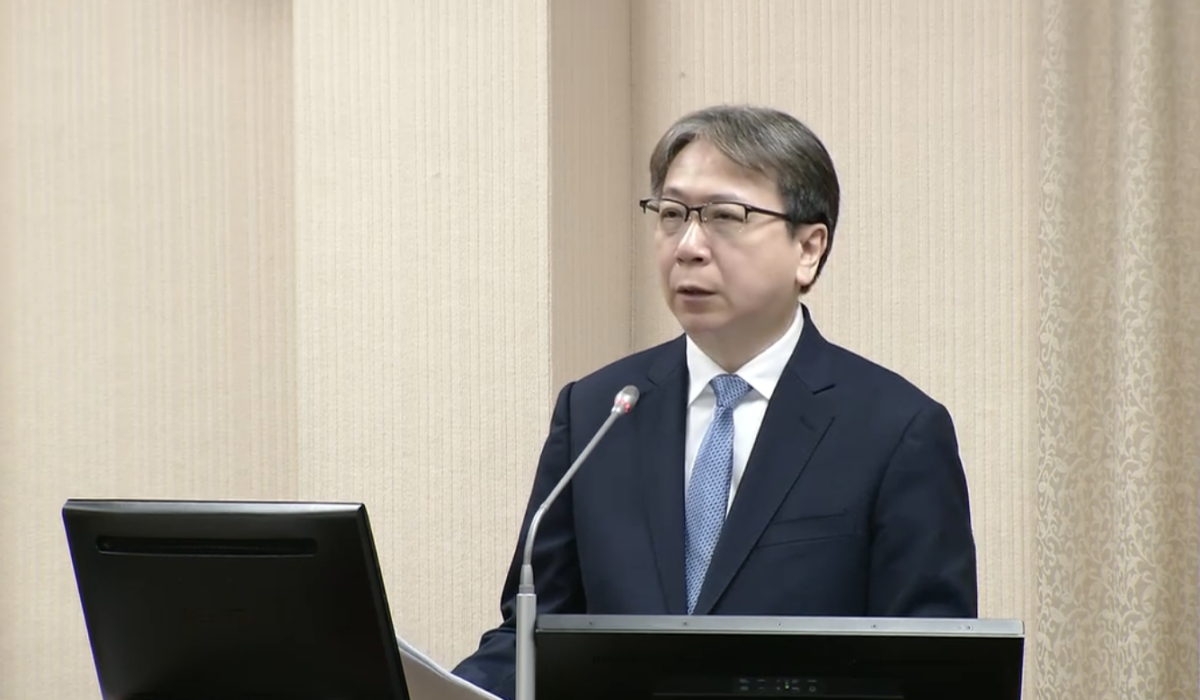
Tsai Ming-yen, director-general of Taiwan’s National Security Bureau, issued the warning at parliament on the morning of April 8 while answering reporters’ questions about Cheng Li-wun’s China trip, now in its second day.
Cheng, chairwoman of Taiwan’s largest opposition party, the Kuomintang (KMT), has described the trip as a “historic journey for peace.”
In response, Tsai said he could not comment on political parties’ activities, but added that the Chinese regime employs a carrot-and-stick strategy.
“On one hand, [Beijing] creates a tense cross-strait atmosphere of potential conflict through military intimidation and gray-zone harassment, intending to make Taiwanese society and its people feel the psychological pressure and anxiety of possible conflict,” Tsai said, according to a translation.
“On the other hand, [Beijing] promotes various cross-strait exchange activities to advance the so-called cross-strait peace led by the Chinese Communist Party, as well as the potential spillover benefits as a result of such peace.”
The CCP views Taiwan as a part of its territory and is rapidly modernizing its military in an effort to take the island by force or compel it to submit to its rule. Its gray-zone tactics have included dispatching military aircraft and vessels into Taiwan’s surrounding areas, as well as holding large-scale military drills in the region.
Beijing’s strategy aims to achieve two objectives, Tsai said.
“First, it is to divide Taiwanese society, amplifying pro-China voices, which can also serve to further hinder efforts to advance U.S. arms sales [to Taiwan],” he said.
“Second, it is to divide Taiwan–U.S. cooperation. Through exchange activities, it seeks to shape cross-strait opinions on reunification, thereby weakening U.S. involvement in Taiwan Strait affairs and its influence on related discussions.”
The KMT is widely seen as more Beijing-friendly than the ruling Democratic Progressive Party (DPP). Since 2016, the Chinese regime has refused to deal with the DPP-led government, branding both President Lai Ching-te and his predecessor, Tsai Ing-wen, as “separatists” for their vocal advocacy of Taiwan’s sovereignty.
Lai’s $40 billion special defense budget, which has the support of U.S. lawmakers, is stalled in the opposition-controlled parliament.
So anytime the CCP is pushing forward cross-strait exchanges, Tsai said, underneath them all are “political and united front strategies.”
The CCP’s “united front” effort is spearheaded by its United Front Work Department, which oversees a network of organizations with the mission of co-opting civic groups, gathering intelligence, shaping the political environments of other countries, and influencing public opinion.
Trips
Cheng, who arrived in China on April 7, made the trip at the invitation of Chinese leader Xi Jinping.
On April 8, Cheng laid a wreath at the mausoleum of her party’s founder, Sun Yat-Sen, in Nanjing, the capital of coastal Jiangsu Province, according to the KMT’s Facebook page.
Nanjing once served as the capital of the KMT-led Republic of China government before it fled to Taiwan in 1949 after losing control of China to Mao Zedong’s communist forces during the Chinese Civil War.
Also in Nanjing, Cheng and her delegation met with Xin Changxing, Jiangsu’s CCP secretary. According to the KMT Facebook page, Cheng and Xin reached a consensus on future cooperation in economy, technology, culture, and youth exchanges.
There has been no official announcement of a meeting between Cheng and Xi before her scheduled departure on April 12. During a briefing on April 8, Zhu Fenglian, spokesperson of China’s Taiwan Affairs Office, did not respond when asked whether the two would meet on April 10.
After speaking with reporters, Tsai attended a parliamentary session hosted by the Foreign Affairs and National Defense Committee to present a report about his agency’s operations.
Tsai told lawmakers that the Chinese regime’s infiltration efforts have primarily targeted mid-level military officers with access to classified intelligence. However, he added that recent observations show that the regime has also begun targeting rank-and-file enlisted personnel.
In March, a Taiwanese active-duty soldier in the air force’s communication unit was indicted with two others for allegedly passing on military secrets to the CCP’s intelligence service.
The report pointed out that 58 individuals have been indicted in espionage cases related to China from last year through March this year. Among them, 32 were active-duty or retired military personnel.
Regarding China’s cyber threats, the report said that Taiwan’s Government Service Network was hit with more than 173 million intrusion attempts in the first three months of this year.
“It cannot be ruled out that the Chinese Communist Party is laying the groundwork to interfere in [Taiwan’s] year-end elections, with intentions to expand intelligence gathering, surveillance, and data theft,” the report reads, according to a translation.
Taiwan is set to hold general elections in November, during which voters will choose city mayors, city and county councilors, and county chiefs.
Zheng’s trip to China comes as several U.S. lawmakers are visiting Taiwan.
On April 7, Reps. Zach Nunn (R-Iowa), Scott Fitzgerald (R-Wis.), Julie Fedorchak (R-N.D.), and Jefferson Shreve (R-Ind.) met with Lai at the presidential office.
Sen. Jim Banks (R-Ind.), who serves on the Senate Armed Services Committee, met with Lai on April 8. According to a statement from the presidential office, Banks said the purpose of his visit was to reaffirm that the United States stands with Taiwan, which he described as an indispensable partner in a free and open Indo-Pacific.
 Friends Read Free
Copy
Facebook
Tweet
Friends Read Free
Copy
Facebook
Tweet