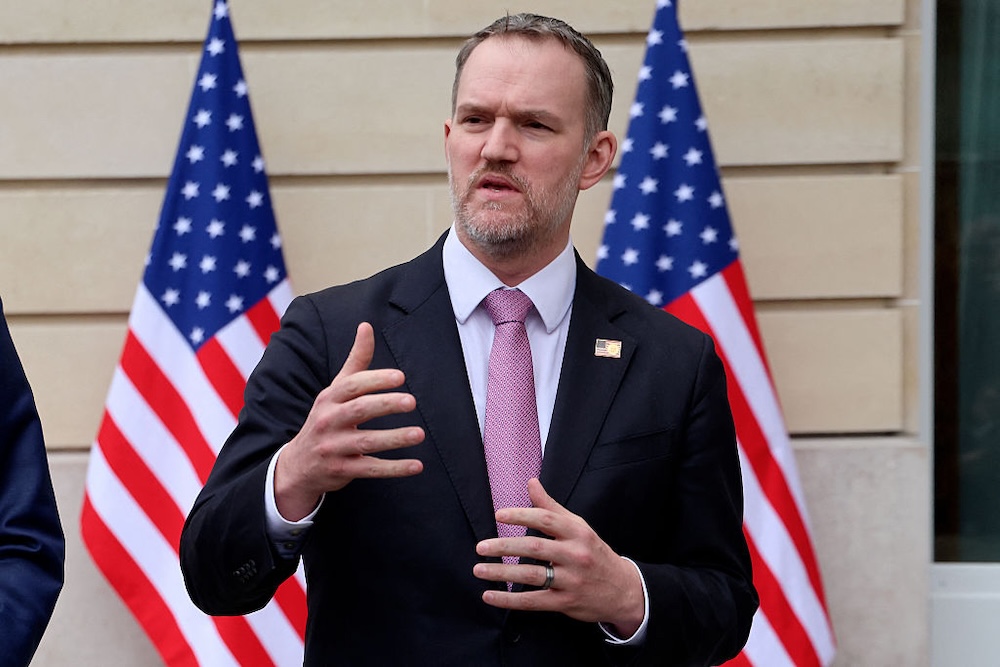

U.S. Trade Representative (USTR) Jamieson Greer said the U.S.–China bilateral meeting set for May 14–15 is still on schedule, and there is no indication that U.S. President Donald Trump is seeking another delay due to the war in Iran.
Greer met with Chinese counterparts in Paris on March 15–16 ahead of the bilateral meeting between Trump and Chinese Communist Party (CCP) leader Xi Jinping, where the negotiators worked out a framework for increasing trade between the two countries. Greer said during a March 31 interview with Bloomberg Surveillance that there are no additional meetings planned before the bilateral between Trump and Xi in Beijing.
Greer reiterated that both sides signaled the shared goal of stability, including possibly extending some terms reached during last October’s bilateral meeting in Busan, South Korea.
“Both sides want stability. Both sides want to see continuity. The Chinese know that the United States is trying to control for giant trade deficits that we’ve had with China for a long time, which went down by 30 percent last year,” he said.
New on the agenda for the U.S.–China trade talks is the formation of an entity to identify areas where trade can be mutually beneficial, Greer said, echoing comments about a U.S.–China board of trade that Greer made after the Paris talks.
“For the U.S., we want to be selling Boeings. We want to be selling medical devices, [agriculture] products, things like that. The Chinese want to be selling things to us, and we’re willing to buy things like low-tech consumer goods and … certain commodities that maybe the Chinese have that we don’t,” Greer said.
“Establishing that type of mechanism at the leaders’ meeting, and then going through a process of figuring out how to optimize trade with each other, that’s going to be a big deliverable.”
Greer previously said there was an opportunity to sell more energy and agricultural products to China as the United States seeks to reduce the trade deficit.
“I actually see a positive agenda with China going forward, where we learn to manage our trade with each other, where we take the kinds of things we want to be selling to each other, things that are mostly non-sensitive to avoid some national security negotiations. I see stability with China,” he said.
Ahead of the Trump–Xi meeting, both countries have opened trade probes into the other, which may result in penalties such as tariffs or fines.
In the United States, a Supreme Court ruling struck down Trump’s use of emergency powers to impose tariffs, leading the USTR to open Section 301 probes into unfair trade practices on the part of trade partners and forced labor in supply chains.
China on March 27 opened two trade investigations targeting the United States specifically, alleging disruption in renewable energy products and the global supply chain.
Greer called the probes “merely symbolic” in a statement on X, stating that China was “in fact the world’s most profligate disruptor of supply chains and trade in green products.”
“No one is fooled,” he said. “For the past year, China has disrupted global supply chains with unprecedented restrictions on basic commodity goods such as rare earth elements, fertilizers, and refined fuels.”
Last year, Beijing imposed sweeping restrictions on global critical minerals sales, and a key outcome of the Busan agreement was a one-year pause on such export controls. Greer said in Tuesday’s interview that the flow of critical minerals was part of the Paris discussions, where he raised concerns from industry that the Chinese side took “under consideration.”
“There are a few things here and there where we highlighted, that we didn’t feel like we were getting rare earths in a timely fashion,” he said.
Greer said an extension on the one-year pause was not a given but still needed assessment, as the United States has “made a lot of progress” securing alternative sources with trade partners and building a critical minerals stockpile.
 Friends Read Free
Copy
Facebook
Tweet
Friends Read Free
Copy
Facebook
Tweet