
Chinese leader Xi Jinping departed the United States on Sept. 25 after a three-day state visit that included White House talks with President Donald Trump, an elaborate military welcome, and a state dinner, but the summit has produced few publicly announced new agreements.
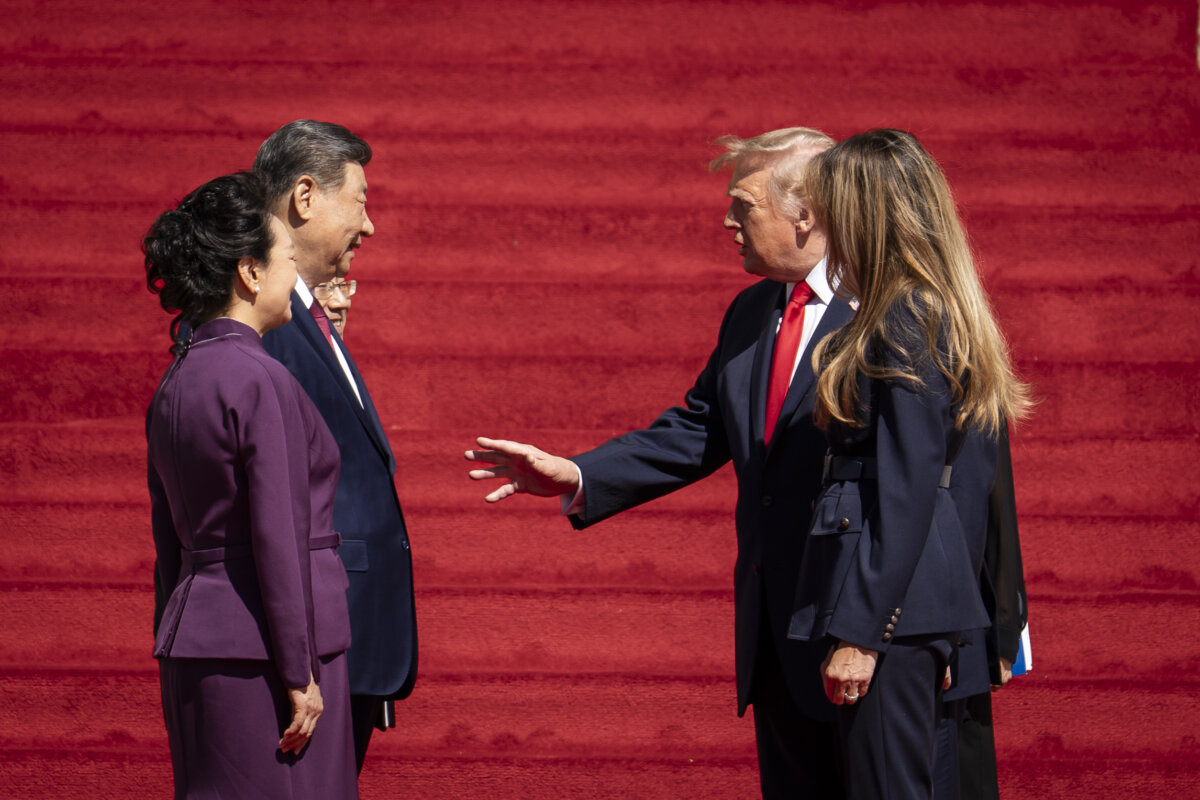
Trump personally greeted Xi and his wife, Peng Liyuan, at Joint Base Andrews on Sept. 23. The following day, the White House held a formal state arrival ceremony and military review before Trump and Xi met for bilateral talks, and the U.S. president and first lady hosted Xi and Peng at a state dinner.
On Friday, the couples met for tea at the White House and visited the National Archives.
The two governments had already extended their existing trade truce for two months before Trump and Xi sat down.
Treasury Secretary Scott Bessent said on Sept. 23 that the arrangement would run through Jan. 10, giving the sides more time to pursue a possible broader economic agreement.
China’s Foreign Ministry said after the summit that the two countries’ economic and trade teams had reached a new joint arrangement.
Its account of Trump’s remarks said the latest consultations had produced “new outcomes” and that negotiations should continue toward a broader deal, but the readout did not spell out the terms of such an agreement.
Broader Deals Remain Unsettled
Bessent said on Sept. 23 that Beijing had met its soybean-purchase commitment for the year but remained behind on other U.S. agricultural purchases, while U.S. officials said shipments of rare earths and critical minerals had fallen short of expectations.
Bessent said possible outcomes from the Trump–Xi meeting could include announcements involving financial services and additional agricultural purchases.
AI talks were also already underway before Xi arrived.
Bessent said the two sides had formalized a bilateral dialogue and were discussing a mechanism for serious AI-related incidents.
Beijing’s post-summit account said Trump and Xi backed continued AI cooperation but did not describe a separate new agreement reached by the two sides.
Shen Ming-shih, a researcher at Taiwan’s Institute for National Defense and Security Research, told the Chinese edition of The Epoch Times on Sept. 25 that Trump’s objectives were likely to center on tangible economic gains.
Shen said those could include Chinese commitments to buy more U.S. agricultural products, oil, or commercial aircraft, together with mechanisms to oversee continued trade commitments.
He said cooperation from Beijing on fentanyl could also become part of the bargaining, with tariff reductions potentially offered in return for steps to reduce the flow of the drug into the United States.
Before Xi arrived, Rep. John Moolenaar (R-Mich.), chairman of the House Select Committee on the Chinese Communist Party, told The Epoch Times that he had “limited expectations on what would come out of this.”
He said he wanted Beijing to honor its agricultural purchase commitments and take steps to prevent fentanyl from entering the United States.
Different Public Accounts
Chen Po-kung, a veteran U.S.-based commentator, told the Chinese edition of The Epoch Times on Sept. 25 that Beijing’s account focused heavily on Xi’s statements while giving Chinese audiences comparatively little information about Trump’s positions during the talks.
“The Chinese people basically don’t know what Trump said,” Chen said, describing the two sides as largely presenting their own accounts of the meeting.
The Chinese Foreign Ministry readout laid out Xi’s positions at length on bilateral relations, trade, artificial intelligence, Taiwan, and international affairs.
Its description of Trump’s remarks was shorter, saying he called Xi a friend, expressed confidence in the relationship, backed continued economic negotiations, and supported dialogue on AI.
Beijing said the two leaders also exchanged views on the Middle East, Ukraine, and the Korean Peninsula and agreed to support each other as hosts of the 2026 Asia-Pacific Economic Cooperation leaders’ meeting and Group of 20 summit.
Shen said he did not expect either side to give much ground on Taiwan, Iran, or the Korean Peninsula.
He also said Trump faced pressure from Congress and members of his administration that, in his assessment, would constrain any major undisclosed concessions to Xi.
Beijing’s account said Xi pressed Trump to oppose Taiwan independence and “handle the Taiwan question with caution.”
It did not say how Trump responded.
Human rights had also been an issue heading into the summit.
A senior U.S. official said on Sept. 18 that Trump was expected to raise cases involving wrongfully detained Americans and other human rights concerns.
Beijing’s account of the talks did not mention human rights.
At the state dinner, Xi said the visit had resulted in “new and important common understandings.” He did not specify additional agreements.
The two sides said their economic teams would continue negotiations on a broader deal.
 Friends Read Free
Copy
Facebook
Tweet
Friends Read Free
Copy
Facebook
Tweet