Chinese leader Xi Jinping’s renewed pledge to intensify his anti-corruption campaign is drawing attention ahead of a key Chinese Communist Party (CCP) meeting, with analysts linking the message to a widening purge of senior military officials and uncertainty over Xi’s control of the armed forces.
The CCP’s official theoretical journal, Qiushi, on Oct. 16 published a speech Xi delivered on Jan. 12, in which he declared that the fight against corruption “cannot stop for a moment or retreat by half a step.”
“Regardless of who they are, how high their positions are, or how great their contributions have been, as long as they engage in corruption, there will be absolutely no leniency!” Xi said in the speech.
He also warned against so-called “two-faced people” within the Party who conceal their true intentions and are prepared to abandon their loyalties when circumstances change.
The publication comes as the CCP prepares for its Fifth Plenum on Oct. 26–29, a key meeting expected to address Party discipline and personnel matters. The timing has prompted speculation that Xi could use the gathering to further consolidate his authority.
U.S.-based Chinese political commentators Chen Pokong and Tang Jingyuan told The Epoch Times that the speech signals Xi’s determination to maintain his anti-corruption campaign while confronting potential opposition within the Party and military.
Chen said the speech was particularly relevant to the investigations of two senior military figures, Zhang Youxia and Liu Zhenli, this year.
Zhang was a vice chairman of the Central Military Commission (CMC), the CCP’s top military command body, while Liu was chief of staff of its Joint Staff Department. Both were placed under investigation for suspected serious violations of discipline and law in January.
Tang said the timing of the Qiushi publication suggested Xi could be preparing for significant personnel changes at the Fifth Plenum, potentially extending the purge beyond the civilian leadership to the military.
Military Leadership Vacuum
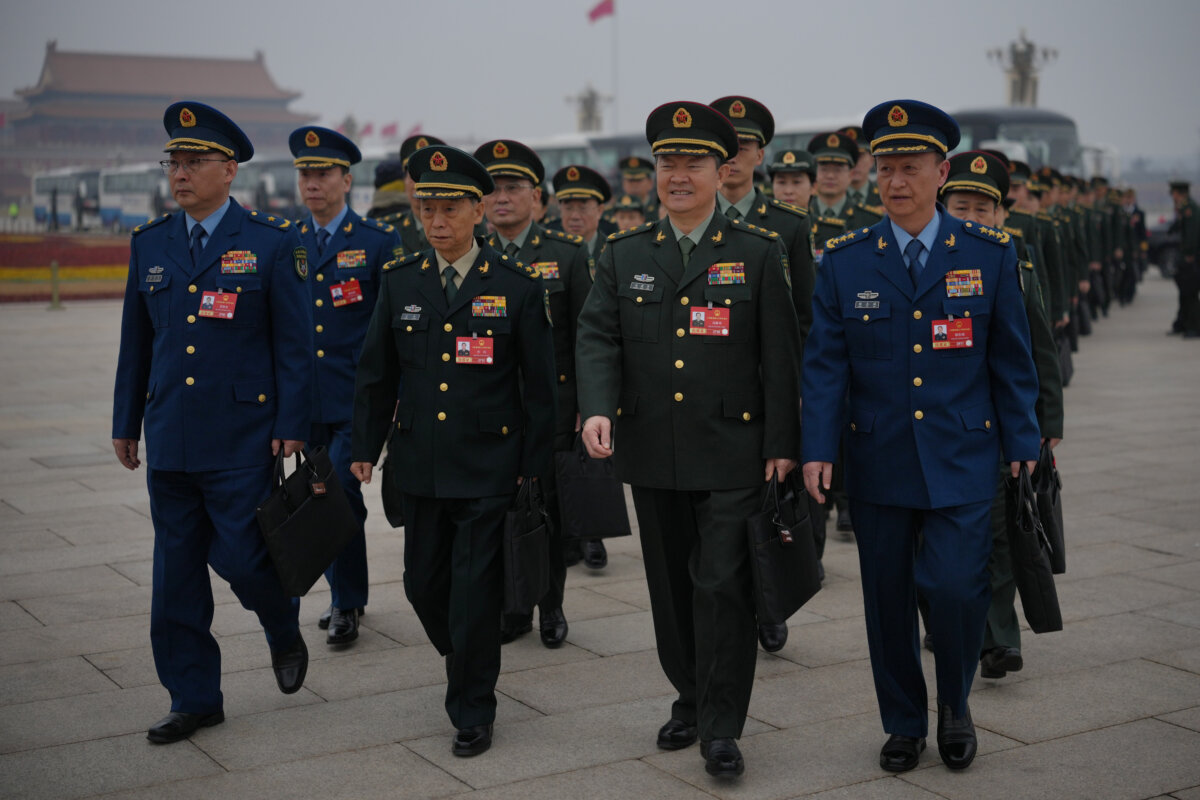
The investigations have left China’s military leadership facing significant uncertainty. Following a series of purges, the CMC has been sharply reduced, with Xi and Zhang Shengmin remaining.
Chen said that the weakened military leadership could benefit Xi by reducing the influence of senior officers with independent power bases. He also suggested Xi could use the Fifth Plenum to fill vacancies in the CMC or other senior Party bodies, although he may defer some appointments until the Party’s next national congress.
Tang, however, questioned whether removing Zhang and Liu had necessarily restored Xi’s control over the armed forces.
He said no senior commanders from the military’s major branches or theater commands had publicly endorsed the investigations or clearly distanced themselves from Zhang.
Tang also pointed to what he described as Xi’s absence from military units and theater commands during the year, arguing that this could indicate unease over the military’s loyalty. These observations, however, do not independently establish the extent of resistance within the armed forces.
The leadership uncertainty comes as Xi is expected to seek another five-year term as Party chief at the 21st Party Congress, scheduled for 2027. Maintaining control over the military is central to his political authority.
Controlling Online Military Content
On Oct. 15, the CCP announced a two-month campaign targeting what they described as improper marketing and sensationalism involving military-related information online.
The regime stated that the campaign will target accounts spreading misleading information about military careers, fabricating military-related stories, or disclosing sensitive details about service histories, military installations, unit designations, equipment, training, and operations.
The official notice was issued by the Cyberspace Administration of China, the Ministry of Veterans Affairs, and two military political and legal affairs departments.
Tang interpreted the campaign as part of a broader effort to manage public discussion during a politically sensitive period, noting that the two-month timeline overlaps with the Fifth Plenum and its potential personnel changes.
Chen said the move reflected concerns about loyalty within the armed forces, suggesting that the regime is seeking to control not only military officials but also discussion among ordinary service members.
The regime has not publicly linked the online campaign to the investigations of Zhang and Liu.
Corruption and Disloyalty
Xi has repeatedly made anti-corruption enforcement a central theme of his leadership since taking power in 2012. The latest published speech emphasized that corruption remains a major threat to the Party despite years of investigations and disciplinary actions.
The official announcement concerning Zhang cited suspected violations of discipline and law. The CCP has also accused other senior officials in recent years of disloyalty or factionalism, allegations that have accompanied Xi’s broader campaign to enforce Party discipline.
Chen said Xi’s repeated warnings against corruption and disloyalty also serve a political purpose, allowing the leadership to frame personnel purges as efforts to protect the Party.
He questioned whether the campaign had achieved its stated goals. “Xi has been in power for more than a decade,” he said. “Has he eliminated the ‘two-faced people’? Has he eliminated corrupt officials? Neither. There are more and more of them.”
Tang said the key indicator of Xi’s political position would be the composition of the next CMC and whether the officials appointed to it are firmly aligned with him.
The Fifth Plenum is expected to draw attention to senior personnel appointments as Xi continues his anti-corruption campaign ahead of the 2027 Party Congress.
Tang Bing and Luo Ya contributed to this report.
 Friends Read Free
Copy
Facebook
Tweet
Friends Read Free
Copy
Facebook
Tweet