
Commentary
As demand for rare earth elements surges worldwide, China’s dominance over the global supply chain continues to grow. At the same time, to its strategic disadvantage, the United States is falling behind in rare earth element production and access, putting its advanced defense infrastructure and weapons systems at risk. The potential impact of this can hardly be overstated.
Currently, the United States appears to be unable to compete with China in this critical area upon which many industries are heavily dependent. The world’s growing appetite for rare earth elements is driven by expanding demand for electric vehicles, critical defense systems, the burgeoning smartphone market, and the growth of clean energy technology.
China’s Near-Total Control Over Rare Earth Processing
In fact, when it comes to accessing rare earth minerals and refining capacity, China is the global leader and is playing hardball with the United States.
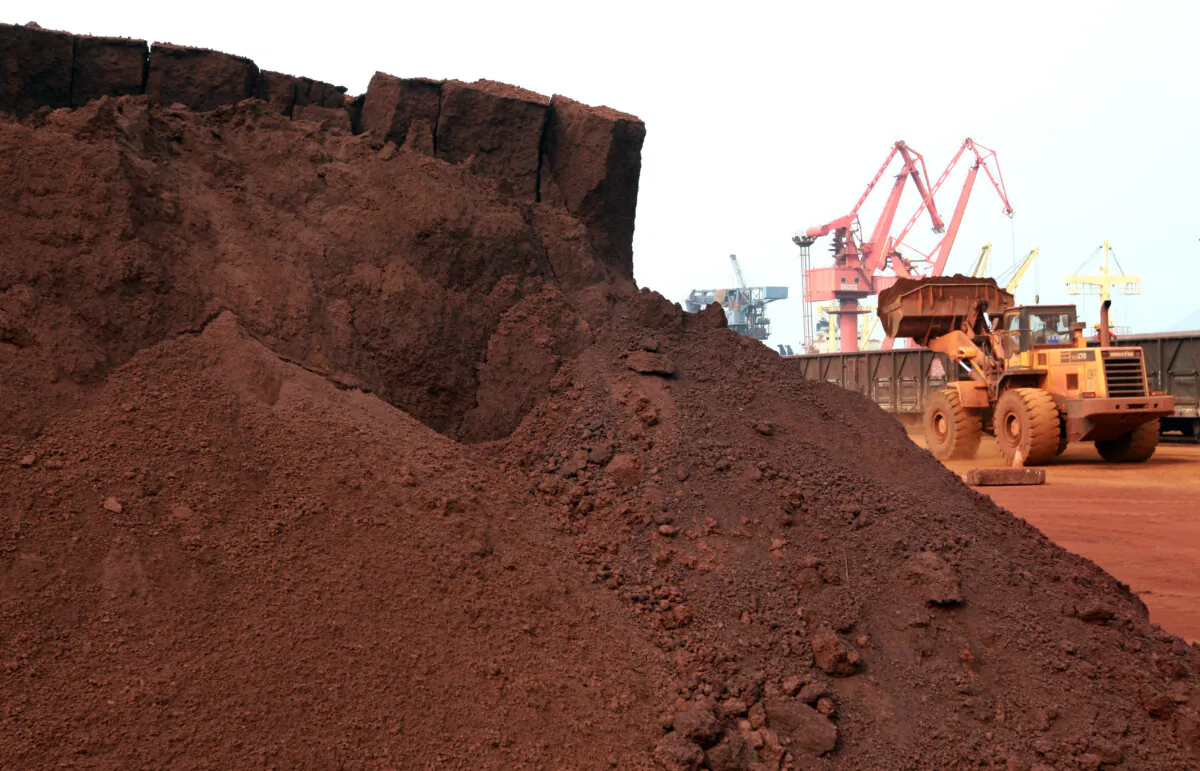
Despite rare earths being geologically widespread, China commands an overwhelming share of the downstream rare earth elements processing market. Estimates show that China controls more than 90 percent of the global rare earth refining and processing capacity. What’s more, the Chinese regime’s policy tightly restricts the exports of key heavy rare earth minerals—especially those vital to defense—adding fuel to trade discussions.
By contrast, the United States is attempting to gain independence in rare earth element production but currently has few options. The Mountain Pass rare earth mine in southeastern California is one, but it is underdeveloped. However, the Department of Defense has recently become the largest shareholder in the company that owns and operates the mine and has been awarded hundreds of millions of dollars in loans, as well as acquiring $1 billion in funding from J.P. Morgan and Goldman Sachs to develop critical processing capabilities.
US Access to a US-Funded Brazilian Mine Blocked by China
China’s policy of denying the United States access is effective because it also extends to foreign suppliers. Recently, the Serra Verde mine, a promising Brazilian rare earth site backed by U.S. and UK private capital, was seen as a potential U.S. ally in diversification efforts. But no Western facilities currently have the capacity to separate the rare earth elements, making China the only viable buyer. Therefore, it has been contracted to China until at least 2027.
This long reach of the Chinese Communist Party’s rare earth restrictions underscores Beijing’s strategic advantage and raises fresh alarm about U.S. access to these critical minerals.
Amid heightened U.S.–China tensions, Brazil has already tripled its rare earth exports to China in the first half of 2025, reaching approximately $6.7 million. That’s a significant increase viewed as part of China’s efforts to diversify its sources of strategic minerals. This rising export trend further strengthens China’s supply security and dominance.
US and Western Powers Racing to Diversify Supply Chains
In response, the United States, the European Union, and others are pursuing alternatives to rare earth element sources outside of China, such as the mine in Brazil, along with Western initiatives such as Aclara Resources’ mine in Canada and related U.S. processing plans that will become strategic counterweights to Chinese dominance.
Aclara has partnered with German company Vacuumschmelze to build a Pentagon-funded permanent magnet plant in South Carolina, thereby combining Brazilian raw materials with U.S. processing to provide a hemispheric solution to a global supply chain challenge.
Trade Deal Eases Rare Earth Restrictions—For Now
Amid the ongoing tensions between China and the United States, Washington and Beijing have agreed on a framework to ease restrictions on rare earth exports. China has agreed to lift its blockade on rare earth elements (REEs) to the United States, at least for a little while, in exchange for eased U.S. punitive actions.
But this arrangement is seen as a short-term reprieve—and for good reason. Both sides have already accused the other of breaching the terms of the deal, a strong indication that it’s not a strategic shift but a bargaining chip in the current trade negotiations.
US Introduces Higher Pricing Policy to Spur Growth
At the same time, the United States is attempting to reduce its dependency on China or other foreign-based REE supply chains by changing the market for rare earth elements.
For example, the U.S. Department of Defense has introduced a new pricing guarantee—$110 per kilogram for neodymium and praseodymium—to promote North American producers, such as MP Materials and Aclara Resources, and support the development of new magnet manufacturing in Texas.
The Trump administration’s strategy resembles a pandemic-era approach aimed at increasing U.S. production of critical minerals and reducing China’s market dominance by guaranteeing a minimum price for these products.
A High-Stakes Challenge and Top Priority
These new policies are a clear acknowledgment by the Trump administration of China’s unrivaled processing capability, its global capacity to capture and control rare earth output, and its ability to thereby deny the United States access to critical rare earth assets. In fact, in April, China suspended exports of several heavy REEs and magnets—effectively hamstringing many U.S. technologies and defense systems.
The bottom line is that China has shown that it is more than willing to exploit these critical vulnerabilities in its ongoing trade negotiations and geopolitical rivalry with the United States. As one would expect, remedying these weaknesses is a top priority for the Trump administration.
Views expressed in this article are the opinions of the author and do not necessarily reflect the views of The Epoch Times.
 Friends Read Free
Copy
Facebook
Tweet
Friends Read Free
Copy
Facebook
Tweet