
Commentary
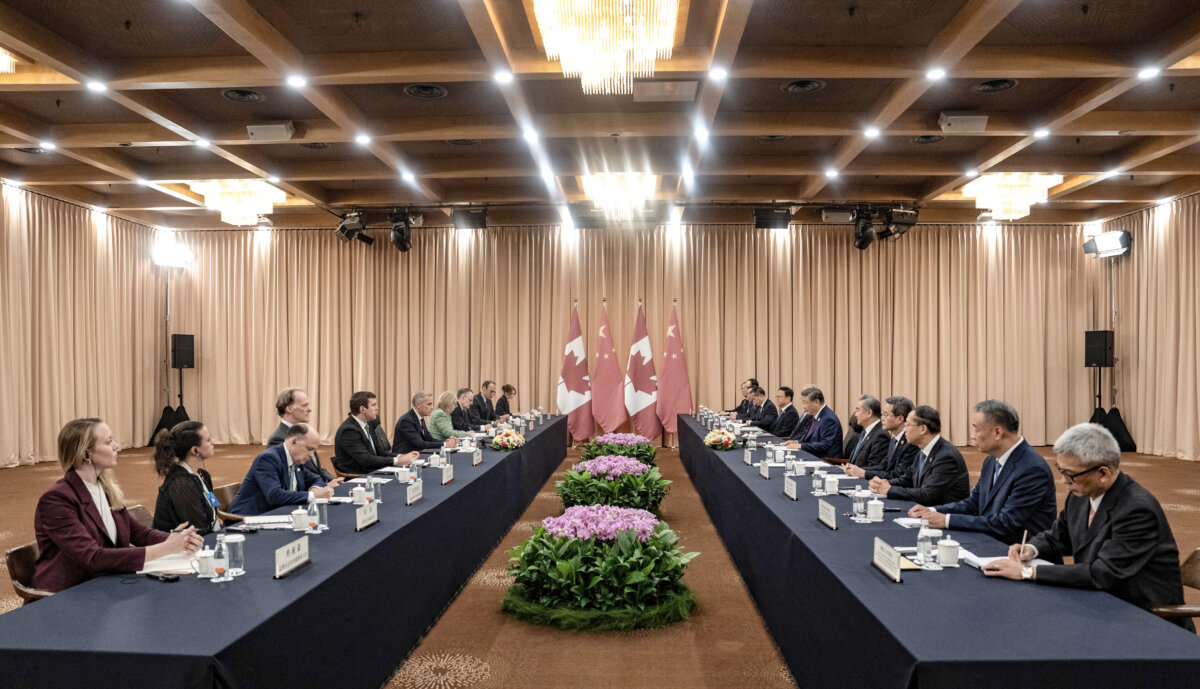
After the Liberal government defined Canada’s relationship with China as a strategic alliance, the prime minister’s visit to Beijing inevitably carried more weight. This was not simply a matter of timing or protocol. It reflected a decision about how Canada wishes to navigate a more contested international landscape. Choices of this kind extend beyond trade or messaging, and when a NATO member edges closer to an authoritarian system, allies recalibrate while competitors probe for advantage.
This is not a circumstance that can be managed through repeated talking points. It demands a harder look informed by experience, available evidence, and the practical obligations Canada has assumed within its alliance relationships.
Canada’s recent experience with the People’s Republic of China does little to support optimism. Over the past decade, Ottawa has grappled with the detention in China of Canadian citizens for political leverage, repeated attempts at foreign interference, pressure directed at diaspora communities, exploitation of regulatory and financial gaps, and the deliberate use of economic retaliation. These were not concerns raised in hindsight. They were not identified after the fact. They emerged through public inquiries, intelligence reporting, law enforcement investigations, and allied assessments, including parliamentary reviews and Five Eyes cooperation.
Against that record, declaring a strategic alliance without clear terms or parliamentary scrutiny exposes the country to significant risks.
Strategic Imbalance as a Structural Risk
The Chinese regime does not treat diplomacy, commerce, security, and political influence as distinct spheres. Under Chinese law and party doctrine, control extends across state-owned enterprises, private firms, academic institutions, diaspora organizations, and financial channels. These are understood as instruments of state power rather than independent actors. Assumptions common in liberal democracies, particularly the belief that economic engagement can be insulated from political influence, do not apply.
Canada’s exposure stems from this imbalance.
Ottawa often approaches engagement as transactional and issue-specific. Beijing approaches it as cumulative and strategic. A strategic alliance functions less as rhetoric than as an indication that boundaries are negotiable, as allied intelligence assessments have repeatedly shown.
Hostage Diplomacy as Proof of Concept
The detention of Michael Kovrig and Michael Spavor in December 2018 was a calculated use of coercive pressure rather than a routine diplomatic dispute, judged less by how it ended than by whether pressure proved effective. Moving toward closer alignment without setting consequences or deterrence for similar conduct signals that such behaviour carries little strategic cost, a pattern reflected in China’s treatment of other democracies during political disputes.
Reconciliation that lacks accountability is not a resolution. It is validation.
Recent Signals of Diplomatic Sensitivity
Developments surrounding Mark Carney’s Beijing visit further illustrate this imbalance. Two Liberal MPs curtailed a sponsored visit to Taiwan after receiving government guidance to avoid conflicting diplomatic signals during the prime minister’s China trip. While Canada’s formal position on Taiwan was restated, the decision was widely interpreted as an effort to avoid provoking Beijing.
These signals matter, especially in relation to Taiwan, where allied backing for its practical autonomy is central to Indo-Pacific policy and any hint of retreat risks unsettling partners and emboldening adversaries.
Economic Engagement Without Leverage Creates Dependency
From a political economy perspective, Canada approaches engagement with China from a position of structural disadvantage. China can replace Canadian exports far more easily than Canada can replace access to Chinese markets. Informal trade restrictions, regulatory obstacles, and selective enforcement have already been applied against Canadian industries.
Expanding economic exposure without enforceable reciprocity or diversification strategies increases vulnerability to coercion. This pattern has been documented by allied governments, international trade bodies, and academic research examining coercive trade practices.
NATO, the Arctic, and Alliance Confidence
What differentiates the current moment from previous engagement cycles is its effect on alliance trust.
Canada’s NATO responsibilities in the North Atlantic and Arctic place it at the centre of a region gaining strategic importance, making China’s near-Arctic claims and pursuit of access through research and infrastructure projects a clear security concern.
Allied warnings have been clear that permissive environments undermine alliance security, which is why signals of closer Canadian alignment with China without clear constraints raise concerns across intelligence and deterrence domains.
These concerns are longstanding. United States officials, congressional reporting, and independent policy institutes have noted that weak enforcement of anti-money laundering laws, limited oversight of foreign capital, and delayed responses to foreign interference have made Canada an attractive environment for hostile state activity. This includes influence operations, illicit financial networks, and proxy actors linked to the Chinese Communist Party.
In this context, Canada risks being viewed not only as exposed but also as an enabler.
Strategic ambiguity toward a systemic competitor weakens alliance cohesion, and while engagement with China is unavoidable, it risks becoming unmanaged exposure without clear, realistic limits.
Diplomacy Versus Strategy
Optimism detached from evidence is not diplomacy. It is the transfer of risk.
Canada has already borne costs for the delayed recognition of hostile state conduct. Repeating that mistake under the language of partnership places not only national interests but alliance confidence at risk.
Diplomacy is necessary, but diplomacy without memory, leverage, or law is not strategy. It is acquiescence, expressed politely, and paid for later.
Scott McGregor is a Canadian intelligence veteran, author, and doctoral researcher specializing in hybrid warfare, transnational crime, and threat finance. He is Managing Partner of Close Hold Intelligence Consulting Ltd. and Senior Fellow at both the Council on Countering Hybrid Warfare and the Frontier Centre for Public Policy.
Views expressed in this article are the opinions of the author and do not necessarily reflect the views of The Epoch Times.
 Friends Read Free
Copy
Facebook
Tweet
Friends Read Free
Copy
Facebook
Tweet