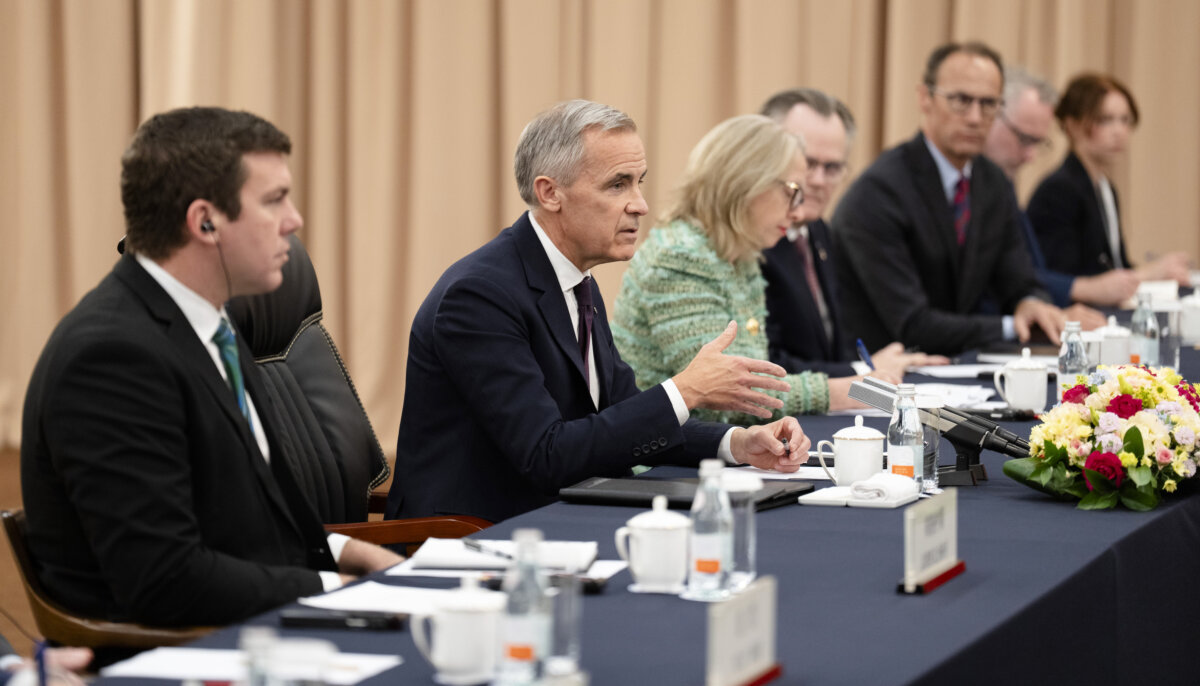

Liberal MP Kody Blois says Prime Minister Mark Carney’s trip to China this week will seek to rebuild ties and set the stage for a broader partnership as Carney seeks to “recalibrate” the relationship.
Blois, who is parliamentary secretary to the prime minister and part of a large Canadian delegation spending a few days in China, called the visit a “big deal.”
“When we think about China being the second-largest economy in the world, certainly the most populous, and one that has great global influence, we think, and the prime minister believes, it’s important that we’re at least getting at the table and having the dialogue,” Blois told CBC News in an interview aired on Jan. 11.
Since taking office, Carney has worked on getting closer to China after years of limited high-level contact between Ottawa and Beijing.
Relations between the two countries were put on ice in late 2018 when Canada executed a U.S. extradition warrant against Huawei executive Meng Wangzhou, who was accused of fraud. In apparent retaliation, China detained Canadians Michael Kovrig and Michael Spavor for over 1,000 days.
Carney’s visit to China comes after he met Chinese leader Xi Jinping in South Korea in late October, where he received the invitation.
Blois had attended that meeting and noted that Xi had called that moment a “turning point” in the relationship. A readout of the meeting from the Prime Minister’s Office (PMO) said the “leaders agreed that their meeting marked a turning point.”
Blois said the trip this week will be a “continuation of that turning point” and that Carney would like to “recalibrate” the relationship.
“He believes there’s opportunity for partnership, that there’s opportunity that China plays a role amongst the many countries that we are building relationships with, as part of our idea to be able to build out more trade around the world,” Blois told CBC.
The Carney government has set the goal to double non-U.S. exports over the next decade, as it seeks new markets to reduce dependency on a more protectionist America under U.S. President Donald Trump. Canada has been hit hard by Trump’s sectoral tariffs targeting metals and automobiles.
China has also hit Canada with tariffs on agricultural and seafood products, in retaliation for Canadian duties on Chinese steel, aluminum, and electric vehicles.
When asked about China tariff concerns, Blois said they’re “of course” important for Canadian stakeholders. “But at the same time, the prime minister believes that there’s an opportunity to look bigger and longer term about where the partnership is going,” he said.
Some Conservative MPs have criticized the upcoming trip and recent moves ahead of the visit.
“After Chinese operatives may have interfered in two Canadian elections, the government passed Bill C-70 to counter foreign interference, then set no deadline to enforce it. Now we’re told China is a ‘new partnership,’ and even Mark Carney is suddenly choosing his words carefully, after calling the PRC Canada’s #1 security threat,” MP Dean Allison said on social media on Jan. 8.
Tory MP Michael Chong also criticized a move by two Liberal MPs to cut their trip to Taiwan short this week. The MPs were part of a cross-party delegation of Canadian MPs visiting the self-governed island, which Beijing seeks to rule.
“Ordering elected representatives home to avoid offending an authoritarian regime sends a clear message: convenience comes before principle,” Chong said in a Jan. 12 statement. “It’s increasingly looking like Prime Minister Carney is taking the same approach as Trudeau on the communist government of China.”
The PMO says Carney will travel to China from Jan. 13 to 17, after which he will visit Qatar and then Switzerland to attend the World Economic Forum in Davos.
Areas of Discussion
Blois, a Nova Scotia MP who briefly served as agriculture minister in Carney’s first cabinet, mentioned energy, agri-food, and climate change as potential areas of partnership with Beijing.
On energy, state-owned PetroChina is part of the joint venture running Canada’s only liquified natural gas export terminal in B.C., LNG Canada. Carney has referred the second phase of that project, which hasn’t received a final investment decision by the owners, to the Major Projects Office in November.
China is also the main buyer of Alberta oil transported by the Trans Mountain pipeline to the B.C. coast. Beijing’s steady supply of Venezuela oil came under jeopardy last week after the United States captured Venezuela’s leader Nicolás Maduro and took control of oil exports.
Blois didn’t comment on the Venezuela situation but said more interest in Canadian oil from China would be welcomed.
“Obviously, if they have a desire to want to buy more for whatever reason they may choose, that’s something that’s good for Canadian workers. It’s good for Canadian exports. It’s good for the Canadian economy. So we’re completely open to the conversation,” he said.
Ottawa’s push to deepen ties with Beijing is coming at a time when the Trump administration is putting in practice its recently published National Security Strategy, which seeks to reduce China’s influence in the Western Hemisphere.
Kovrig, a former diplomat working for the think tank International Crisis Group who was detained in China, has warned against expanding ties with the Chinese Communist Party (CCP) to reap short-term economic benefits.
“How the CCP behaves toward people it governs, detains, or dislikes is a preview for how it’s likely to deal with other citizens and countries it acquires power over,” he said in Jan. 11 X post.
“That’s why the necessary whole-of-government-and-society responses must be holistic, strategic, and grounded in principled realism and a long-term vision of statecraft rather than short-term, transactional, issue-by-issue dealmaking.”
Kovrig also said that China human rights is not a separate issue that can be “tidily compartmentalized into perfunctory dialogues.”
Asked by CBC about Chinese human rights and how the Carney government intends to navigate this issue which pertain to a country’s values, Blois said what is important is opening diplomatics channels to have the “opportunity for a dialogue.”
 Friends Read Free
Copy
Facebook
Tweet
Friends Read Free
Copy
Facebook
Tweet