
Commentary
Washington and American technology companies are tightening controls on advanced artificial intelligence (AI) chips, yet the technology continues to seep into China.
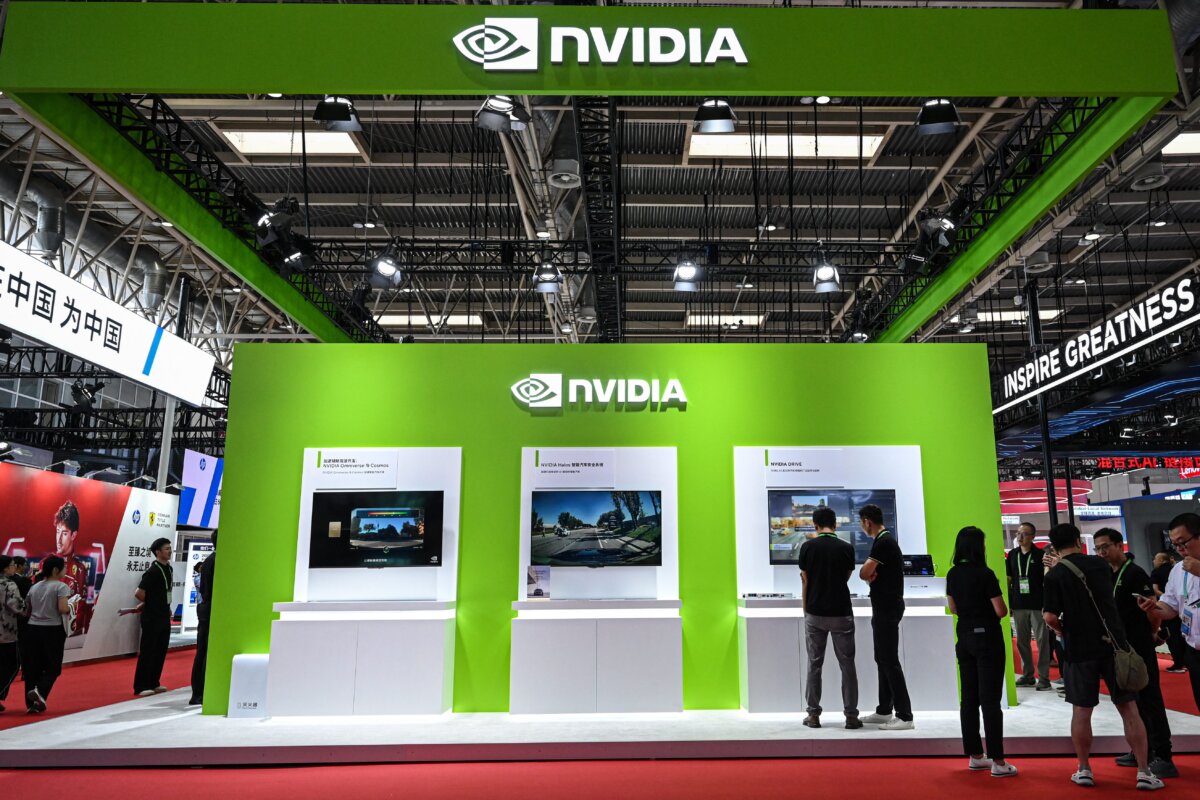
A visitor to the Beijing-based SinoInfo website sees a curious pairing. The company describes itself as an Nvidia “elite partner” and has displayed a letter authorizing it to sell Nvidia data-center products in mainland China, subject to restrictions on destination, end-user, and end-use.
A few scrolls lower, SinoInfo identifies relationships with China Aerospace Science and Technology Corporation, or CASC, and China Aerospace Science and Industry Corporation, CASIC—two state-owned giants embedded in China’s aerospace and defense establishment. The Wire China documented the arrangement in July.
The page raises a hard question: How much visibility does an American technology company retain once advanced computing enters China’s reseller network?
Nvidia has cut more than half of its authorized Asian AI-chip buyers after tougher compliance reviews, while a September C4ADS investigation documented restricted Nvidia processors moving through universities, Southeast Asian transshipment networks and opaque corporate structures. The weak point increasingly sits downstream from the original sale.
The Risk Begins After the Invoice
Nvidia publicly lists SinoInfo as an authorized networking reseller in China. The Wire China found that, among 123 Nvidia partners, at least 23 had won bids to supply universities, companies, or laboratories subject to U.S. restrictions or tied to China’s defense sector. Some contracts reportedly included Nvidia components.
The overlap matters. CASIC appears on the Pentagon’s list of Chinese military companies. Treasury has identified both CASIC and CASC as Chinese military-industrial complex companies. Their structures span missiles, satellites, aerospace engineering, electronics, and research. A distributor operating in that environment deserves more scrutiny than a routine commercial buyer.
Each layer makes tracking harder. A processor can be built into a local server, transferred among affiliates, or installed in a shared computing center. Procurement records may identify the integrator and server model while saying little about the accelerators inside. Think of a chop shop. Once the car is gone, pieces are easier to get rid of than a stolen car.
China Is Organized to Exploit the Gap
Beijing’s military-civil fusion system connects universities, civilian companies, state laboratories, and defense organizations, enabling the flow of technology and expertise among them.
The U.S. Commerce Department describes China as pursuing “intelligentized warfare” and using military-civil fusion to share resources and factors of production between the military and civilian sectors. This military-civil blend is prominent across all sectors in China.
A university can conduct legitimate research while training engineers for defense programs, and commercial AI techniques can be adapted for state applications. The same computing infrastructure can support materials science, aerospace simulation, satellite imagery, or autonomous systems.
Nvidia’s New Whitelist Tells Us Something
In July, the Financial Times reported that Nvidia had removed more than half of its previously authorized Asian AI-chip buyers after creating a tougher whitelist. The company intensified due diligence in Singapore, Malaysia, and Japan. Nvidia personnel reportedly visited data centers, verified contracts, and interviewed end users to determine whether customers were genuine. That is a significant change.
Similar scrutiny is likely to become routine for sensitive sales that touch China’s technology ecosystem in Southeast Asia.
Washington Is Reopening the Front Door
The timing creates a policy contradiction. On July 14, Under Secretary of Commerce for Industry and Security Jeffrey Kessler told Congress that a small number of Nvidia H200 chips had begun shipping to China. U.S. authorities had approved roughly 10 Chinese companies to purchase the processors. Reuters identified approved buyers, including a ZTE subsidiary and Chinese server maker Maginfra.
Supporters of licensed H200 argue that legal access gives Washington more visibility than forcing demand into a black market and helps keep Chinese developers dependent on American technology. That argument makes downstream visibility more important.
The U.S. Commerce Department acknowledged the broader problem in May, clarifying that certain advanced-computing licensing requirements apply to China-headquartered entities and their ultimate parent companies, even when the immediate recipient is outside China. We are finding that geography alone is no longer a reliable measure of risk.
Nvidia Has a Fair Defense
Nvidia cannot prevent every criminal diversion.
The U.S. Justice Department has described schemes using shell companies, false shipping records and relabeled GPUs. Operation Gatekeeper involved the seizure of more than $50 million in Nvidia technology and cash tied to an alleged China-linked smuggling network. Prosecutors said one part of the scheme involved at least $160 million worth of export-controlled H100 and H200 processors.
Those cases involve deliberate deception. The harder policy question concerns warning signs visible before prosecutors arrive. SinoInfo’s advertised relationships with major Chinese defense conglomerates required no subpoena to discover. Resellers operating in such environments need to face continuing review rather than one-time approval.
Congress is also seeing the writing on the wall. On Aug. 10, House Select Committee on China Chairman John Moolenaar urged Commerce to enforce rules requiring chip manufacturers to scrutinize customers that could be acting as fronts for restricted Chinese firms. His warning followed the Sophgo episode, in which chips manufactured by TSMC for a Chinese designer were later found inside Huawei AI processors.
Follow the Technology Further
Washington may need to require serial-level tracking for the most sensitive processors, auditable records through authorized resales, and verification of final installation sites. The goal is to preserve visibility as technology moves downstream.
The United States still holds an extraordinary advantage in advanced computing. To stay competitive, Beijing will seek to absorb enough of it through distributors, server integrators, overseas affiliates, and shared computing infrastructure.
Export approval is only the beginning of control. For technology this consequential, Washington and Nvidia need to know where the trail ends.
Views expressed in this article are the opinions of the author and do not necessarily reflect the views of The Epoch Times.
 Friends Read Free
Copy
Facebook
Tweet
Friends Read Free
Copy
Facebook
Tweet