
Commentary
China’s rising youth unemployment and retreat into such trends as “lying flat,” “rat people,” and “full-time grandchildren” reveal a growing disconnect between Chinese leader Xi Jinping’s calls for national rejuvenation and a generation increasingly unwilling or unable to work.
When people talk about China’s “lost youth” or “lost generation,” they are usually referring to the demographic decline and aging crisis. These issues stem from decades of the one-child policy, followed by a sharp rise in the cost of living. As the job market becomes increasingly competitive and housing prices continue to soar, many young people are delaying marriage and spending more time in school before entering the workforce.
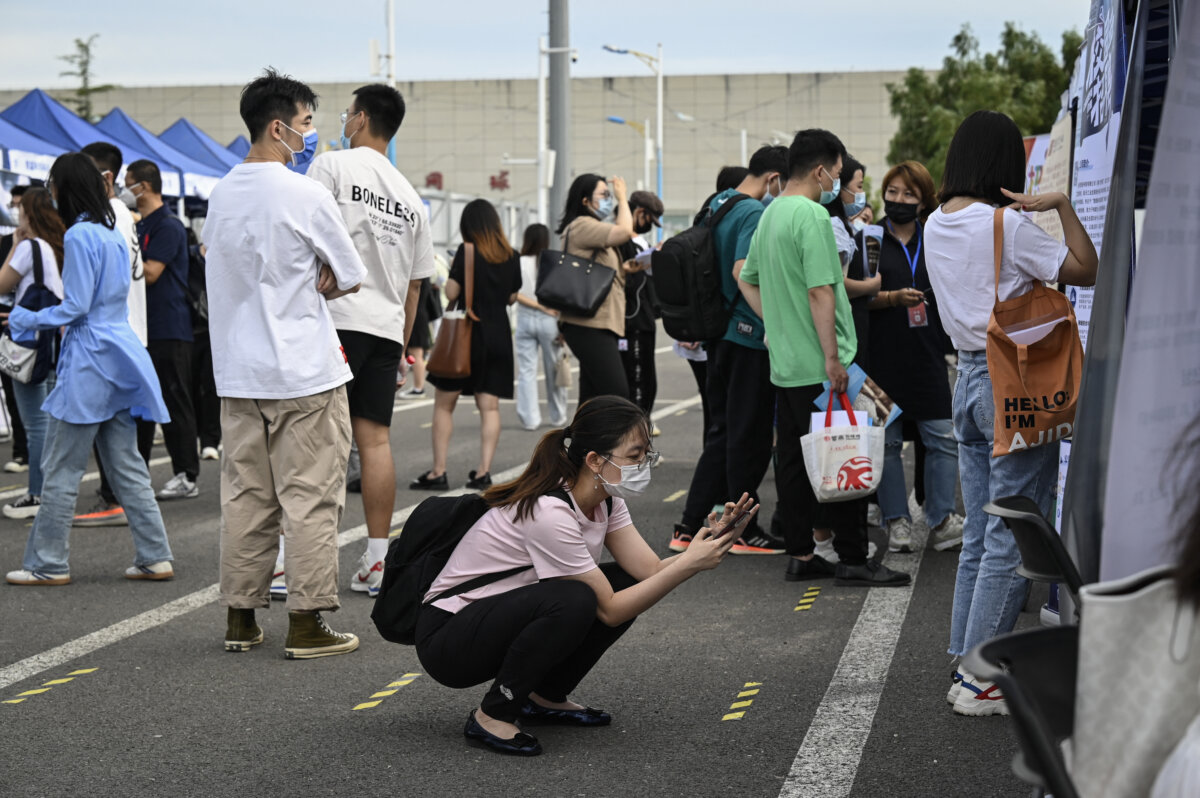
While these demographic trends continue to worsen, an even more troubling “lost generation” is unfolding: young people who have either completely checked out of society and the job market, or who want to work but cannot find employment in China’s slowing economy.
This “lost youth” phenomenon includes the fake job crowd, the “lying flat” movement, the “rat people,” and the “full-time grandchildren.” Together, they make up a significant portion of the population and represent a form of hidden unemployment, meaning the actual youth joblessness rate for individuals aged between 16 and 24 is likely far higher than the 14 percent to 16.5 percent often cited by mainstream media.
The pressure to find a job in China’s struggling market has given rise to a trend where young unemployed adults pay to “pretend” they have office jobs. Rather than admitting that they cannot find work, some choose to pay 30–50 yuan ($4–$7) a day at shared spaces like the Pretend To Work Company, which provides desks, computers, internet, and sometimes meals. Attendees use the time to search for jobs, work on personal projects, or simply enjoy the structure and social interaction of an office environment.
For some young Chinese, paying for fake jobs is about maintaining dignity, easing family pressure, or fulfilling university internship requirements. The trend highlights frustration over limited job opportunities and a mismatch between education and the labor market. While many in the fake-job crowd still hope to work, others have completely withdrawn, joining the “Bai Lan” (“let it rot”) movement.
Bai Lan, which grew out of the earlier “Tang Ping” (“lying flat”) trend of 2021, rejects the grueling “996” work culture, soaring living costs, and lack of upward mobility that make career advancement seem impossible, especially for middle- and lower-income youth. It is both a coping mechanism and a form of silent resistance, favoring minimal work to meet basic needs over high-stress, lucrative jobs.
An even more extreme offshoot of the “lying flat” counterculture, the “rat people” (老鼠人, lao shu ren) reject the relentless social competition, academic pressure, and hyper-efficient lifestyles imposed by the education system and job market. The trend has gained traction as a projected record number of graduates—12.2 million in 2025—enter an oversaturated labor market, with many young people feeling that career advancement is increasingly out of reach.
Popular among unemployed or underemployed millennials and Gen Zers, the movement embraces a nocturnal, low-energy, reclusive lifestyle modeled after the habits of a rat, such as avoiding bright light, staying indoors, and living quietly on the margins. Participants spend their days in bed, browsing online, eating takeout, and posting humorous or self-deprecating “daily schedules” on platforms, including Xiaohongshu, Douyin, and RedNote.
Unlike “lying flat,” which still involved pursuing personal interests, “rat people” deliberately reject self-discipline and social expectations, presenting themselves as the opposite of glamorous, high-achievement influencers, posting 4 p.m. bedbound videos instead of 4 a.m. workout routines.
The movement is fueled in part by the younger generation, whose parents benefited from China’s earlier economic boom and can provide financial support, allowing for extended periods of joblessness. While some posts exaggerate the lifestyle for attention, experts say the trend reflects deep disillusionment.
Yet another example of young people abandoning traditional jobs and careers is the rise of “full-time children,” young adults paid by their families to stay home, handle housework, and care for relatives. Many have left stressful jobs or studies to escape intense competition, while others returned home after failing to find work.
A similar trend is the “full-time grandchild,” where unemployed young adults move back home to care for grandparents. This role provides companionship, emotional support, and daily assistance, and is often regarded as more filial than the “full-time children” arrangement. Many in this role are supported financially by their grandparents’ pensions, enabling them to focus entirely on caregiving.
The Chinese Communist Party (CCP) views rising youth disengagement as a threat to economic growth and at odds with Xi’s calls for young people to contribute to “national rejuvenation.” Xi is reviving wartime rhetoric, urging citizens to adopt the “Long March Spirit” and “Chosin Reservoir Spirit” in preparation for a potential conflict with the United States, particularly over Taiwan.
However, the high youth unemployment, combined with these negative social trends, highlights a growing disconnect between the CCP’s military mobilization goals and Xi’s economic ambition to surpass the United States within the next decade. While the CCP would never accept blame for China’s “lost generation,” its tightening control over the economy and society has contributed to a sharp slowdown, producing a wave of disillusioned young people who either cannot or will not participate in the job market. This, in turn, could stall communist China’s momentum and undermine its aspirations for global dominance.
Views expressed in this article are the opinions of the author and do not necessarily reflect the views of The Epoch Times.
 Friends Read Free
Copy
Facebook
Tweet
Friends Read Free
Copy
Facebook
Tweet