
Commentary
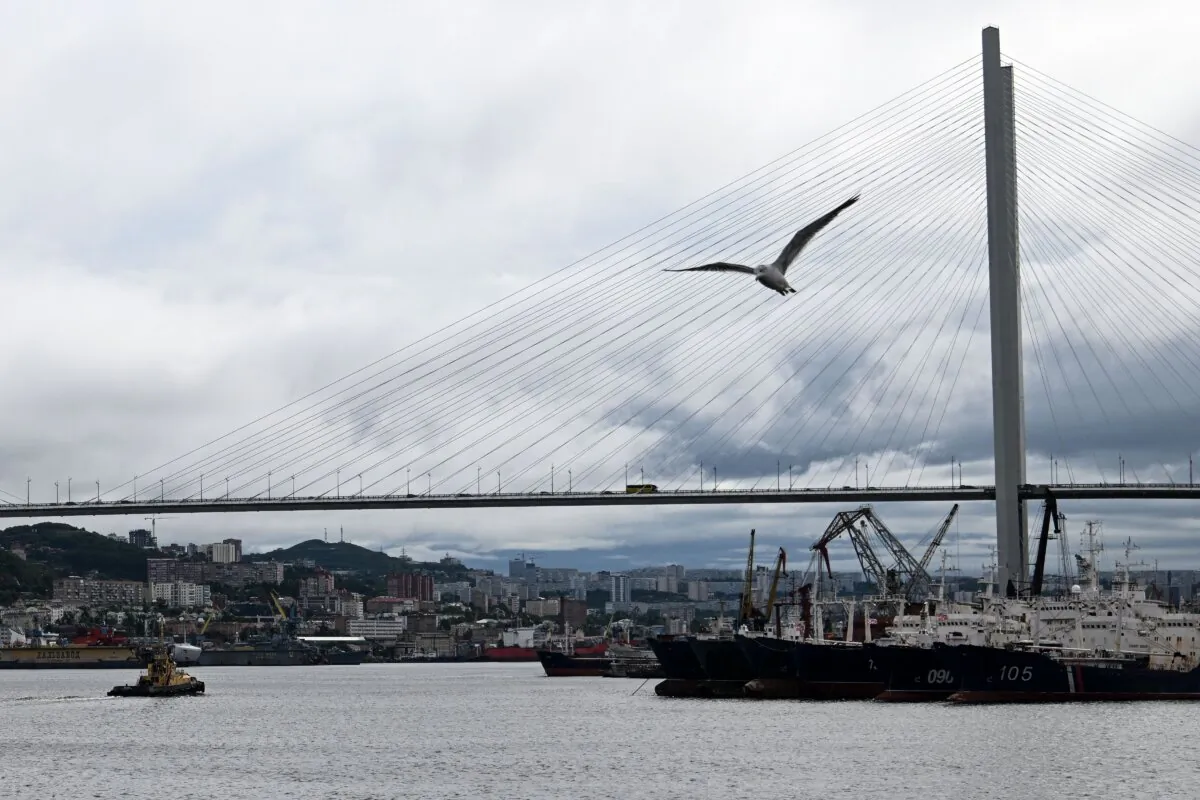
Imagine walking through the streets of Blagoveshchensk or Vladivostok in Russia’s Far East. What catches the eye isn’t the Soviet-era architecture or the vast Siberian landscape; rather, it’s Chinese everywhere.
Shop signs, menus, hotel brochures, and even some traffic signs now feature Mandarin characters. Late in 2024, locals in Blagoveshchensk photographed new downtown direction signs in Chinese only, sparking questions that led to bilingual replacements near the city’s cross-border bridge.
This isn’t annexation, but it’s a visible marker of a profound shift: These cities are reorienting southward, chasing trade, tourism, and investment from across the Amur River.
Two new hard links have, in recent years, shrunk the frontier. The first road bridge between Russia and China, the Blagoveshchensk–Heihe Bridge, opened in June 2022. The first rail bridge, the Tongjiang–Nizhneleninskoye railway bridge, opened to traffic in November 2022. Those crossings turned the river from a moat into a main street, moving people, timber, ore, and consumer goods in both directions.
So is China taking over Russia’s Far East?
Yes: not with tanks, but through economics, infrastructure, and subtle influence that bind the region more tightly to Beijing than to Moscow.
Eastern Russia’s Strategic Riches
This phenomenon reflects broader dynamics in eastern Russia, a vast expanse from Lake Baikal to the Pacific that covers more than 5 million square miles, or 77 percent of Russia’s territory. Far from empty tundra, it’s a resource powerhouse that has drawn covetous eyes from global powers for centuries.
The region’s energy riches are legendary: massive oil and gas reserves funneled through pipelines such as the Eastern Siberia–Pacific Ocean line, which pumps crude directly to China, and the Power of Siberia-1 line, which delivers gas to China under a 30-year contract launched in 2019. Minerals abound, too: gold, palladium, and critical rare earths totaling 658 million metric tons across 29 types, as per Russia’s Ministry of Natural Resources and Environment in February. Siberia supplies more than half of the world’s palladium, vital for auto catalysts and electronics.
Above ground, boreal forests provide timber exports, while leased farmlands grow soybeans for Chinese markets. The Sea of Okhotsk and Pacific coasts are gold mines for fish, yielding salmon, pollock, and crab. Russia’s fleets landed more than 330,000 metric tons of pollock alone by February, with scientists proposing a quota of 2.42 million metric tons for 2026.
This region accounts for a significant slice of global seafood: historically, about 10 percent, although exact figures fluctuate with quotas and climate. Strategically, eastern Russia’s geography—it borders China, Mongolia, North Korea, and the Pacific—makes it closer to Beijing or Tokyo than Moscow, turning it into both Russia’s frontier vulnerability and a prize for influence.
Beijing’s Subtle Embedding
Beijing’s approach isn’t overt conquest but a patient embedding through pipelines, payments, and persistence.
The Eastern Siberia–Pacific Ocean and Power of Siberia-1 pipelines have hardwired Russia’s exports to China, with Beijing financing deals for discounted access. Power of Siberia-2 pipeline, the proposed sequel via Mongolia, remains stalled in active talks as of May, allowing China to squeeze better terms amid Russia’s desperation.
In finance, the yuan dominates, especially after Western sanctions kicked in over the Ukraine war: More than 95 percent of Russia–China trade settles in yuan or rubles, a figure holding steady in 2025 despite a 9 percent dip in overall trade volume to $106.48 billion in the first half of the year. This makes Russia a yuan testing ground, but Chinese banks’ caution over U.S. secondary sanctions gives Beijing a veto-like power, stalling payments when convenient.
Trade tells a similar story. Western car brands fled after sanctions and Chinese vehicles filled the void, holding 55 percent to 57 percent market share in the first half of 2025. This is a slight decline from 60 percent in 2024 because of Moscow’s hiked tariffs and “recycling fees” to protect local makers. Electronics, machinery, and consumer goods have followed suit, flooding Russian shelves with “Made in China” labels.
Forests, farms, and fisheries deepen the tie: Chinese companies lease vast tracts in Russia’s Zabaykalsky Krai and log timber under concessions. Chinese fleets dominate Pacific catches, processing them south and creating food security dependencies.
Economic Asymmetries and Local Dependencies
For Far East governors, this isn’t unwelcome; it’s survival. Moscow’s decades-long neglect of the region traces back to the post-Soviet era, when the collapse of centralized planning triggered severe economic dislocation and a dramatic population exodus.
Since 1991, the Russian Far East has lost more than a quarter of its population, dropping to about 6 million people from about 8 million by the 2010s, with official statistics showing a decline of 1.75 million between 1990 and 2010 alone. This demographic hemorrhage was fueled by chronic underinvestment from the central government, leading to crumbling infrastructure, inadequate health care and education, and transport networks that remain underfunded and underdeveloped, particularly in eastern Siberia and the Far East.
Many locals complain that Moscow prioritizes western regions, treating the Far East as a remote periphery despite its resource wealth and exacerbating issues such as high living costs, harsh climates, and limited job opportunities that drive migration westward to cities such as Moscow or St. Petersburg.
Efforts such as incentives for ethnic Russians to relocate eastward have fallen short, leaving infrastructure in disrepair and prompting regional leaders to seek alternatives from Beijing, which delivers cash, workers, and projects. Chinese contractors build roads, farmers cultivate land, and banks extend credit. The result? A region economically more aligned with China’s Harbin than the Kremlin.
A Lopsided Partnership
This asymmetry reshapes China–Russia relations, belying the “no-limits” rhetoric.
In energy, China’s delays on Power of Siberia-2 turn Moscow into a price-taker, especially with Europe off-limits. Yuan dominance offers stability but exposes Russia to Beijing’s whims. Regional integration pulls Far East provinces southward, where markets and investors are closer.
Politically, Beijing calibrates support—enough to keep Russia afloat but not enough for a true alliance. Consider Iran: Amid 2024 tensions with Israel, China offered no military backing or shield from the United Nations, prioritizing oil security over defending its “partner.” It’s transactional: access for Beijing, minimal risk.
The CCP’s Long-Term Playbook
This fits the long-term strategy of the Chinese Communist Party (CCP), not mere opportunism.
Eastern Russia secures overland inputs—oil, gas, metals—bypassing sea vulnerabilities such as the Malacca Strait, where U.S. naval power could choke supplies.
Russia is a sandbox for yuan internationalization, with 95 percent of bilateral trade in local currencies proving the model for Belt and Road Initiative partners. Dependency expands influence: Loans and infrastructure mirror patterns in African mines or Latin American oil deals, preserving formal sovereignty while dictating terms. Deeper ties put a wedge between Russia and the West, preventing any thaw that could realign Moscow.
Not Natural Allies: Historical Tensions
Yet China and Russia aren’t natural allies. History bristles with clashes: The 1960s Sino–Soviet split culminated in 1969 Ussuri River skirmishes, in which Moscow pondered nuclear options. Russia expanded eastward as a colonizer; China recalls Qing-era territorial losses via unequal treaties.
Worldviews diverge: Russia’s worldview as a besieged empire seeking buffers and China’s worldview as a communist regime leveraging its economy.
Today’s partnership is pragmatic, born of Russia’s isolation but brittle and unequal.
Fiction Versus Reality, and the Human Factor: Lessons From Tom Clancy
Tom Clancy’s 2000 novel “The Bear and the Dragon” eerily foresaw this. In it, a crisis-hit China invades Siberia for resources. Clancy nailed the stakes: Siberia’s riches, China as challenger, Russia as swing state. But he erred when it came to the CCP’s methods and nature. Expansion has come not via tanks but via contracts, which are quieter and more effective. And there are no rational Party elders who could bring meaningful reform.
Russia, so far, has chosen Beijing dependency over Western reconciliation. In the book, Russia shifts because of protagonist Jack Ryan’s integrity and strategic acumen. It’s fiction, but leaders matter. We’ve seen CCP leader Xi Jinping’s mettle; if counterparts—from the United States, Europe, or Asia—blend character and competence, alliances could shift. Debates swirl on figures such as U.S. President Donald Trump, but the point transcends ideology: Wise choices now could help Russia pry itself from the CCP’s orbit.
A Potential Off-Ramp: ‘Corridor for Peace’
What if the United States and allies offered an off-ramp?
A “corridor for peace” could link limited, monitored exports of eastern Russian resources—such as palladium or titanium—to Japan and South Korea, tied to Ukraine cease-fire compliance. Payments could be made via audited escrows, which are reversible if broken. Russia could gain diversified buyers, reducing Beijing’s monopoly; allies could secure minerals, bolstering supply chains. China would lose leverage.
Risks abound—enforcement issues, public backlash, retaliation—but the prize would be relief for Ukraine, ally resilience, and a glimpse for Russians of alternatives to CCP dependency.
Conclusion
Those Chinese signs symbolize an ongoing tilt: eastern Russia’s pipelines, markets, and currencies leaning south. The CCP has secured a resource lifeline, a yuan experiment, and a geopolitical wedge, eroding Moscow’s sovereignty. Clancy glimpsed the prize but missed the method: deals over invasion. Yet creative statesmanship by credible and competent leaders, offering options such as a peace corridor, could perhaps rebalance the odds.
Views expressed in this article are the opinions of the author and do not necessarily reflect the views of The Epoch Times.
 Friends Read Free
Copy
Facebook
Tweet
Friends Read Free
Copy
Facebook
Tweet