
Commentary
In an era in which traditional diplomacy often falters amid endless aid commitments and fleeting cease-fires, a novel approach is taking shape under the Trump administration. What if peace were not merely an idealistic goal but a structured business model? Imagine resolving decades of conflict by bundling cease-fires with revenue-generating infrastructure—railways that reroute trade, mining rights that fuel reconstruction, or ports that secure long-term leverage.
This is the essence of what one could term the “Corridors for Peace” playbook, a strategy the United States has already deployed—and revealed—across three continents in recent months. From Ukraine’s mineral fields to Central Africa’s copper belt and a new transit route in the South Caucasus, these deals publicly emphasize reconciliation while privately reshaping strategic geography to favor U.S. interests, sideline rivals, and transition from aid dependency to self-sustaining economic ties.
The Consistent Blueprint
Taken together, these reveal what appears to be a repeatable playbook. At its core lies a security-for-economics exchange: halting hostilities in return for access to profit-generating assets. This is coupled with exclusive U.S. oversight or development rights over corridors, funds, or resource sectors and deliberate supply chain rerouting to diminish the influence of adversaries such as Russia, China, or Iran.
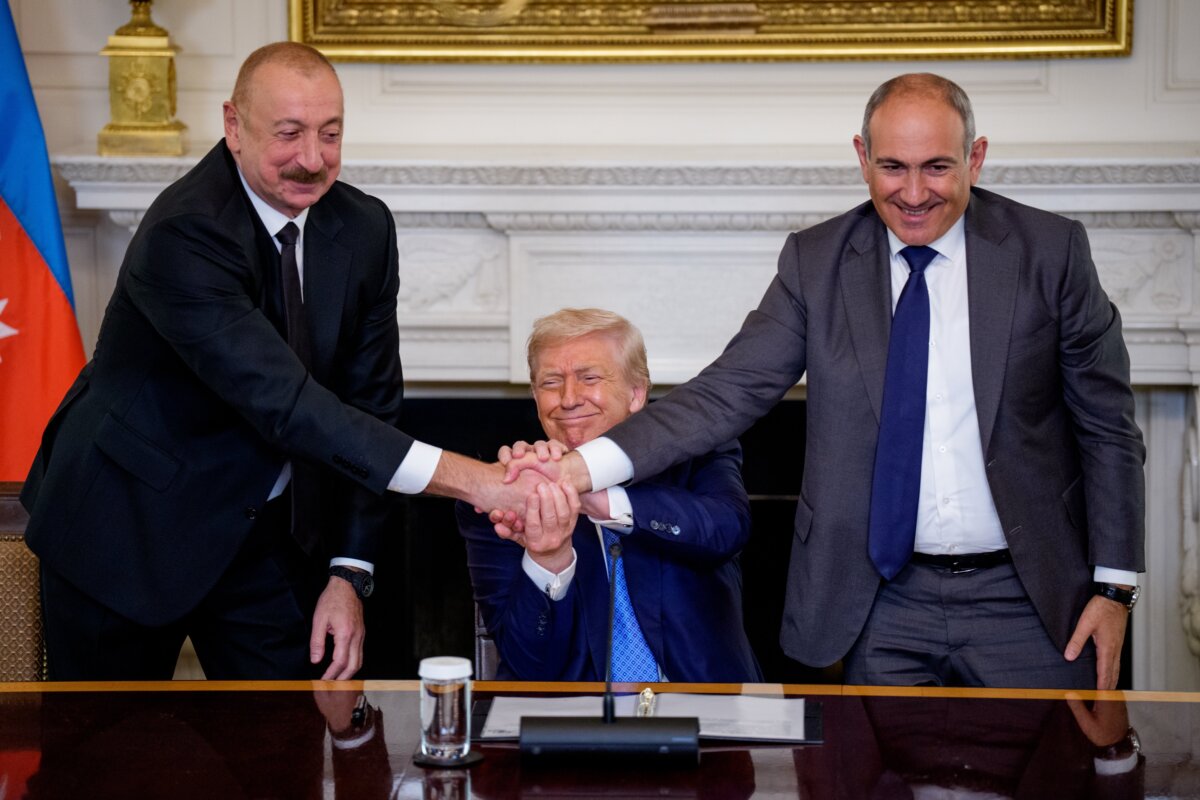
Consider the Ukraine–U.S. mineral agreement, formalized in April, that establishes a Reconstruction Investment Fund drawing 50 percent of future royalties from uranium, lithium, rare-earth elements, and other critical minerals to finance postwar recovery, with the United States gaining priority access and oversight. In the Congo and Rwanda, a June pact brokered by Washington links troop withdrawals and the end of rebel support with Western investment in cobalt, copper, and lithium supply chains, opening the Great Lakes region to U.S.-backed capital, creating an alternative to China’s chokehold. Meanwhile, the August Armenia–Azerbaijan accord includes the Trump Route for International Peace and Prosperity corridor, granting the United States 99-year exclusive development rights over a transit link that bypasses Russian and Iranian routes, committing both nations to territorial respect and noninterference. These initiatives span diverse conflicts yet adhere to the same architecture: peace tied to profit, with America at the helm.
The Public Narrative
Publicly, the narrative is one of triumph and prosperity. Handshakes and ceremonies dominate the optics, with U.S. President Donald Trump describing the Armenia–Azerbaijan deal as a “historic” shift in which former foes “are going to be friends for a long time.” Secretary of State Marco Rubio echoed this, celebrating its potential for regional prosperity. Rwandan Foreign Minister Olivier Nduhungirehe called the agreement with Congo a turning point. For many involved, this framing is genuine—a moral imperative to end suffering. Yet it masks deeper mechanics.
Strategic Underpinnings
Beneath the surface, these accords are engineered for strategic depth. They embed U.S. firms in chokepoints, from African rail lines to Caucasian passes, while rerouting trade away from competitors. The funding model pivots from endless aid to self-financing: mineral royalties and tolls sustain stability, creating incentives that endure only if peace holds.
This aligns interests across layers—local revenue for stability; U.S. leverage for supply-chain security, denying rivals control of key assets and gaining diplomatic leverage; and a global demonstration of U.S. deal-making prowess. A fourth, crucial layer is durability: Unlike potentially volatile aid, these economic engines, according to their proponents, would generate ongoing value, making backsliding costlier for all parties.
Successes and Limitations
The model’s success hinges on pragmatism. It flourishes when leaders prioritize compromise over absolutism, as in the 1978 Camp David Accords—land for peace—or the 2020 Abraham Accords—normalization via trade and tech, bypassing core disputes. Conversely, Ukraine’s current impasse—Kyiv’s demand for full territorial return versus Moscow’s insistence on neutrality and annexations—illustrates its limits, despite the mineral fund’s promise. We’ll see what happens after the Trump–Putin meeting in Alaska.
Past US Approaches
To grasp the shift, compare the Corridors for Peace model to earlier U.S. playbooks.
Under President George W. Bush, peace efforts often meant invasions and nation-building—think Iraq and Afghanistan—with massive troop deployments, trillion-dollar costs, and little linkage between stability and local economic gain.
President Barack Obama pivoted to diplomacy, sanctions, and multilateral deals such as the Joint Comprehensive Plan of Action—trading sanctions relief for compliance—but without U.S. economic stakes to anchor outcomes, leaving agreements vulnerable to political change.
President Joe Biden followed with coalition-driven aid and sanctions, as in Ukraine, channeling billions of dollars without self-financing mechanisms to make peace profitable for all sides.
Even President Bill Clinton’s Dayton Accords used NATO enforcement and institutional reforms but no revenue-producing assets to lock in stability.
The new approach flips it: Broker deals where peace pays—through shared profits, U.S. oversight, and rival sidelining. It’s pragmatic, cost-conscious, and interest-driven, although critics warn that it may sacrifice deeper governance reforms for shorter-term wins.
Contrasting Global Approaches
This U.S. strategy stands apart from that of its competitors. China’s Belt and Road emphasizes unrecoverable loans for influence, fostering dependency but vulnerable to leverage shifts—evident in Beijing’s $3 billion annual aid, contrasting with meager domestic flood relief. Russia freezes conflicts via peacekeepers for control, lacking economic anchors. The European Union dangled, to European nations, accession incentives tied to reforms. The United Nations monitors cease-fires without revenue mechanisms. The U.S. edge lies in transparency: explicit, enforceable trades where peace yields profit, rewarding collaboration with predictability—unlike rivals’ opaque or coercive tactics.
Debates and Divisions
Domestically, debate rages across ideologies. Proponents hail it as efficient—ending wars without troops, slashing aid, and countering rivals. Critics decry it as veiled imperialism, risking sovereignty, and making human rights trade-offs. Congolese Nobel laureate Denis Mukwege termed the Congo deal a “scandalous surrender.” This tension reflects broader questions: Is transactional peace sustainable or a perilous precedent?
Looking Ahead: Predicting the Next Frontiers
Upon examining the Ukraine mineral agreement, the Rwanda–Congo framework, and the Armenia–Azerbaijan corridor, one may notice that they all hinge on the convergence of six distinct conditions. One could use it as a diagnostic tool to evaluate the potential applicability of the Corridors for Peace model in other conflict zones, identifying both opportunities for success and risks of failure.
- Transactional Actors: Both sides must be willing to trade concessions for concrete gains. When leaders cling to maximalist demands, as in Ukraine, there’s no room for compromise.
- Strategic Asset: A port, corridor, or resource that generates steady revenue. This economic anchor is what makes peace self-reinforcing.
- Enforceable U.S. Role: The United States must have the ability to oversee or secure the deal’s economic component so that compliance brings tangible rewards.
- Rival Displacement: The agreement should push out a competitor, whether China’s Belt and Road, Russia’s regional influence, or Iran’s trade access.
- Coalition Buy-In: Allies investing alongside the United States spread the risk and strengthen commitment.
- Domestic Political Payoff: A win that voters can see—jobs, trade, or revenue streams—that sustains support at home.
When these filters are applied to the global landscape, potential hotspots might begin to emerge.
Conclusion: A New Era of Transactional Diplomacy?
In conclusion, this playbook isn’t infallible—it’s just one tool, thriving on aligned incentives, faltering amid intransigence.
Yet in a world of shifting alliances and rising competition, the United States is betting that it can still make the peace table the place where both sides win—and where America wins just a little more. Whether that bet pays off depends not just on the skill of the dealmakers but perhaps also on how long the economic glue can hold before rivals try to pry it apart.
Time will reveal whether this approach reshapes the global order for good. For now, it signals a shift in U.S. diplomacy—one in which peace is tied to economic dividends.
Views expressed in this article are the opinions of the author and do not necessarily reflect the views of The Epoch Times.
 Friends Read Free
Copy
Facebook
Tweet
Friends Read Free
Copy
Facebook
Tweet