

Commentary
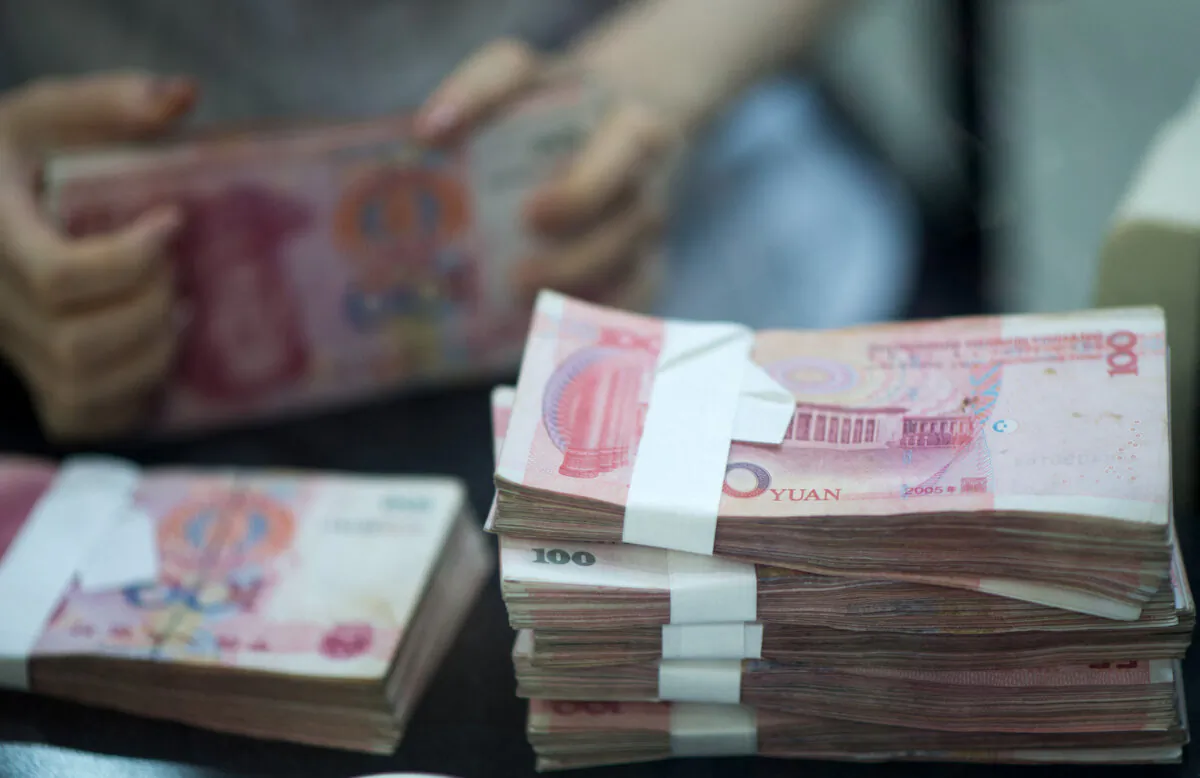
Information on China’s economic health is increasingly hard to find. Although Beijing is always opaque about anything that could potentially indicate instability or weakness, this behavior is reaching a point where its attempts at obscurity are giving an unambiguous message: The Chinese economy is struggling.
On May 4, The Wall Street Journal reported that the Chinese Communist Party (CCP) is “vanishing” vast amounts of economic data following reports of plummeting land sales, flatlining gross domestic product (GDP) growth, rising unemployment, and even dropping soy sauce production.
“Beijing has stopped publishing hundreds of statistics,” the paper reported. “The disappearing data have made it harder for people to know what’s going on in China at a pivotal time, with the trade war between Washington and Beijing expected to hit China hard and weaken global growth.”
Why this is happening is obvious: The CCP, and Xi Jinping especially, are worried about what poor economic numbers will do to their credibility and grip on power.
We should not, however, rush to conclude that we are now in 1989, about to witness the fall of the Berlin Wall. Nor should we conclude that this is merely a structural transition before China becomes a high-tech superpower.
The reality is likely somewhere in the middle.
China, like the United States, is facing a myriad of political and economic struggles that will not necessarily derail the country but that do signal mediocre performance ahead. The major difference is that the United States has a system to peacefully remove those in charge when their ideas have failed.
China’s Growth Story
The People’s Republic of China, after a series of market reforms in 1978 and ascension to the World Trade Organization (WTO) in 2001, experienced an economic miracle, going from one of the world’s poorest countries to the world’s second-largest economy. The explanations for this are myriad and well-recited. They include an emphasis on manufacturing and cheap but increasingly productive labor, strong educational achievement, stable governance, and being generally open for business, especially for a Communist regime. China, however, also indulges in large-scale industrial policy, has a comparatively low degree of economic freedom, and has a political system that reacts wildly to anything that may threaten the CCP’s hold on power. The last point is especially relevant post-2012, when Xi Jinping, the current Chinese leader, came to power and decided that the country had ceded too much to the alleged chaos of the private sector, prompting a drastic curtailing of political and economic liberties.
As economic growth slowed for both natural and policy reasons, the government began releasing less and less information. China, which used to boast about its double-digit annual growth rates, is now growing at a rate of roughly 3 percent to 4 percent, according to some experts. Although this would be considered strong for a developed country like the United States, China’s per capita GDP is multiples lower than the corresponding number for the United States, and room for substantial growth remains.
Impediments to Growth
Part of the reason for this slowing growth is natural. As an economy progresses, certain structural changes must happen before it hits the next stage. This is known as the Middle Income Trap, which refers to a phenomenon where rural countries experience rapid economic growth as they modernize and progress toward an economy based less on farming and more on manufacturing and investment. However, growth begins to slow because the next stage beyond manufacturing, which does not require specialized training, requires certain levels of education and infrastructure. It is easy to build factories and fill them with workers, but creating the conditions for tech startups, corporate finance, and an economy driven by consumption demands more than just labor and reasonable stability. China is dealing with this problem right now as it grapples with massive developmental disparities between its rich coastal cities and its rural interior.
However, another reason China is experiencing an economic slowdown stems from the policies of its central government. GDP growth is slowing for a variety of reasons but certain sectors of the economy are particularly hampered by government intervention. For example, following a sudden and aggressive regulatory assault on its own companies in a campaign known as “Common Prosperity“ in 2021, the Chinese stock market was substantially affected and continues to struggle.
The common prosperity campaign was compounded by the ongoing crackdown on Chinese society during the outbreak of COVID-19 and the use of the zero COVID strategy. The Shanghai Composite Index, which tracks all stocks on the Shanghai Stock Exchange, has remained relatively flat, while Alibaba, China’s equivalent of Amazon, is trading at less than half of its October 2020 high. China, which had begun to develop a reputation as the future of business, is now viewed by investors as hostile and unpredictable. China’s dependence on foreign trade to power its manufacturing base is also increasingly viewed as a liability as the United States and other countries rebalance their relationship with China for both economic and geopolitical reasons.
The reality is that China’s industrial policies are starting to backfire. A large driver of growth has always been the real estate sector, which is now on the verge of collapse as years of easy money and government planning take their toll, most notably with the default of the financial giant Evergrande. Industrial policies geared at propping up specific sectors (ranging from semiconductors to electric vehicles) misallocate capital and cause inefficiencies, resulting in mass disruption. In 2023, for example, news headlines were filled with reports of mass electric vehicle graveyards as people found it more worthwhile to abandon their EVs entirely than try to sell them. The primary driver of this issue was reckless subsidies that supported failing companies and encouraged consumers to purchase cars regardless of whether their cities had the appropriate infrastructure to support them.
What Does This Mean Going Forward?
China’s slowing economic growth should certainly be seen as an indictment of Xi’s policies, and industrial policy more generally, and the inability of Beijing’s authoritarian model to properly cope with structural economic growing pains. That does not necessarily mean that China will collapse tomorrow or not be a geopolitical contender to the United States. China’s high-tech sector continues to grow, fueling growth in strategic industries such as drones, rare earth minerals, and artificial intelligence. Although it remains to be seen whether Beijing’s industrial policies will catapult the country into modernity, there is still room for growth, if at a far more moderate pace than desired. It is safe to say, however, that far too many things have to go right for China to see the rapid economic growth industrial policy proponents believe should be coming.
Although China will be experiencing far slower economic growth than had been anticipated, the future likely does not yield collapse but rather mediocrity. The question to ask then is, how would an increasingly paranoid, authoritarian entity like the CCP deal with this dilemma?
Will the government take radical steps to promote free enterprise and reset relations with the West? Highly unlikely. How will Xi deal with well-intentioned suggestions that some of his policies should be moderated? Will he quietly adopt the criticism or resort to political purges? He has done both before.
The answer is likely somewhere in between. That is, increasingly erratic behavior from the Chinese government as it attempts to appease popular discontent on the one hand and suppress it on the other. The end result is subdued economic growth prospects for the near-term future and an increasingly anxious and embattled tenure for Xi.
From the American Institute for Economic Research (AIER)
Views expressed in this article are the opinions of the author and do not necessarily reflect the views of The Epoch Times.
 Friends Read Free
Copy
Facebook
Tweet
Friends Read Free
Copy
Facebook
Tweet