
Commentary
At the moment, Chinese monetary and currency policies face a mish-mash of conflicting objectives, and it remains far from clear which way Beijing will move.
On the one side, China needs to lower interest rates to help revive its flagging economy. Beijing has, on more than one occasion, referenced such a need. Rate reductions would tend to depress the foreign exchange value of the yuan. That result might be welcome because a depreciating yuan would also reduce the cost of Chinese-made goods to Americans and so blunt the real economic impact of the Trump administration’s tariffs on Chinese exports.
But on the other side of Beijing’s yuan equation is the desire to keep it strong in the service of the ambition of the Chinese Communist Party (CCP) to have a broader economic, financial, and diplomatic stature on the global stage. Beijing appears not to have yet decided which side of this dilemma it wants to take.
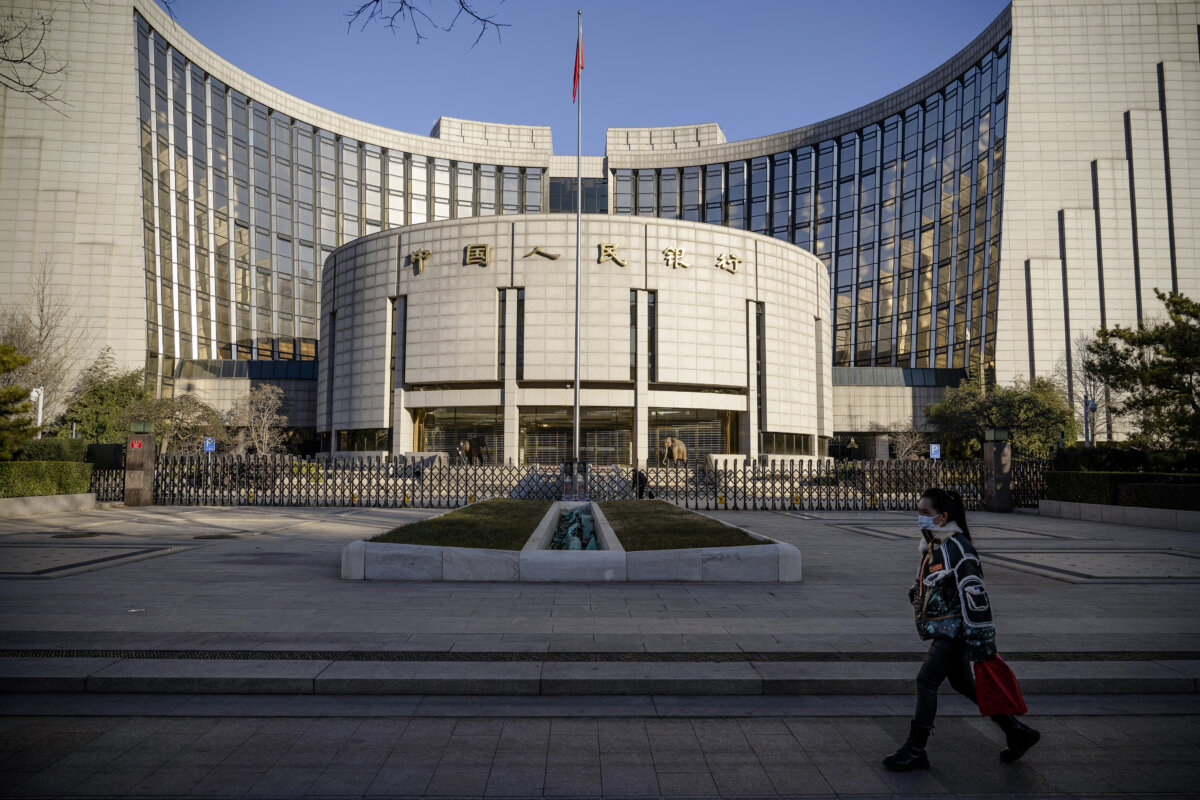
Certainly, the yuan’s pattern for the past few years—and especially since President Donald Trump’s election—has shown the influence of both sides of this dilemma. China’s currency fell by almost 10 percent on balance against the U.S. dollar in 2023 and 2024, as the country’s economic troubles convinced investors to hold assets elsewhere and because it was widely expected that the People’s Bank of China (PBOC) would cut interest rates to help the economy and consequently reduce returns on yuan holdings.
The yuan would probably have fallen even more, except that the PBOC dragged its feet in reducing interest rates. The central bank made gestures toward offering the economy help, but slow-moving rate reductions of less than a percentage point were far short of the need or the sense of Beijing’s pronouncements about rate reductions.
It would seem that the bankers were torn between the economy’s clear need for lower interest rates and the CCP’s desire to keep the yuan strong to support its ambitions to make the currency an international medium of exchange and perhaps eventually displace the U.S. dollar as the premier global currency. This counterforce actually prompted some yuan appreciation during the summer and early fall of 2024.
After Trump’s election in November 2024, however, the threat of high tariffs against Chinese imports to the United States became a reality, and the yuan fell again. The immediate influence was for global currency traders to move away from the yuan on the expectation that U.S. tariffs would hurt Chinese exports.
Also at work was a memory of responses to the Trump tariffs of 2018 and 2019. Back then, the yuan fell so much against the dollar and so reduced the dollar cost of Chinese-made goods to Americans that the yuan depreciation all but completely offset the cost of those tariffs, and volumes of Chinese exports hardly suffered. Currency traders no doubt expected a repeat of that experience, especially because, with China’s economy so much weaker in 2025 than in 2018 and 2019, traders doubtless also expected the PBOC to reduce Chinese interest rates for the economy’s sake and so further weaken the yuan by reducing the appeal of holding it.
There was another difference. In 2018 and 2019, Beijing was not promoting the yuan as an international currency as it is today. In this more recent time, Beijing, even as the yuan was falling on traders’ expectations, was promoting international deals denominated in yuan both in the CCP’s far-flung Belt and Road Initiative and elsewhere. An especially recent example is the recently floated 14.2 billion yuan ($1.98 billion) syndicated offshore loan arranged by the Bank of China for the Australian metals giant Fortescue to buy clean energy technology and other machinery from China.
To be sure, this and other similar, if less dramatic, arrangements still do not make the yuan an international currency. That will only happen when, as is the case with the U.S. dollar today, trades and loans are denominated in yuan even when no Chinese nationals or companies are involved in the transactions.
But these recent arrangements, if they do not put the yuan where Beijing would like, do increase the need for international players to hold yuan balances, and that, despite the tariffs and the weakness of China’s economy, has raised demand for the currency and pushed it up against the dollar. Since spring 2024, it has regained about a third of the ground it had lost against the U.S. dollar in 2023 and 2024.
There is another factor at work in this recent period. Expectations have risen that the U.S. Federal Reserve will soon begin to cut interest rates and so also the return available on dollar holdings. With the PBOC still dragging its feet on interest rate reductions in China, such a Fed action would, at the margin, reduce the allure of dollar holdings relative to the yuan.
Of course, if the PBOC were to follow Beijing’s other promises to ease monetary policy as a stimulant to China’s troubled economy, such a rate reduction in the United States would have less of a currency effect. But traders clearly are betting that the PBOC will continue to resist dramatic, if otherwise needed, interest rate reductions.
While this mash of motivations can explain the yuan’s movements against the dollar to date, it still leaves the CCP with quite a dilemma. If it wants to help China’s economy and blunt the impact of Trump’s tariffs on its export prospects, policymakers will delay the drive to seek international status for the yuan and seek its depreciation against the dollar in part through dramatic interest rate reductions.
If, however, the CCP is willing to sacrifice China’s immediate economic health and bear the full weight of Trump’s tariffs, then policymakers will forgo interest rate reductions, press for more yuan-denominated deals, and seek yuan appreciation.
There is no middle way and no way for the CCP to have it both ways. As yet, Beijing seems not to have made up its mind.
Views expressed in this article are the opinions of the author and do not necessarily reflect the views of The Epoch Times.
 Friends Read Free
Copy
Facebook
Tweet
Friends Read Free
Copy
Facebook
Tweet