Commentary
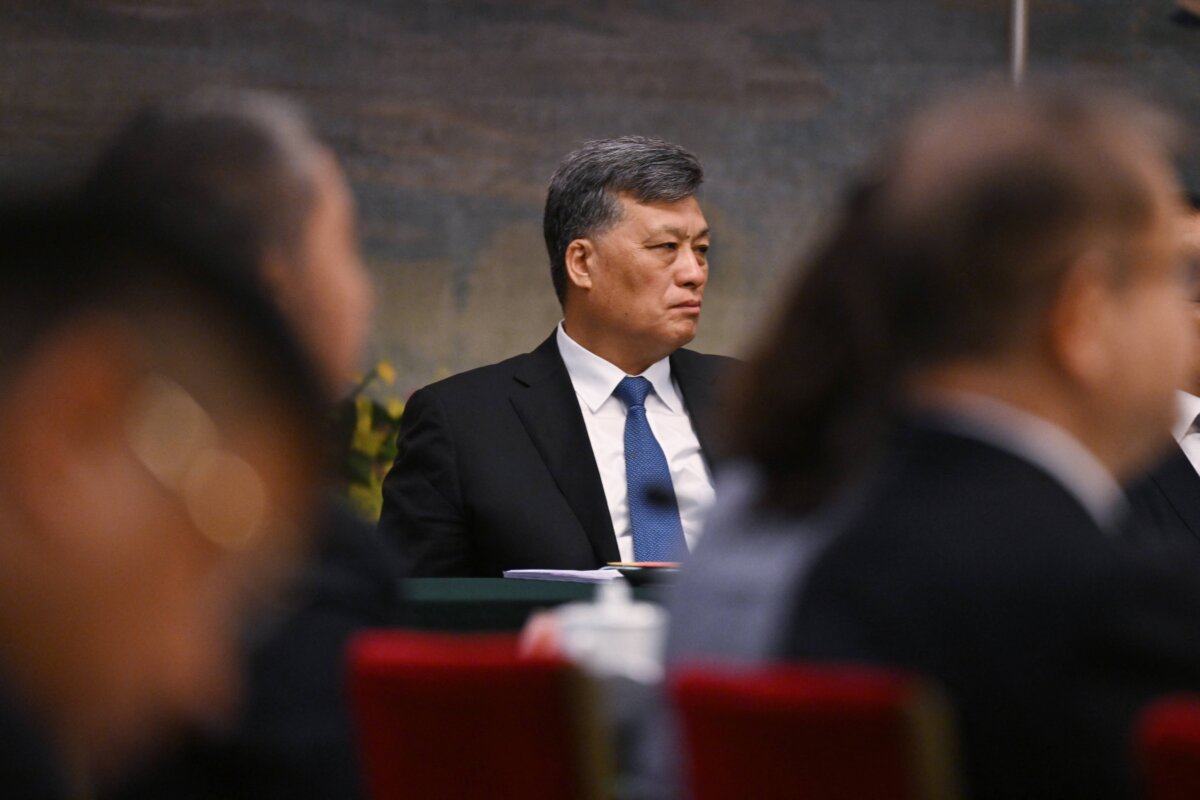
China’s top disciplinary watchdog—the Central Commission for Discipline Inspection (CCDI)—announced in early April that Ma Xingrui, a member of the Politburo and former Communist Party secretary of Xinjiang, was placed under investigation for serious violations of discipline and law.
It’s noteworthy that the notice was not issued by the CCDI itself. Instead, it cited a report from the state-run Xinhua News Agency. The notice also did not address Ma as “comrade,” a subtle yet meaningful indication in the Chinese Communist Party’s (CCP’s) rhetoric that his situation is especially grave.
Compared to earlier high-level ousters, such as former Chongqing Party Secretary Sun Zhengcai and former Shanghai Party Secretary Chen Liangyu, who both lost power in 2017 and 2006, respectively, they still retained the title “comrade” in official announcements of their falls.
There are three major factors surrounding Ma’s abrupt downfall.
It Took Months to Officially Announce Ma’s Fall
Ma was removed from his position as the Xinjiang region’s Party secretary in July 2025. Beginning in November 2025, he missed several important public events and Party meetings, fueling intense speculation about his fate. Yet it took about five months before authorities formally announced he was under investigation—an unusually long gap for a Politburo-level official. The Politburo is the CCP’s second-highest decision-making body, and disciplinary actions at this level are normally handled with political urgency.
Recent precedent suggests much shorter timelines between rumors and official confirmation, although the CCP’s opaque internal processes make exact comparisons difficult. In past cases, senior officials such as Sun Zhengcai were formally investigated within days of removal from office. Even the high-profile corruption case of former Shanghai Party chief Chen Liangyu moved from initial signs of trouble to formal action within a matter of months rather than nearly half a year.
One exception cited by some observers is the case of Central Military Commission Vice Chairman He Weidong, whose rumored investigation circulated for months before any official confirmation.
Why did it take a while for the CCP to announce Ma’s downfall? Chinese legal scholar Yuan Hongbing has claimed, citing sources within the CCP, that Ma and He formed a political alliance against Chinese leader Xi Jinping that could have complicated the timing of any announcement.
Given the current unstable dynamics in CCP politics, characterized by intense conflicts between Xi’s faction and anti-Xi groups—and even disputes within Xi’s own circle—anything could happen.
Xi’s Ruthless Purge of His Once Favored Protégé
Ma rose quickly under Xi, based on public information. An aerospace expert with no known prior personal ties to Xi, Ma became a member of the CCP Central Committee at the 18th Party Congress in 2012, when Xi emerged as China’s paramount leader.
Within about a year, Ma was promoted to key roles, including vice minister of Industry and Information Technology, head of both the National Space Administration and the China Atomic Energy Authority, and deputy chief commander of the Chinese Lunar Exploration Program.
Xi clearly had big plans for him. He appointed Ma as deputy Party secretary of Guangdong Province in 2013, using Ma to keep an eye on the then-provincial Party Secretary Hu Chunhua and to gain local governing experience.
Hu Chunhua was widely seen as a potential successor under earlier CCP leadership norms linked to Hu Jintao’s political network. However, Xi broke with recent precedent by securing a third term as CCP general secretary in 2022, sidelining Hu Chunhua and effectively ending the informal succession model that had previously governed elite promotions and sidelining figures once viewed as possible future leaders.
In 2021, Ma became Party secretary of Xinjiang—a position that traditionally increases the chances of joining the Politburo, which he obtained at the 20th Party Congress in 2022.
Now, following Ma’s fall, individuals close to him are also under investigation, including his former secretary in Shenzhen, Guangzhou Municipal Party Secretary Guo Yonghang, and Gao Shiwen, a secretary from Ma’s aerospace days and later the former Nanchang municipal Party secretary.
The fact that the CCP’s announcement of Ma’s fall omitted the word “comrade” indicates how complicated the CCP’s internal politics have become and Xi’s plan to reshape the CCP leadership with his trusted allies for what is supposedly his fourth term.
Potential Decline of Xi’s Military-Industrial Clique
Ma was a classic technocrat who rose through China’s defense and aerospace industry. Xi has long favored officials with military-industrial backgrounds.
In the current Politburo, there is an informal group called the “military-industrial gang of five,” which includes Ma, Vice Premier Liu Guozhong, who majored in Department of Artillery Engineering at East China Engineering Institute; Vice Premier Zhang Guoqing, formerly general manager of NORINCO; United Front Work Minister Li Ganjie, a graduate of Tsinghua University’s nuclear reactor engineering; and Chongqing Party Secretary Yuan Jiajun, who has an aerospace background.
Since the 2023 Rocket Force corruption scandal—and especially after the Iran war exposed weaknesses in Chinese weapons and military tech—Xi has been aggressively purging the military and defense sectors.
Ma’s fall from being a top symbol of this group is a significant blow.
Yuan Jiajun, now Chongqing’s municipal Party secretary, has been identified by some overseas Chinese-language media and analysts as a potential figure to watch ahead of the CCP’s 21st National Congress. Yuan served as a deputy general manager of China Aerospace Science and Technology Corp. from 2007 to 2011, overlapping with Ma’s tenure as general manager at the company from 2007 to 2013. After Ma’s purge, will Yuan also be implicated because of his association with Ma during that time?
Timing is crucial. With major leadership changes expected across all levels in the second half of this year and the next, and the 21st CCP National Congress set for 2027, Xi cannot afford delays. Chinese media outlets have reported that Xi has launched a large-scale, retrospective corruption investigation across the entire aerospace sector, covering the past 20 years. The move aims to clean up the system and pave the way for personnel reshuffles ahead of the 21st Party Congress.
Concluding Thoughts
Ma’s dramatic fall highlights the intense power struggles within the CCP—not just between Xi and his opponents, but also the fierce infighting within Xi’s own trusted circles.
At the same time, China has lost its South American ally, Venezuela, while its Middle East ally, Iran, is struggling to survive. Amid infighting and the loss of foreign allies, the CCP is on shaky ground and could collapse at any moment.
Views expressed in this article are the opinions of the author and do not necessarily reflect the views of The Epoch Times.
 Friends Read Free
Copy
Facebook
Tweet
Friends Read Free
Copy
Facebook
Tweet