
Commentary
This series, “Communist China Would Sacrifice Its Own Troops to Conquer Taiwan,” examines the most likely strategy of the Chinese Communist Party regarding its potential invasion of Taiwan, including the willingness to sacrifice its own soldiers. Read part two here.
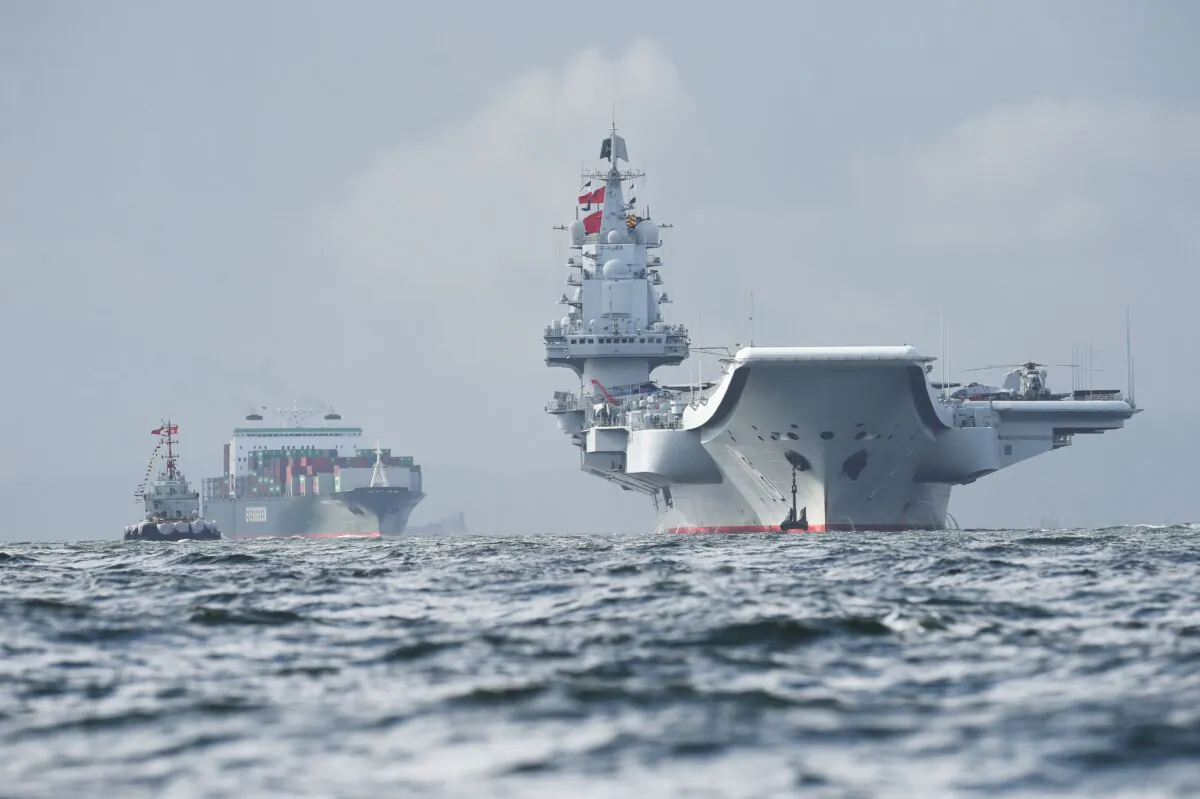
From June 7 to June 10, both of China’s aircraft carrier groups—the Liaoning and the Shandong—appeared simultaneously beyond the First Island Chain, with the Liaoning even pushing past the Second Island Chain.
While the operation posed a political and military threat to Japan, it also revealed elements of what may be Beijing’s emerging naval strategy: deploying its less advanced carriers as expendable assets to distract, delay, and complicate a U.S. military response.
In the event of a conflict in the Taiwan Strait, China could deliberately sacrifice both carrier groups to buy time and weaken the speed and intensity of U.S. and allied reinforcements. Can the U.S. military effectively counter such a tactic?
2 Limited-Capability Carriers
China’s third aircraft carrier, the Fujian, now closely resembles U.S. carrier design and operational doctrine, marking a clear departure from the Soviet-inspired model. This evolution effectively renders the Liaoning and Shandong semi-obsolete; while they are not entirely useless, they may no longer be considered core assets and could potentially be used as bait in a conflict.
If the Chinese regime were to initiate hostilities in the Taiwan Strait, these two less capable carriers would likely be deployed beyond the First Island Chain to act as decoys, drawing U.S. and allied firepower away from the main theater. Their job would be to divert and tie down portions of U.S. naval and air assets, buying critical time for the regime’s amphibious assault on Taiwan. Recent drills suggest the Chinese navy has already been rehearsing this scenario.
This tactic closely mirrors a historical precedent from World War II.
In October 1944, as U.S. forces launched their campaign to retake the Philippines with an amphibious landing at Leyte Gulf, they engaged the Imperial Japanese Navy in what became the largest naval battle in history: the Battle of Leyte Gulf. In a desperate last-ditch effort, Japan committed nearly all of its remaining naval forces in a final attempt to turn the tide of the war.
Although Japan had only one full-sized carrier, three light carriers, and two hybrid battleship-carriers left—with a total of 108 aircraft—these vessels were deployed not for direct combat, but as decoys. They aimed to lure away the U.S. carrier task forces and clear a path for Japan’s battleships and cruisers to strike vulnerable American landing forces.
At that time, the U.S. and Australian navies fielded a staggering force: nine fleet carriers, eight light carriers, 18 escort carriers, nearly 1,500 aircraft (including land-based ones), and more than 2,000 support vessels, including 179 battleships, cruisers, and destroyers.
The Japanese decoy force did succeed in drawing off the U.S. carriers, but the rest of Japan’s fleet failed to accomplish its mission. The result was a devastating defeat: Japan lost most of its remaining naval power and would never again be able to challenge American control of the seas.
Today, China is facing a similar dilemma. In order to challenge the United States in the Pacific, Chinese forces must break out of the First Island Chain, which is surrounded by Japan, Taiwan, and the Philippines. If they fail to do so, the People’s Liberation Army (PLA) Navy will remain strategically constrained. In this scenario, a failed Chinese assault on Taiwan could result in most of China’s naval fleet—whether at sea or in port—being destroyed.
This may explain Beijing’s cautious approach. The Chinese regime has long hesitated to launch an attack on Taiwan, primarily due to the concern that U.S. forces could intervene swiftly. Now, it seems that the regime may be considering strategies similar to those used by Japan during World War II—specifically, utilizing its two weaker aircraft carriers as bait to slow down and disrupt a U.S. response.
Contesting US Carrier Positions
According to Japan’s Ministry of Defense, at 2 a.m. on May 27, the Liaoning passed through the Miyako Strait and entered the Pacific. It then sailed south toward the eastern waters off Luzon, Philippines—an area long regarded by the U.S. Navy as a critical staging point to block the Bashi Channel and support Taiwan.
Rather than remaining east of Taiwan, the Liaoning moved on to the eastern Philippines, where it lingered for several days, seemingly simulating a contest over critical carrier deployment zones with the U.S. Navy.
Subsequently, the Liaoning turned northeast, moving toward Japan’s southeastern islands. By 6 p.m. on June 7, it was positioned between Iwo Jima and Minamitorishima, beyond the Second Island Chain.
If the U.S. forces were to deploy a second carrier strike group in the Philippine Sea, they would likely be stationed southeast of Okinawa to control the Miyako Strait.
Also on June 7, the Shandong appeared roughly 342 miles southeast of Okinawa—seemingly rehearsing a scenario in which it competes with a second U.S. carrier group for control of that strategic area. The Liaoning, meanwhile, was sighted east of Iwo Jima.
The coordinated movements of the Shandong and Liaoning could be a rehearsal for a scenario in which Chinese forces attempt to divide and counter U.S. carriers, potentially forcing them to defend against multiple directions simultaneously.
Coincidentally, the USS George Washington had just departed Yokosuka for its 2025 deployment, sailing southward—fitting into this unfolding Chinese simulation of a two-pronged pincer movement against a U.S. carrier.
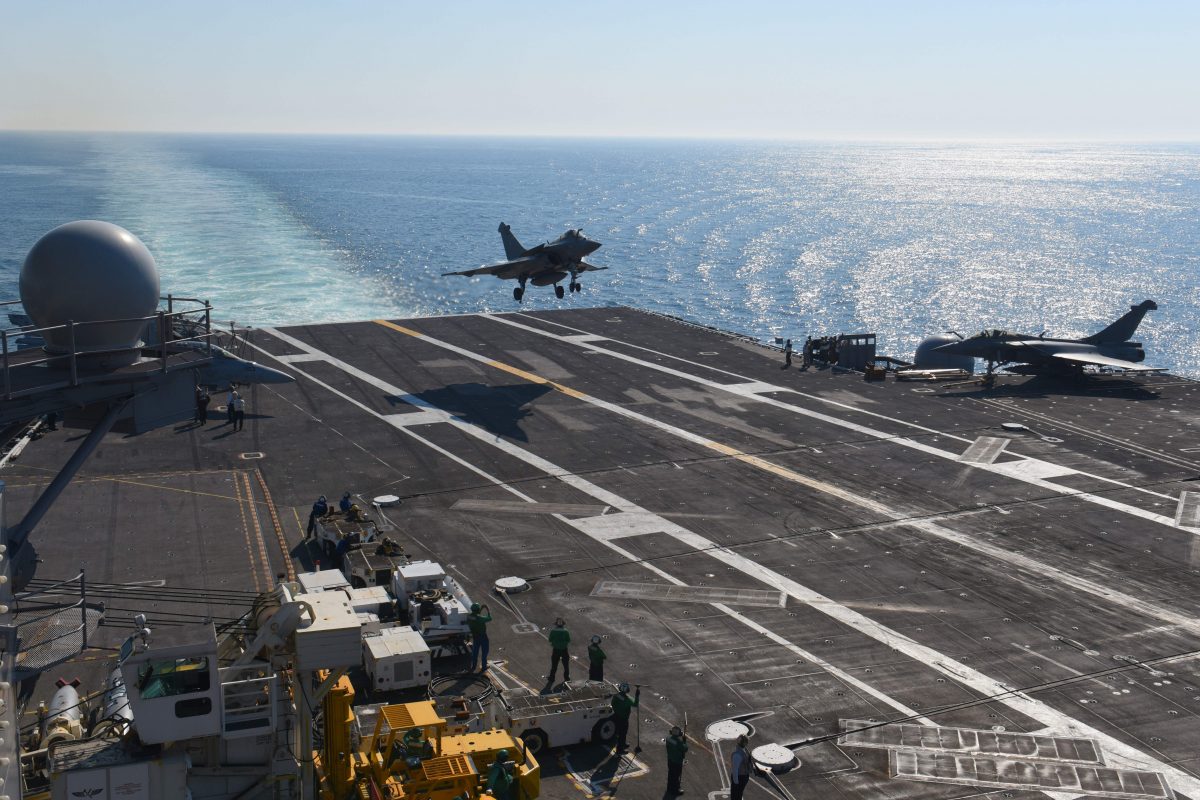
Beijing is fully aware that its older carriers lack the ability to confront U.S. carrier strike groups in a direct engagement. Their likely objective is to force U.S. carriers off key tactical positions or to disrupt their ability to execute planned operations.
China’s Ministry of National Defense officially announced the dual-carrier exercise, claiming it tested “far-sea defense and joint combat operations.” However, operating beyond the First Island Chain offers little defensive value to the PLA Navy. In the event of war, combat vessels deployed beyond the First Island Chain are unlikely to return safely.
This wasn’t a defensive drill—it was a rehearsal for a sacrificial attack.
The J-15 fighters on board, restricted by ski-jump flight decks, have minimal strike capability and pose little direct threat to U.S. or Japanese forces. However, the presence of China’s carriers can still disrupt U.S. air and naval operations intended to support Taiwan.
Read part two here.
Views expressed in this article are the opinions of the author and do not necessarily reflect the views of The Epoch Times.
 Friends Read Free
Copy
Facebook
Tweet
Friends Read Free
Copy
Facebook
Tweet