
Commentary
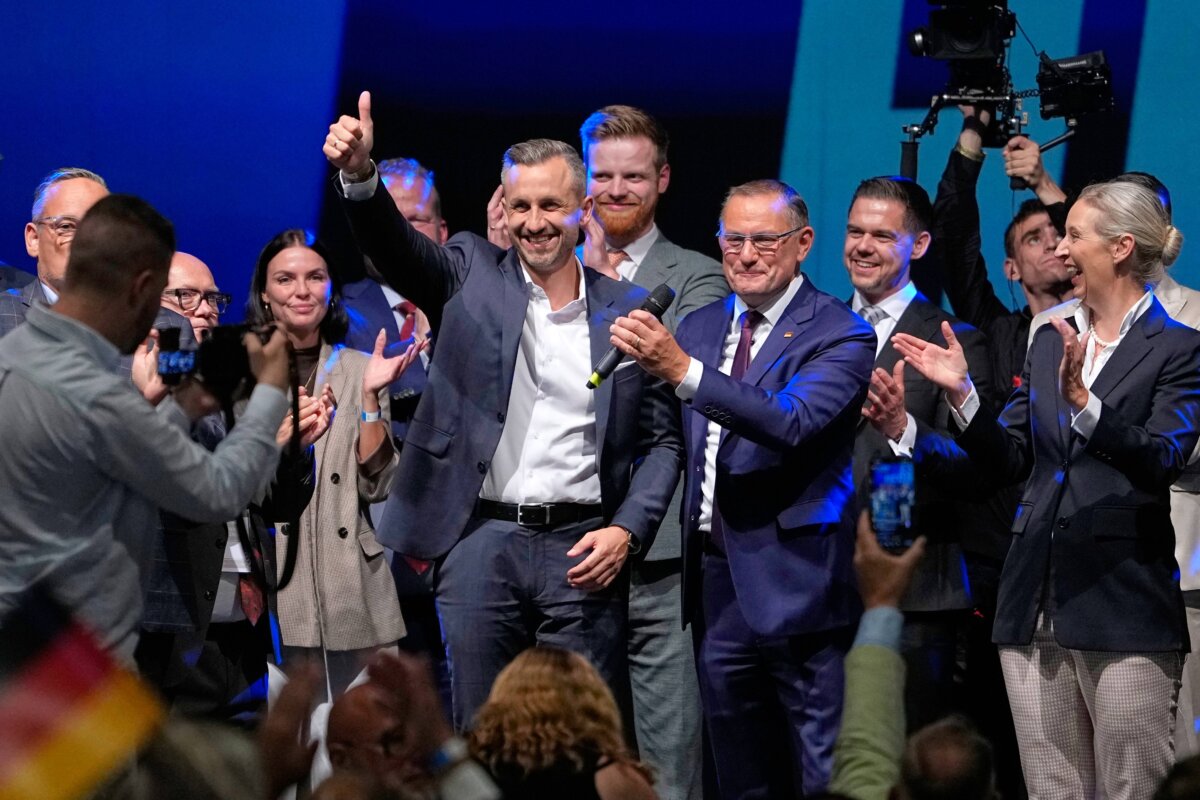
The almost outright victory of the Alternative for Germany party in the recent Saxony-Anhalt election vividly illustrates the European political sickness and the failure of the European Union and the euro-federalist establishments of the principal member countries to recognize the problem.
In the setting up of the institutions of a federal European commercial union, and then a federated Europe, the founders and their successors have, for notorious reasons in the violent history of modern Europe, paid Danegeld to the workers and small farmers in the interest of domestic tranquility. This, coupled with a very inadequate birthrate, rolled up heavy social costs and high taxes.
Labour scarcity as well as compassionate grounds caused much of Europe to favor large immigration quotas. This was especially the policy of the long-serving German Chancellor Angela Merkel (2005–2021), herself an East German originally. It is to her credit at a moral level that she recognized that Germany could partly redeem the infamies of Nazism with a relatively permissive acceptance of destitute foreigners. But it was a political and economic disaster: over a million Middle Easterners flooded in, with none of the zeal to assimilate and promote their new nationality that the generations of enthusiastic immigrants to the United States and Canada in the 19th and 20th centuries showed. They more closely resembled the swarming masses of Asians and Eastern Europeans flooding into the Western Roman Empire in the fourth and fifth centuries A.D., both to escape the fiercer barbarians behind them and to fetch up in a more comfortable and temperate place than they had fled.
Recent European governments did not make remotely adequate housing provision for these new arrivals, and it became a prolonged and debilitating humanitarian issue over whether it was appropriate to use elements of force in maintaining the borders against these migrants. The result was tremendous strain on the social safety net and the education system, sharply higher crime rates, and increases in housing prices that caused great hardship to citizens of modest means. These problems were compounded by the tendency of many of the European governments, when legitimate complaints arose from aggrieved citizens about their reduced standard of living, to prosecute them on often false and often outrageous allegations of racism.
In the principal Western European countries, a revolt has gradually arisen against the traditional party consensus in favor of these policies. These dissident movements were the National Front in France, now known as the Ralliement National, the Brothers of Italy, the Reform Party in Britain, and the Alternative for Germany (AfD) party. With fluctuating levels of justification, the political establishments in those countries attempted to lock arms and bar these new forces, dismissing them as fascistic revivals of odious political elements in the past: Mussolini’s fascists, Vichy collaborators, Nazis, and, in Britain, skinheads, rockers, and assorted hooligans. In the 2002 runoff election in France between the Gaullist incumbent Jacques Chirac and the National Front’s Jean-Marie Le Pen, Chirac won 82 percent–18 percent.
The established European parties settled into the comfortable position of dismissing any dissent from their consensus as effectively totalitarian thuggery. This so-called firewall was broken by Giorgia Meloni in Italy in 2022 when, in the Italian manner, a woman led a party called the Brothers of Italy to victory, espousing traditional Catholic values unhindered by her unorthodox personal arrangements: not married to her child’s father, whom she booted out in 2023 over louche comments to a journalist. She has been an extremely effective leader and is no longer susceptible to any serious suggestion of extremism.
In France, the National Front has been gradually house-trained. Le Pen’s daughter, Marine, took over the party and expelled her father from it for anti-Semitic utterances and, in what is now the French tradition, she currently faces the possibility of being excluded for legal reasons from the next election. Still, her party appears likely to win next year’s election, no matter who leads it.
It is more complicated in Britain, where the Reform Party has suffered from allegations of financial irregularities and is now running practically neck and neck with the governing Labour Party and the traditional Conservative Party, none of them enjoying the country’s confidence.
In Germany—where the stigma of the horrible atrocities of extreme politics is naturally stronger than anywhere in the West—for a variety of tactical and reflexive reasons there is a tendency to view any party of the right as the Nazi gorgon rising again like a cobra’s head. This practice of the establishment attacking any breach of the national consensus as the beginning of the descent into the hell of an evil past was bound to box it into a corner eventually. In locking arms to keep the AfD out of power-sharing, the moderately conservative Christian Democrats and Free Democrats have made themselves unable to govern without a coalition with the left-of-center Social Democrats and Greens. The detritus of the old Communist Party of East Germany, now called the Left, has also been quarantined as unfit to govern.
This arrangement has now broken down as these left-right coalitions, including the present government of Chancellor Friedrich Merz, cannot significantly reform the policies that the new right finds most obnoxious without their coalitions disintegrating. In fact, the only position of the AfD that causes legitimate concern is its position on Russia in the Ukraine war because of its objections to the high price of gas and oil caused by the boycott of Russia during the war. The logical step now would be for Chancellor Merz to invite the AfD into the federal government in exchange for their change of stance in the Ukraine war.
There is at this point no reason to imagine that Germany or any other major European country is headed toward fascistic government. This charge was made against Viktor Orban in Hungary, but he was peacefully sent packing in the recent election after nearly 20 years in government.
This trend will continue in Europe until better policy is arrived at, and apart from the Russian question, there is nothing in the success of the AfD to arouse the fear of sensible people.
Views expressed in this article are the opinions of the author and do not necessarily reflect the views of The Epoch Times.
 Friends Read Free
Copy
Facebook
Tweet