
Commentary
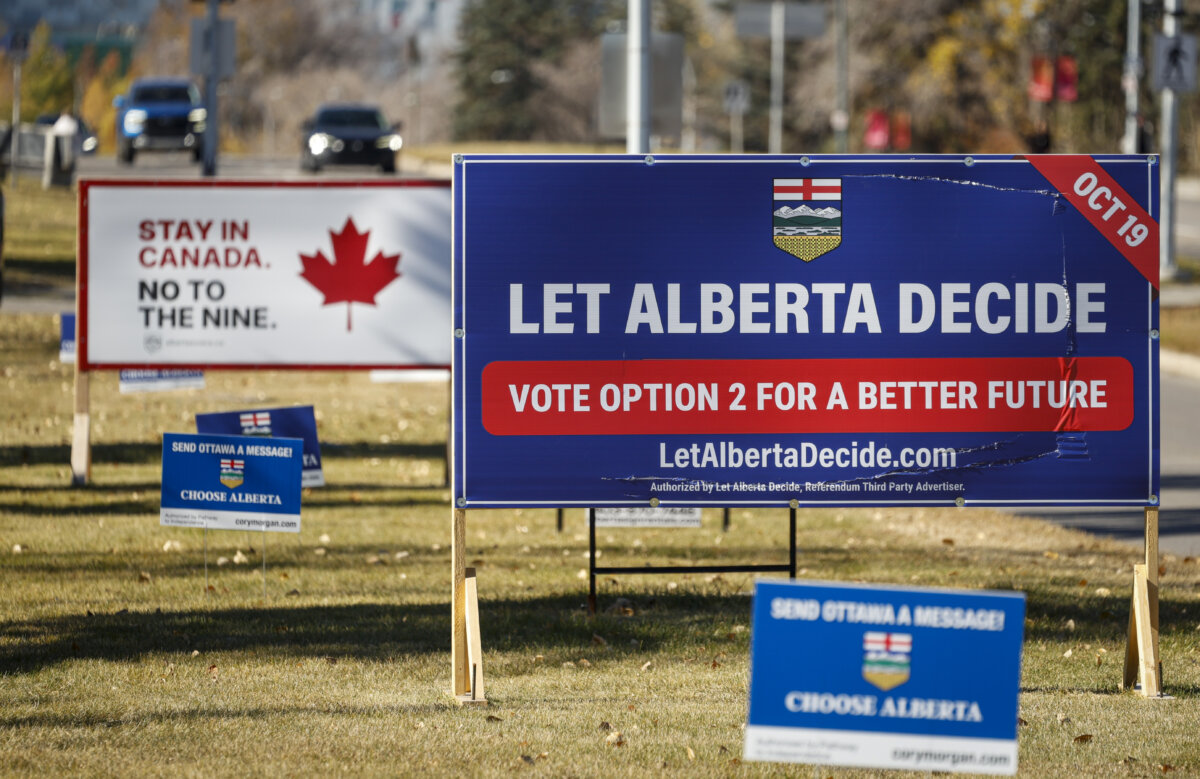
The referendum being held in Alberta on Oct. 19 is non-binding and doesn’t offer a direct path to provincial independence. It only asks Albertans if they want to begin the process of formally pursuing provincial independence in a future referendum. Still, the referendum has dominated the national discourse in Canada for months, and how Albertans choose to vote will have repercussions impacting politics on both the federal and provincial scenes.
Option 1 on Question 10 offers voters the choice to support the status quo and to have Alberta remain a province in Canada. Polling indicates this choice is supported by most Albertans. If Option 1 wins solidly, it will give Alberta Premier Danielle Smith some breathing room within her party, but not a lasting settlement. Even if a majority of Albertans may reject pursuing provincial independence, the sovereigntist faction within the United Conservative Party is significant.
An election year is approaching for Alberta’s provincial government, and Smith will need to quell internal dissent within her party. She will need to show some tangible progress on the issues that fostered the independence movement in Alberta in the first place. Smith’s message will likely be that Albertans have spoken and the government will now deliver results inside Confederation. But if nothing beyond more promises, MOUs, and announcements happen without actual groundbreaking on projects such as the proposed Pacific Link pipeline, frustrated and impatient independence supporters may revolt. Smith’s balancing act in maintaining a big tent conservative party won’t end with the referendum.
If momentum on the campaign for Option 2 picks up and there is a successful vote for it, Premier Smith’s job becomes much more complicated. An Option 2 plurality or near-plurality would hand her a public mandate she did not fully seek while a general election looms. She could not simply ignore the result without confirming the suspicion already circulating among independence supporters that the UCP leadership is more interested in managing the issue than resolving it.
Holding a binding referendum in the same year as a general election would be potentially catastrophic for Smith’s party. She would be tempted to try to defer the next referendum beyond the general election date, but could face a rebellion from independence supporters in doing so. Campaigning on core issues such as health care and education would be difficult with another independence referendum looming over and dominating the discourse.
On the federal front, Prime Minister Carney would be relieved by a strong result favouring Option 1. It would allow the prime minister to treat the episode as contained Western discontent and to emphasize national economic priorities. He would be well-served by remembering the underlying causes of Western discontent remain unresolved, though. Equalization, regulatory timelines for major projects, and the perception that Alberta’s resource wealth is systematically constrained remain live political facts regardless of the referendum tally.
A stronger Option 2 showing would force a different calculation. Carney could not dismiss it as fringe without risking further growth in the movement, particularly if economic conditions remain difficult or if subsequent federal decisions are read as punitive. The more durable response would be to identify the specific, addressable grievances that poll highest among soft Option 2 supporters (those who want leverage rather than full independence) and to demonstrate measurable movement on them. Those choosing to use the referendum to send Ottawa a message could quickly morph into full-blown independence supporters if it appears the message was ignored.
The Alberta referendum has already altered the political landscape of both the province and the country by forcing a once-marginal conversation about separation into the mainstream of public debate. For decades, western alienation was expressed through party politics, Senate reform campaigns, and periodic threats. It has now been converted into a formal, province-wide vote whose results will be cited for years. The mere existence of the ballot has normalized discussion of Alberta’s place in Confederation inside the governing UCP, among ordinary voters, and in federal political calculations. That shift from diffuse resentment to measurable alienation will shape caucus management, election platforms, and federal-provincial negotiations well beyond the Oct. 19 tally.
At the same time, the campaign has changed how Albertans and other Canadians understand the durability of national unity. By putting the question of commencing a formal separation process before voters, the referendum has demonstrated that provincial self-determination is no longer purely hypothetical and that a significant share of the population is prepared to entertain it as leverage or as a longer-term option. A stronger showing for Option 2 would accelerate pressure on both provincial and federal governments to deliver tangible policy changes rather than rhetorical reassurance. A strong showing for Option 1 eases that pressure, but doesn’t mean that governments can afford to ignore growing regional discontent.
As is the case in Quebec, the unity question is now permanently a part of the political culture in Alberta.
Views expressed in this article are the opinions of the author and do not necessarily reflect the views of The Epoch Times.
 Friends Read Free
Copy
Facebook
Tweet
Friends Read Free
Copy
Facebook
Tweet