
Commentary
The ongoing realignment of international trade flows in the midst of the escalating tariff wars between the United States and other nations and trading blocs (principally China and the European Union) continues to ripple across the world. Yet the changes we are witnessing are by no means caused by these tariff wars; instead, they are more the catalyst to spur on such changes, perhaps irreversibly.
For instance, the sudden 50 percent tariff slapped on Indian jewelry exports to the United States in the summer has been cast as a new trade shock. In reality, it is the culmination of pressures that have been building for years and a turning point that is already reshaping global trade patterns. The outlines of this shift can be traced through the past six months, from early warnings to the contemporary strategic pivot toward the Middle East.
Analysts were already flagging in April that the potential tariff would carve deeply into a sector that had long relied on the United States for nearly a third of its exports, with forecasts suggesting a dramatic fall in shipments. By July, jewelry and apparel firms were openly acknowledging what the numbers implied: Jobs would go, capital expenditure would be shelved, and India’s small exporters were about to be caught in a liquidity trap.
For an industry that accounts for as much as 7 percent of India’s entire gross domestic product, this is a significant threat, one that risks India’s strategic goal to grow its economy and become a major player in global trade.
The impact became visible on the ground in August. Reports from Surat, the beating heart of India’s diamond-cutting industry, described a sector scrambling to adjust. Small workshops and micro, small, and medium enterprises (MSMEs) faced a brutal squeeze, unable to cover costs as American buyers paused orders. For these firms, already operating on thin margins, the shock of the actual tariff was existential.
Yet alongside the distress, an alternative strategy was forming. Exporters began to diversify their own markets, especially in the east and west: to East Asian buyers and, critically, to the Persian Gulf. Journalists walking through Surat’s cutting rooms heard the same refrain: if the U.S. market was closed, India’s future lay in Riyadh, Dubai, and beyond.
By September, the pivot had become unmistakable. In Surat, exporters reported a surge of interest from Saudi Arabia, with shipments rising by nearly 45 percent in the past financial year, studded jewelry climbing by more than 50 percent. Trade fairs like SAJEX in Jeddah were being billed as the new Las Vegas or Hong Kong, backed by both Indian and Saudi ministries.
At the same time, Jaipur’s exporters offered a sobering counterpoint. NDTV reported on pieces gathering dust in U.S. warehouses, orders canceled, and local artisans stranded without buyers.
Policy was never far behind. The Gem & Jewellery Export Promotion Council pressed Delhi for relief: interest equalization, extended credit windows, anything to keep cash flowing while exporters hunted for new markets. EXIM Bank stepped in, signaling enhanced credit lines and encouraging diversification, not only to the Persian Gulf but also to Africa as a longer-term play. Behind these firefighting measures lies a structural reality: jewelry exports live and die by finance. Without affordable pre- and post-shipment credit, even the most promising market opportunities cannot be seized.
It is important to recognize that tariffs were not the only stressor. Even before Washington’s measures, India’s cut-and-polished diamond exports had fallen to a 20-year low, reflecting weak global demand and tightening finance. Earlier this year, diamond prices were already declining, both for mined and lab-grown diamonds. The tariff did not create the crisis, but it did accelerate it.
That is why the consequences extend beyond a single bilateral relationship. What is happening now is trade diversion in real time: a sector forced by price wedges to rewire its supply chains, building new institutional bridges in the Persian Gulf even as old channels to the United States wither.
The implications are significant. The United States will, of course, not disappear as a market, but its role will shrink, skewing toward higher-end, brand-anchored purchases that can carry the price premium. For most mid-tier exporters, the American market is no longer viable. Instead, the Persian Gulf is emerging as the natural substitute. Saudi Arabia’s jewelry market is forecast to nearly double by the end of the decade, part of the broader luxury and retail push alongside the diversification of the economy and investments under Vision 2030.
Jewelry also sits neatly within Riyadh’s bid to diversify its economy and position itself as a luxury hub: Partnerships with Indian exporters provide both competitive supply and industry know-how in grading, branding, and logistics. For India, these partnerships promise more than market access; they promise footholds in the Persian Gulf’s economic transformation.
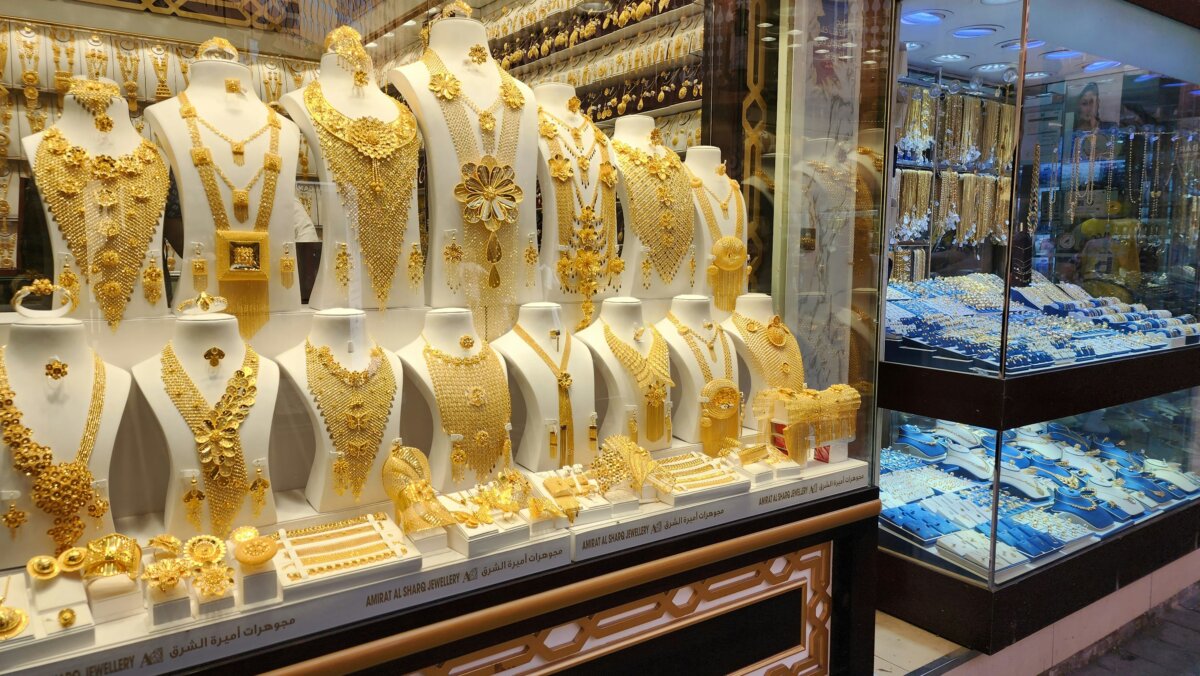
Dubai, meanwhile, offers a complementary path. Free zone policy has long been designed to attract global traders, and with the new tariff-driven diversion, the United Arab Emirates (UAE) is positioned to become a logistics and finishing hub for Indian jewelry re-export. Already home to some of the world’s largest gold and diamond exchanges, Dubai’s tax and customs regimes make it the natural node through which Indian supply can be channeled to wider markets. In effect, Riyadh’s Vision 2030 ambitions and Dubai’s free zone pragmatism dovetail to provide India with the infrastructure it needs to reroute its trade.
Globally, three second-order effects are worth watching:
- First, U.S. consumers will see higher prices and reduced variety in India-origin jewelry as the tariffs bite, while Gulf shelves expand their assortment.
- Second, the squeeze will accelerate consolidation in India: larger exporters with access to credit and Gulf partnerships will absorb market share, while smaller firms may vanish.
- Third, the policy response itself creates stickiness. Once exporters and banks begin hard-wiring diversification into their strategies, it is difficult to return to the old status quo, even if tariffs are lifted. Africa, Europe, and the Gulf are not just emergency outlets; they are becoming the future shape of the trade.
The bottom line is this: Washington’s tariff is not a passing shock but a catalyst to accelerate long-evolving global market dynamics. It has taken a long-simmering downturn in global diamond demand and forced India’s exporters to re-map their markets. The winners will be those who can navigate financing gaps and secure footholds in Saudi Arabia, the UAE, and beyond.
The losers will be the smaller hubs, where inventories sit unsold and artisans face layoffs. For now, the jewelry that once glittered in New York’s storefronts is increasingly destined for Jeddah and Dubai. And that is how a single tariff decision begins to redraw the map of global trade.
Yet this is not just a story about diamonds and bangles but about the fragmentation of global commerce. Trade blocs are hardening, supply chains are rerouting, and countries like Saudi Arabia and the UAE are using industrial policy to turn this diversion into long-term gain. The jewelry trade may be a case study, but it is also a warning: tariffs imposed in Washington ripple outward, and the new alignments they trigger will not easily be undone.
From the Foundation for Economic Education (FEE)
Views expressed in this article are the opinions of the author and do not necessarily reflect the views of The Epoch Times.
 Friends Read Free
Copy
Facebook
Tweet
Friends Read Free
Copy
Facebook
Tweet